5 Critical Post Merger Integration Process Rules
For many years, acquirers could hide weak integration behind a good purchase price.
That logic is harder to rely on now.
When assets are expensive, competition is intense, and sellers are better prepared, the buyer has fewer chances to win the deal simply by buying cheap.
That is why the post merger integration process has moved from a back-end execution topic to a front-end value creation topic.
A disciplined post merger integration process is how a buyer turns a signed deal into higher cash flow, faster capability building, lower cost, stronger governance, and a better strategic position.
In plain terms, the deal model may explain why you want to buy the company, but the post merger integration process determines whether that logic shows up in EBITDA, free cash flow, and enterprise value.
This is also why serious acquirers no longer treat integration as a checklist after close.
Bain says integration planning should start during diligence, McKinsey argues culture should be built into integration planning from the start, and PwC’s survey results show many large-company buyers now plan operating models before due diligence and launch change management before signing.
Where the Post Merger Integration Process sits in the Buy Side Process
The first mistake junior practitioners make is to think the Post Merger Integration process begins after closing.
It does not.
The real start is due diligence.
That is where the buyer moves from story to evidence.
That is where the buyer tests whether synergies are real, whether systems can connect, whether customers may react badly, whether key talent may leave, and whether the operating model should be integrated fully, partially, or only in selected functions.
Bain explicitly says to start planning integration during diligence, and Deloitte frames Day One readiness as a structured readiness program built well before legal close so the business can maintain continuity once the transaction happens.
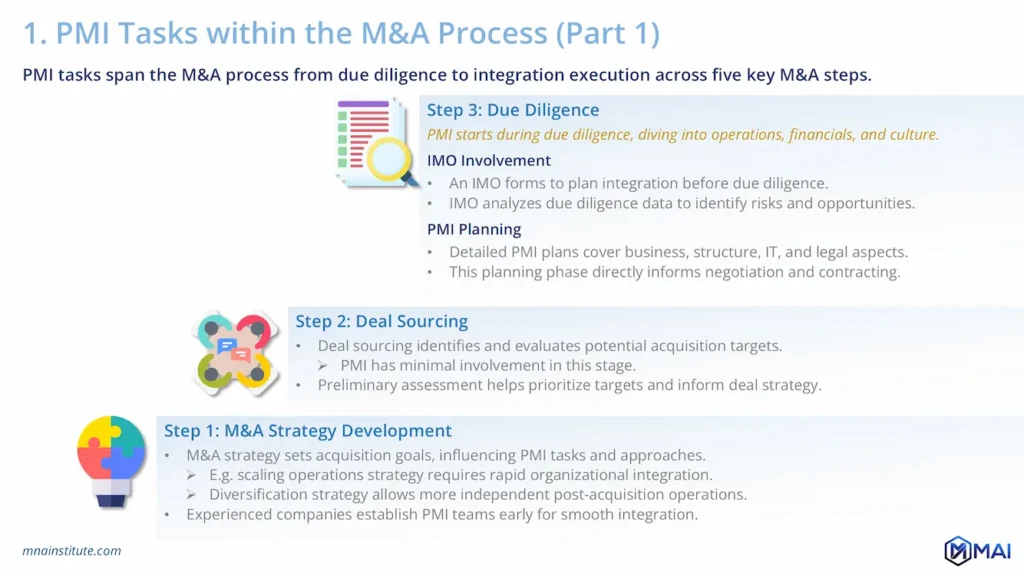
A practical way to understand the Post Merger Integration process is to place it inside the full buy-side workflow.
- Step one is strategy.
- Step two is sourcing.
- Step three is diligence.
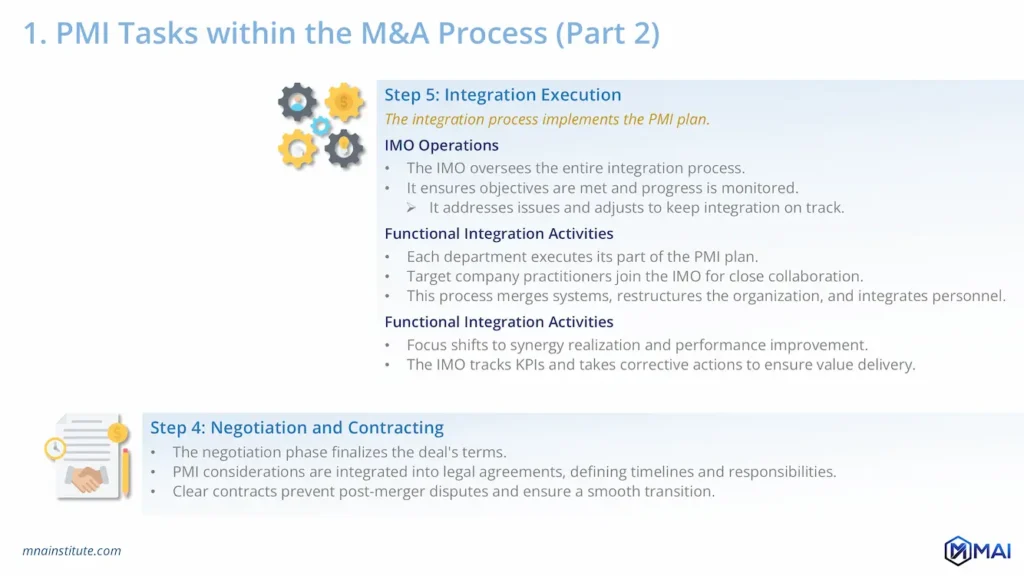
- Step four is negotiation and signing.
- Step five is sign to close preparation.
- Step six is Day One.
- Step seven is the first one hundred days.
- Step eight is the longer value-up phase.
The post merger process touches all of them, but its weight changes by stage.
At the strategy stage, the buyer should already be asking one blunt question.
What kind of integration is required for this deal thesis to work.
A scale deal often needs faster consolidation of overlapping functions, systems, and procurement.
A scope deal may need lighter integration so the acquired business can preserve customer trust, product speed, or entrepreneurial energy.
Bain describes this as building an integration thesis from the deal thesis.
That is an important distinction.
The deal thesis says why the asset is attractive.
The integration thesis says how value will actually be captured after closing.
At the sourcing stage, integration work is lighter, but not absent.
The buyer should screen targets not only for strategic fit, but also for integration difficulty.
A target with a fragile ERP environment, concentrated customer contracts, founder-dependent sales process, or high regulatory complexity may still be attractive, but the bid logic changes.
The buyer may lower the valuation, ask for stronger protections, or delay certain synergy assumptions.
This is where the post M&A integration process starts influencing target ranking rather than merely execution after close.
Due diligence is where the Post Merger Integration process becomes operational.
Here, the buyer should not only analyze the company.

The buyer should build integration hypotheses by function.
Finance should test close process, cash controls, chart of accounts, tax exposures, treasury structure, and reporting gaps.
HR should identify key talent, retention risks, benefit mismatches, labor issues, and leadership overlaps.
IT should map applications, interfaces, cybersecurity exposure, data migration risk, and cutover complexity.
Commercial teams should assess account concentration, pricing logic, channel overlap, salesforce design, and cross-sell realism.
Operations should review footprint, procurement, manufacturing, service delivery, and supply chain interdependencies.
Legal should examine change-of-control clauses, licenses, claims, consent requirements, and integration restrictions.
A simple example makes this clearer.
Imagine a software buyer acquiring a workflow automation company.
The investment memo says the deal will create value through cross-selling and lower overhead.
During diligence, however, the buyer discovers that the target’s customer contracts require consent for data-hosting changes, the target’s code deployment process is built around a separate cloud stack, and the head of enterprise sales holds personal relationships with the ten largest accounts.

That discovery changes the Post Merger Integration planning immediately.
The buyer cannot assume instant system consolidation, fast cost takeout, or automatic cross-selling.
It now needs a phased integration path, a retention package, and a customer migration sequence.
That is not post-close housekeeping.
That is core deal economics.
The negotiation and signing phase should convert diligence findings into decision rights, timelines, protections, and funding.
If a system cutover cannot happen by Day One, the buyer may need a transition services arrangement.
If key managers are essential, the buyer may need retention packages and clearly defined reporting lines.
If customer contracts are sensitive, communication sequencing becomes part of deal protection.
If synergy delivery depends on quick access to data, clean team design and pre-close planning matter.
This is where the Post Merger Integration process stops being a slide deck and becomes binding execution architecture.
The sign-to-close period is often underused.
In reality, it is one of the highest-value windows in the Post Merger Integration process.
Some legal limits remain.
The buyer cannot jump the gun and run the target before closing.
But the buyer can still build governance, define workstreams, test Day One scenarios, prepare communications, map dependencies, create readiness checkpoints, and pressure-test critical assumptions.
Deloitte’s Day One readiness framework is useful here because it focuses on maintaining business continuity while operational teams prepare for cutover, customer continuity, payroll, supplier readiness, IT access, and finance opening balance sheet issues.
- Then comes Day One and the first one hundred days.
- Day One is not where value is captured in full.
- Day One is where confusion is either contained or allowed to spread.
- Employees want to know who they report to.
- Customers want to know whether service is stable.
- Suppliers want to know who approves orders.
- Banks want clarity on cash management.
- Auditors want control continuity.
- Regulators want the buyer to comply.
A strong Post Merger Integration process therefore treats Day One as a continuity milestone, not a victory lap.
The first one hundred days then convert continuity into measurable value capture.
Who Plans Post Merger Integration Planning and What They Must Do
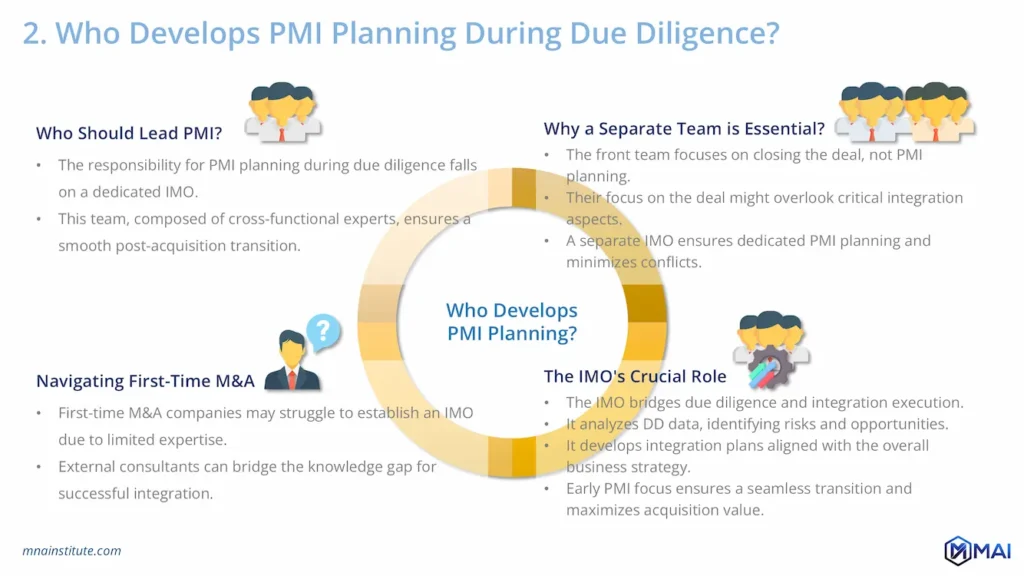
The cleanest answer is that a dedicated Integration Management Office should lead the work.
McKinsey describes the Integration Management Office as the group that creates the comprehensive plan, manages key risks and interdependencies, and speeds integration activities.
That description matches real practice.
The deal team should remain heavily involved, but it should not be the only group running the Post Merger Integration planning effort.
The deal team is rewarded for closing.
The IMO is rewarded for realizing value.
Those are related goals, but they are not identical.
A team that is pushing hard to sign can easily underweight awkward realities such as system fragility, leadership conflict, consent requirements, customer churn risk, or cultural mismatch.
A separate integration lead creates the discipline to say that a synergy item is late, a workstream has no owner, or a Day One dependency is impossible without extra spend.
That separation protects value.
The best IMO is cross-functional.
It usually includes an integration leader, finance lead, HR lead, IT lead, legal lead, operations lead, commercial lead, communications lead, and workstream owners from both buyer and target.
For larger deals, it also needs a dedicated synergy office, PMO support, data room and clean team coordination, and country or business-unit leads where regulatory or regional complexity exists.
Target-company participation matters.
A buyer-only integration team often produces elegant plans that fail on contact with reality.
For first-time acquirers, building this internally is difficult.
That does not mean the company should avoid M&A.
It means the company should be honest about the capability gap.
An internal sponsor can still own decisions, but external specialists, operating partners, or an interim IMO lead may be needed to structure the post M&A integration process, build the cadence, and keep the buyer from confusing activity with value capture.
This becomes more important when the buyer is pursuing a transformational deal rather than a small tuck-in.
What does the IMO actually do in a disciplined pmi process.
It does six things.
- First, it defines the integration objective and end state.
- Second, it translates that into workstreams, owners, milestones, and dependencies.
- Third, it links every major action to value capture, risk control, or business continuity.
- Fourth, it sets governance, escalation rules, and decision rights.
- Fifth, it runs communications across employees, customers, suppliers, lenders, regulators, and leadership.
- Sixth, it tracks whether promised value is actually appearing in the numbers.Culture deserves its own sentence because many teams still treat it as a soft topic.
McKinsey’s 2023 survey of almost 1,100 M&A leaders found that 44 percent cited lack of cultural fit and friction between buyer and target as top reasons integrations fail.
That is not a branding issue.
That is an execution issue.
If one company moves fast with decentralized decisions and the other relies on layered approvals, the post merger process will slow down unless leadership addresses decision rights, incentives, and management norms very early.
PwC’s survey findings reinforce the same point from another angle.
Among Fortune 1000 respondents, 60 percent planned operating models before due diligence, 98 percent recognized the importance of a value creation plan, and 71 percent launched change management initiatives before signing.
The message is simple.
Serious acquirers do not wait for the closing dinner to start organizing the business.
How to Execute Post Merger Integration Planning in Practice
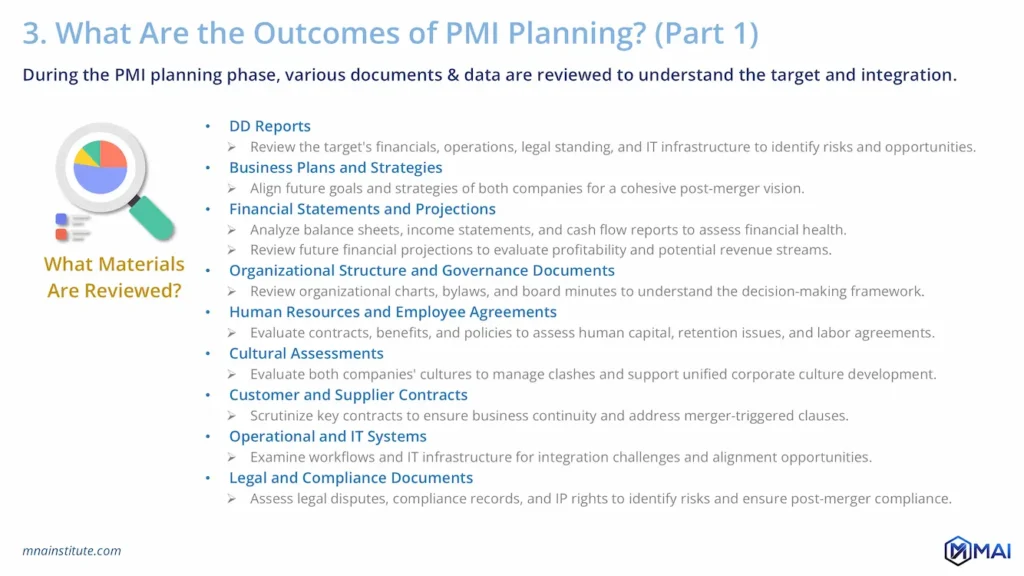
Good Post Merger Integration planning starts with document review, but it does not end there.
The practical question is not merely what documents exist.
The practical question is what each document should force the buyer to decide.
That is the difference between passive review and execution-oriented integration work.
Start with due diligence reports.
These reports should be converted into an integration issue list.
Commercial diligence should feed pricing actions, customer segmentation choices, and sales integration sequencing.
Financial diligence should feed the opening balance sheet approach, quality of earnings watch items, control remediation, and cash management priorities.
Legal diligence should feed consent trackers, dispute response, and regulatory workplans.
IT and operational diligence should feed the cutover roadmap, TSA needs, application retention decisions, and facility integration steps.
Review business plans and strategy documents next.
The buyer needs to see whether the target’s growth plan is realistic, where the management team believes value comes from, and which initiatives can survive the integration.
This review should produce a combined strategic blueprint.
That blueprint should answer five questions.
- What will we integrate fully.
- What will remain separate for now.
- What revenue synergies are real and owner-backed.
- What cost synergies are feasible without damaging the business.
- What capabilities do we want the combined company to build over the next twelve to twenty-four months.
Then review financial statements, projections, and management reporting.
Do not stop at valuation inputs.
Use them to build an operational baseline.
- What is the real monthly close cycle.
- Which cost centers can be consolidated.
- Which SG&A items can be removed.
- Which working capital assumptions are too optimistic.
- Which KPI definitions differ between the two companies.
A buyer that does not standardize the baseline early often reports synergies that cannot be reconciled to actual performance later.
Organizational charts, governance documents, and board materials are equally important.
These materials tell you how decisions are actually made.
A target may look simple on paper yet depend heavily on one founder, one divisional CFO, or one operations chief who approves exceptions informally.
The output of this review should be a leadership map, a provisional organization chart, a decision-rights framework, and a retention priority list.
Without those outputs, the Post Merger Integration process becomes slow because workstream leaders keep waiting for approvals that no one formally owns
HR documents and employee agreements should produce more than a compensation summary.
They should produce action.
- Who is mission critical.
- Who is at risk of leaving.
- Where are compensation bands incompatible.
- Which benefits need harmonization.
- Which labor rules or employee consultation requirements apply in specific countries.
- Which managers should be announced on Day One.
The quality of these answers usually determines how much talent leakage the buyer suffers in the first ninety days.
Customer and supplier contracts should be reviewed line by line where concentration is high.
The key output is a contract action tracker.
That tracker should flag change-of-control clauses, consent requirements, termination triggers, rebate and service-level obligations, supplier dependency, and communication timing.
A buyer may believe procurement synergy is easy.
Then it discovers that the target’s top supplier contract locks in volumes or service conditions for another year.
That is why contract review sits inside the post M&A integration process, not outside it.
Operational and IT materials are where many integrations quietly fail.
Application maps, infrastructure diagrams, cybersecurity reviews, data architecture, process maps, plant data, logistics routes, service escalation procedures, and vendor lists should all roll into one integration blueprint.
The output should include Day One access rules, cutover sequencing, data migration checkpoints, business continuity safeguards, and a decision on what gets integrated now, later, or never.
Deloitte’s readiness checklist is especially useful because it forces teams to test finance, payroll, supply chain, IT access, service continuity, and compliance as live operational risks rather than slide headlines.
Legal and compliance materials should produce a risk register, not just a memo.
List all open claims, licensing dependencies, compliance weaknesses, data protection concerns, and regulatory approvals.
Then rank them by probability, severity, owner, and mitigation timing.
A good Post Merger Integration planning process puts this register into the weekly governance pack so the leadership team sees the real blockers, not only green progress boxes.
Culture review should also produce concrete outputs.
Those outputs include a decision-rights map, leadership behavior standards, communication messages, change champions, and early points of integration friction.
McKinsey recommends factoring culture into planning from the start and using early insights before the deal is even announced.
That is sensible because culture problems usually first appear in meetings, approvals, and talent departures long before they show up in survey slides.
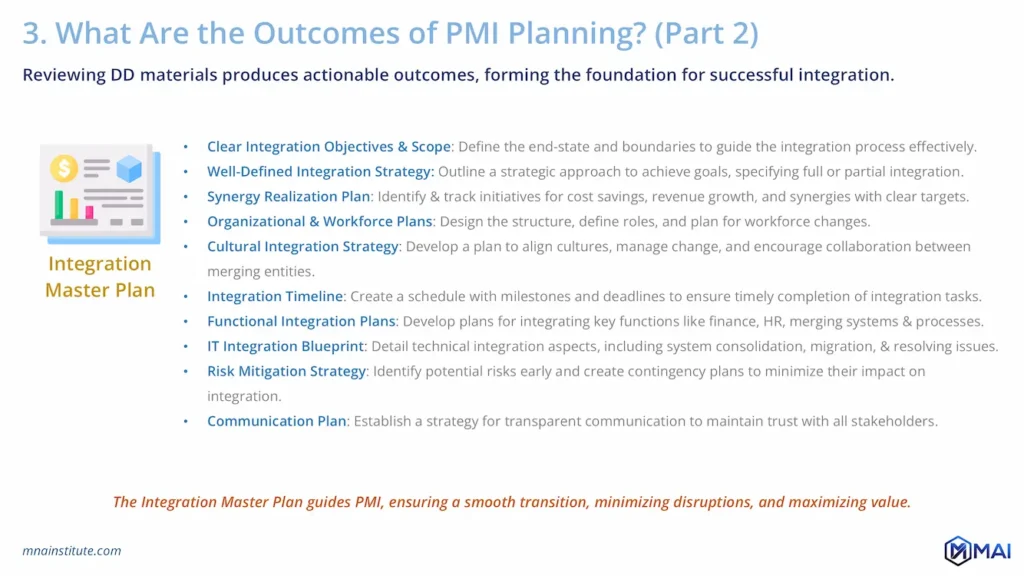
Once the reviews are complete, the buyer should produce a short list of core deliverables.
- The first is the Integration Master Plan.
- The second is the Day One readiness plan.
- The third is the first one hundred day value capture plan.
- The fourth is the synergy tracker with baselines, owners, timing, and financial impact.
- The fifth is the risk register.
- The sixth is the communications plan.
- The seventh is the KPI dashboard.
- The eighth is the governance calendar with weekly, monthly, and steering-committee cadences.
These are the working outputs that turn the PMI process into execution.
KKR Capstone and the Shift from Deal Making to Value Creation
The RJR Nabisco buyout remains one of the most famous LBOs in history.
Britannica describes KKR’s 1988 takeover of RJR Nabisco as the most famous LBO in American history and gives the deal value as 25 billion dollars.
That transaction became a symbol of the era’s debt-heavy deal making and of the limits of financial engineering when operating improvement is not equally institutionalized.
It is important to state this carefully.
KKR Capstone was not created to fix RJR Nabisco itself.
Capstone came later.
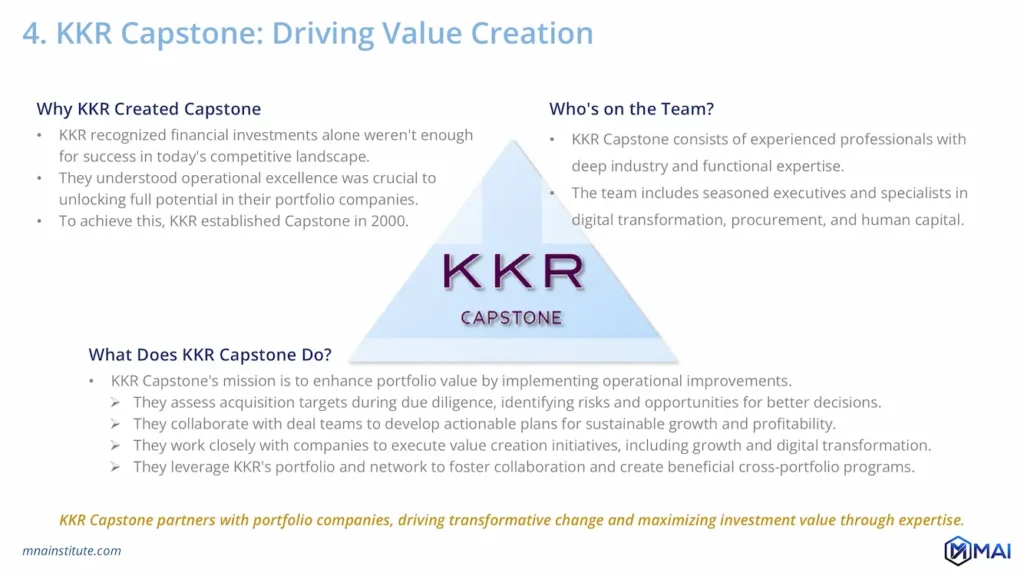
According to KKR’s official history, the firm formed Capstone in 2000 as a value creation resource for companies.
That timing matters because it shows an institutional evolution.
The lesson was not that M&A should stop.
The lesson was that ownership without a repeatable operating model is incomplete. KKR’s official Capstone page is revealing because it describes exactly how a serious owner thinks about value creation.
KKR says Capstone began in 2000 as a small team focused on private equity and has grown to roughly one hundred full-time operating professionals.
The same page says Capstone supports asset selection during due diligence, designs value creation plans with investment teams and management, drives on-the-ground initiatives, and maximizes cross-portfolio synergies.
Those are not marketing adjectives.
They are the core building blocks of an institutional Post Merger Integration process.
The most useful insight for corporate acquirers is not that they need to copy private equity branding.
It is that they should copy the operating discipline.
A buyer should have a mechanism that can evaluate operational value during diligence, define the end-state operating model before close, push execution after close, and keep the deal thesis tied to measurable improvement.
On KKR’s own page, post-merger integration appears as one of the value-creation levers alongside organic growth, digital value creation, procurement, governance, and human capital.
That is exactly the right framing.
PMI is not only about combining two org charts.
It is a route to higher enterprise value.
A corporate buyer can apply the same lesson without building a one-hundred-person operating team.
- It can create a smaller integration and value creation office.
- It can require every deal to have an integration thesis.
- It can force every major synergy item to have an owner, timing, dependency map, and baseline.
- It can run weekly escalation meetings during the first one hundred days.
- It can compare promised value with actual value every month.
That is how the post merger process becomes an operating system rather than a ceremonial phase after close.
Our Courses for Practitioners who Want to Execute the Post Merger Integration Process Better
-
For professionals who want the full buy-side pathway from strategy to diligence, negotiation, and integration, Mergers and Acquisitions Online Course provides the end-to-end structure.
-
For practitioners who need to understand where integration starts in the transaction timeline, Merger and Acquisition Process Course builds the deal-stage logic that sits before execution.
-
For teams that need stronger diligence inputs before integration begins, M&A Due Diligence: CDD, FDD, LDD, & HRDD focuses on the workstreams that feed integration decisions.
-
For operators and deal professionals focused directly on post-close execution and value capture, Post-Merger Intergration and Value-Up Strategy is the most direct fit.
External sources referenced for the KKR Capstone section
- KKR Capstone page and KKR Firm History.
- Britannica on the RJR Nabisco leveraged buyout.
- Additional operating and integration context from Bain, McKinsey, PwC, and Deloitte.