Sales and Marketing Integration in M&A: A 6-Phase Roadmap
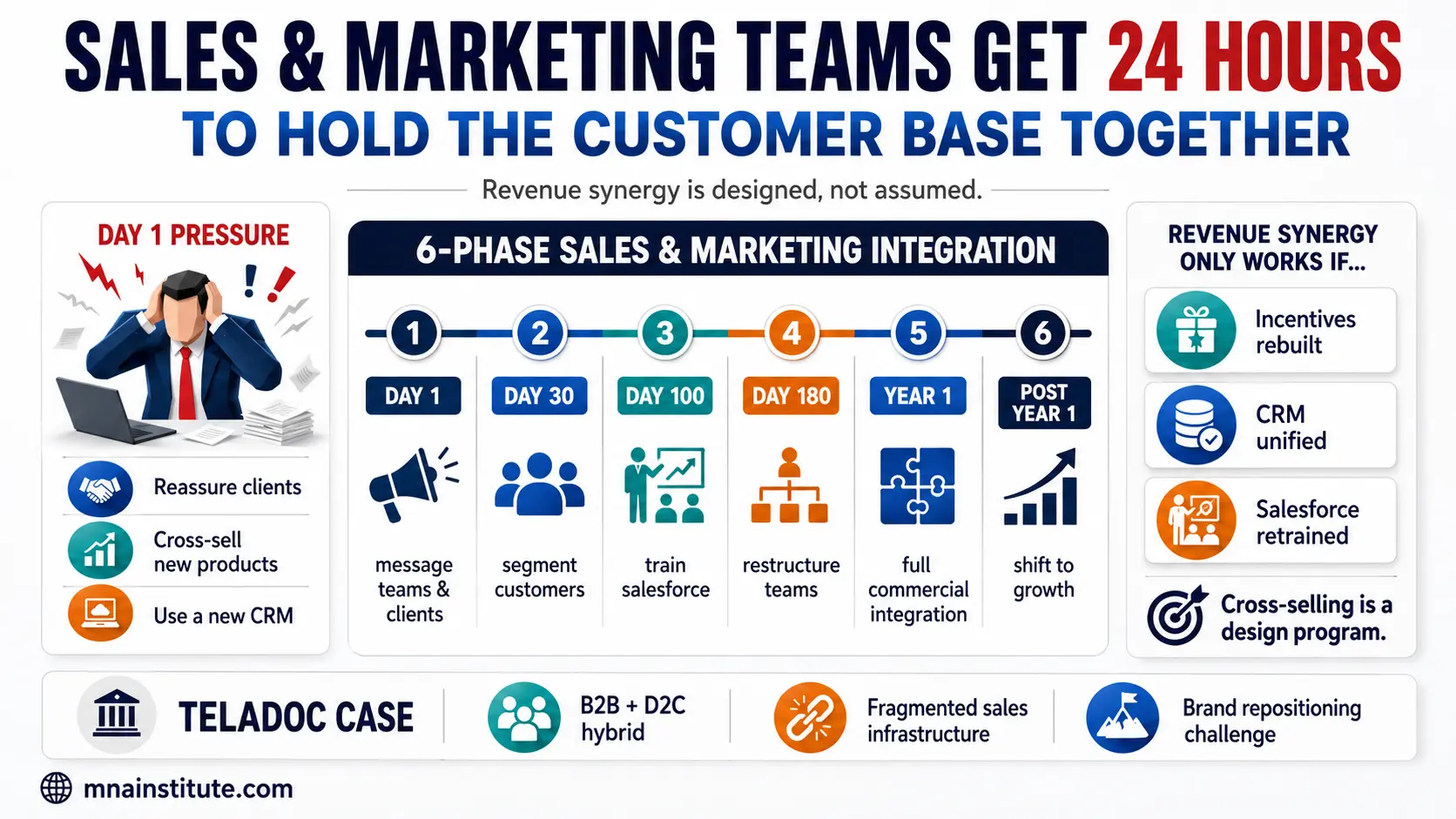
Sales and marketing integration is where post-merger strategy meets customers, revenue, brand trust, and commercial execution.
A deal may close because the valuation model shows synergy, but the market only rewards the buyer when customers keep buying, sales teams know what to sell, and marketing can explain the combined value proposition without confusion.
That is why sales and marketing integration cannot be treated as a late-stage communication exercise after legal closing.
It has to start with due diligence, customer analysis, revenue retention planning, CRM design, salesforce readiness, and post-close KPI discipline.
This article explains how sales and marketing integration should work from Day 1 to Year 1, using a practical sales integration roadmap and a Teladoc-style sales integration example.
For buyers, sales and marketing integration is the bridge between the signed deal thesis and actual customer behavior.
The focus is not generic branding theory.
The focus is how revenue synergy in M&A becomes visible through customer segmentation, cross-selling, campaign execution, data integration, and salesforce alignment.

Section 1. Sales and Marketing Integration: Team’s Role in PMI Planning
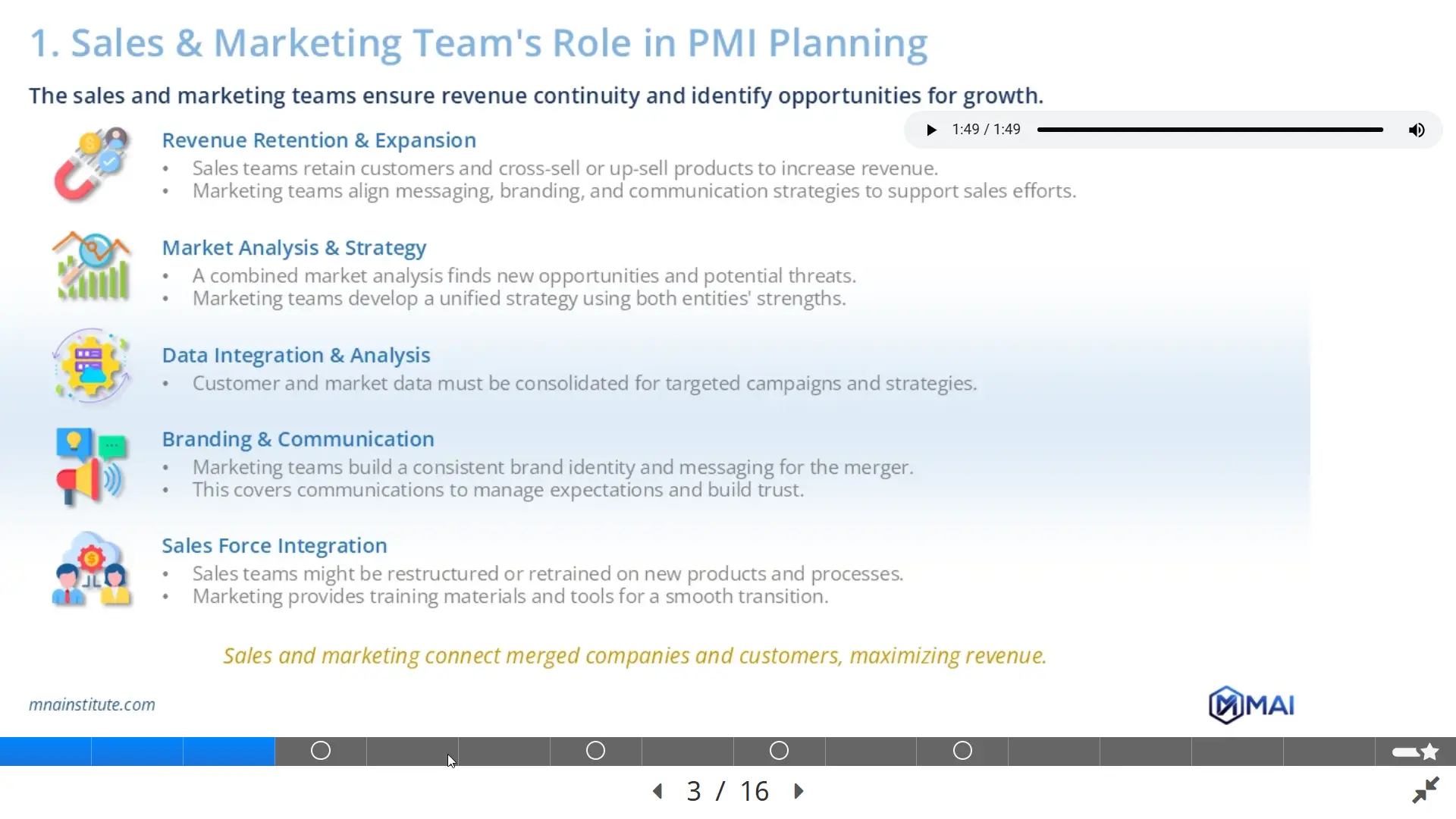
In a merger or acquisition, sales and marketing teams sit between the combined company and the customer base.
Their role is to protect revenue continuity while creating new growth opportunities from the combined product portfolio, customer data, brand assets, and market coverage.
This is why sales and marketing integration begins before the first post-close campaign is launched.
The sales and marketing integration team needs to understand which customers may be anxious, which accounts have cross-sell potential, which messages must be frozen temporarily, and which sales motions need new enablement.
At a practical level, the sales and marketing workstream owns five core questions.
- Which existing customers must be protected immediately after close.
- Which customer segments become more valuable after the two companies combine.
- Which products can be cross-sold or up-sold without confusing customers.
- Which brand message should be used during the transition.
- Which sales processes, CRM fields, and marketing systems must be integrated first.
Those questions make post merger sales integration different from a normal commercial transformation project.
In a normal sales transformation, the company can move at its own pace.
In PMI, customers, competitors, employees, and distributors all react at the same time.
If the buyer does not control the narrative, competitors will use the transaction to create doubt around service quality, pricing, account coverage, and product continuity.
The sales team therefore has to stabilize relationships before it pursues aggressive cross-selling.
Marketing has to translate the deal rationale into language that customers can understand.
The combined company may believe it has a stronger offering, but customers only care if that stronger offering reduces cost, improves service, expands capability, or lowers risk for them.
Sales and marketing integration also requires close coordination with finance, HR, IT, legal, and operations.
Finance needs commercial KPIs that distinguish retained revenue from new revenue.
IT needs a practical sequence for CRM consolidation and data migration.
HR needs to know which sales leaders, account managers, product marketers, and customer success staff are essential for retention.
Legal needs to review customer contracts, change-of-control clauses, data permissions, marketing consents, and pricing commitments.
Operations needs visibility into whether promised service levels can still be delivered during integration.
A strong sales and marketing integration team does not simply send messages.
It converts the merger thesis into account-level action.

Section 2. Sales and Marketing Integration Value-Up Strategy
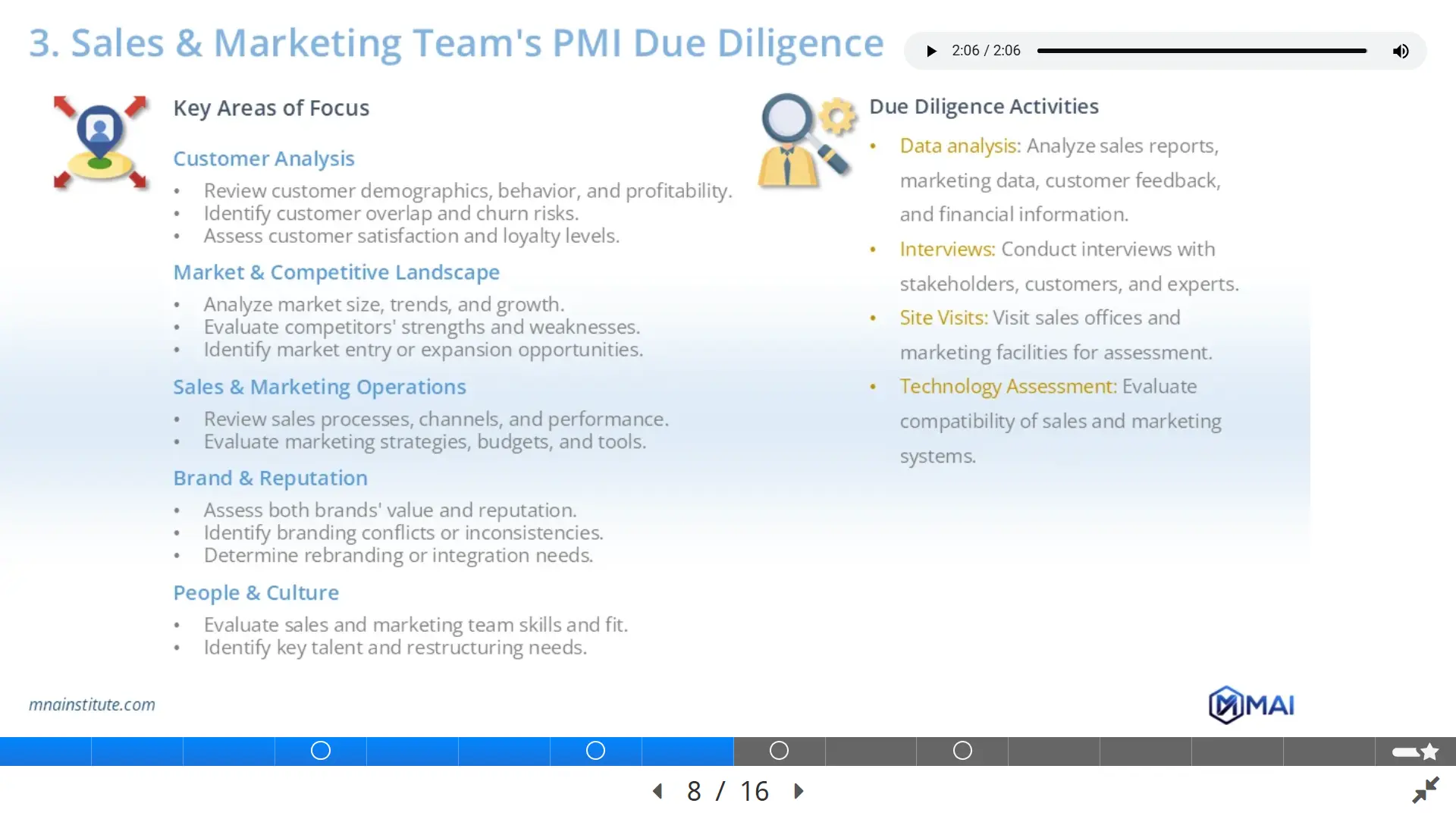
The value-up strategy for sales and marketing integration should start with the customer base, not the brand book.
Branding matters, but the first commercial question is where revenue can be retained, expanded, or lost.
A buyer should not assume that combining two customer lists automatically creates revenue synergy in M&A.
McKinsey has noted that cross-selling is a leading source of post-transaction revenue synergies, but also that it requires detailed understanding of the opportunity and execution discipline.
That point is consistent with what most commercial teams discover after close.
The customer overlap may be attractive in a presentation, but real execution depends on account ownership, customer permission, product fit, incentives, and timing.
Customer segmentation and targeting
The first step is to re-segment the combined customer base.
The buyer should combine customer data from both companies and classify accounts by value, retention risk, cross-sell potential, buying behavior, profitability, region, channel, and decision-maker structure.
This creates a better commercial map than a simple list of customers by revenue size.
For example, a mid-sized customer that buys three services annually with high renewal probability may be more attractive than a larger account with falling usage and price pressure.
The segmentation should also separate overlapping customers from gap customers.
Overlapping customers may have immediate cross-sell potential, but they may also be sensitive to account coverage changes.
Gap customers may represent new market entry opportunities, but they may need different messaging, channel support, or product education.
Marketing should then translate these segments into tailored campaigns rather than one broad announcement.
Cross-selling and up-selling
Cross-selling should be designed like a product launch, not like a slogan.
The combined salesforce needs a clear offer, a target segment, sales scripts, objection handling, pricing rules, case studies, and incentive alignment.
If a salesperson is paid only on legacy products, cross-selling will stay low even if the strategic logic is sound.
If incentives change too aggressively, legacy account managers may push unfamiliar products before they understand customer fit.
The balanced approach is to phase the cross-sell motion.
- Start with customers where the need is obvious and the product fit is low risk.
- Give account managers concise product training and sales enablement tools.
- Track adoption by segment rather than only total revenue.
- Adjust incentives once the team can sell the expanded portfolio with confidence.
This is the discipline behind revenue synergy in M&A.
It is not enough to say that two companies have complementary products.
The commercial team must specify which customers will buy which products, through which channel, by which date, with which owner and KPI.
This is why sales and marketing integration must be managed as a revenue operating system, not just a communications program.
Data-driven sales and marketing strategies
CRM integration is often the hidden constraint in sales and marketing integration.
A combined company cannot run targeted campaigns or cross-sell effectively if customer data remains fragmented across systems, fields, naming conventions, and ownership rules.
The first CRM objective is not technical perfection.
The first objective is a reliable view of customer relationships, active opportunities, renewal dates, product usage, churn risk, and account ownership.
Once that baseline is in place, analytics can support better targeting, campaign measurement, marketing spend allocation, and sales productivity improvement.
Marketing automation can then personalize email campaigns, customer education, onboarding flows, and renewal communications.
The danger is moving automation before the data is clean.
Poor data creates poor personalization, and poor personalization damages customer trust during a period when trust is already fragile.
A disciplined sales and marketing integration plan therefore treats CRM quality as a revenue protection issue.
Branding, positioning, and customer retention
Brand decisions should follow the deal logic.
If the acquired brand has stronger trust in a niche market, rapid rebranding may destroy customer loyalty.
If the combined company needs a single enterprise message, gradual brand migration may create unnecessary confusion.
The question is not whether one brand should win.
The question is which brand architecture best protects customers and supports growth.
In practice, sales and marketing integration should decide brand timing based on customer risk and market advantage, not internal preference.
Customer retention should be managed as a separate workstream.
Customers need clear communication on service continuity, account coverage, product roadmap, support channels, and any changes in pricing or contracts.
Loyalty programs, executive sponsor outreach, renewal incentives, and early access to new offerings can help stabilize high-value accounts.
A post merger sales integration plan should identify customers at risk before competitors contact them.

Section 3. Sales and Marketing Integration Due Diligence
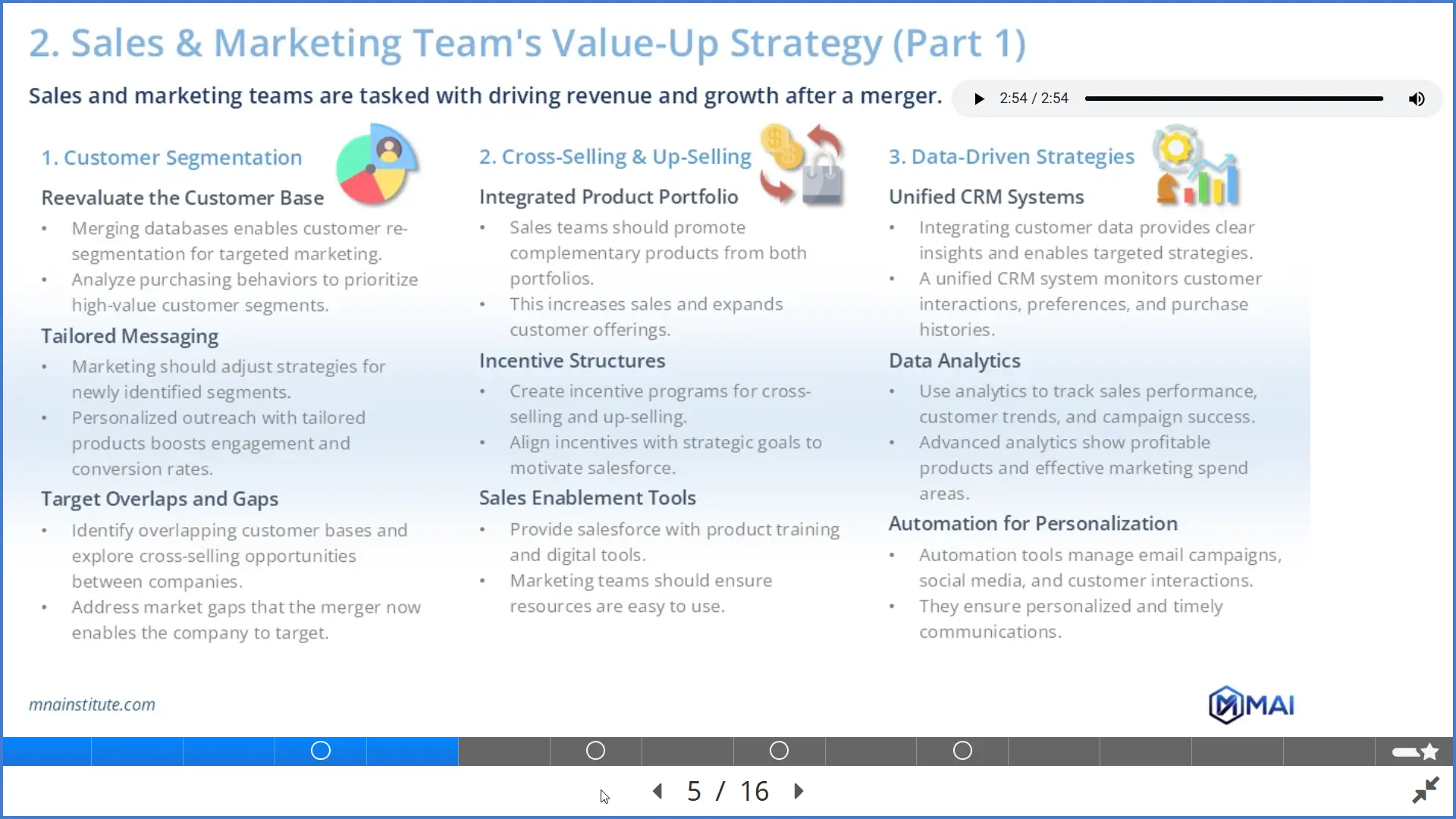
Sales and marketing integration due diligence should test whether the revenue story is executable after close.
This is different from simply reviewing historical sales reports.
The diligence team needs to understand customer quality, market position, sales capability, marketing effectiveness, brand risk, and commercial system compatibility.
Our M&A due diligence course is closely related to this stage because commercial diligence must connect customer evidence with operating feasibility.
Customer analysis
The team should review customer demographics, buying behavior, contract terms, renewal patterns, profitability, product usage, satisfaction scores, and churn trends.
It should identify where the two companies share customers and where one company has access to segments the other does not.
Customer overlap can be valuable, but it can also reveal concentration risk or channel conflict.
The buyer should also distinguish revenue that is sticky from revenue that depends on one relationship, one discount, or one temporary campaign.
Market and competitive landscape
A combined market analysis should test market size, growth potential, competitor position, pricing pressure, channel dynamics, and new entrant risk.
If the deal thesis assumes market expansion, diligence should show how the combined company will actually enter or penetrate that market.
This means testing channel access, local customer behavior, sales coverage, product localization, and marketing cost.
If the deal thesis assumes cross-selling, diligence should show whether customers are already buying from competitors and what it would take to switch them.
Sales and marketing operations
The sales operations review should examine pipeline quality, win rates, sales cycle length, quota attainment, compensation plans, territory design, partner channels, and customer success coverage.
The marketing review should examine campaign ROI, lead quality, brand equity, budget allocation, content assets, automation systems, and messaging consistency.
The technology review should compare CRM systems, marketing automation platforms, analytics tools, consent records, and data governance standards.
A sales integration roadmap should be grounded in these findings, because the roadmap cannot be credible if it ignores system and process gaps.
That is where sales and marketing integration becomes operational rather than conceptual.
Brand, reputation, people, and culture
Brand diligence should identify whether the two brands reinforce each other or create conflict.
Reputation risk can emerge from customer complaints, poor service history, regulatory scrutiny, social media sentiment, or inconsistent market positioning.
People diligence should identify key sales leaders, account managers, marketers, customer success teams, and technical sellers who must be retained.
Cultural diligence should test whether the teams share similar attitudes toward pricing, customer service, data discipline, campaign speed, and account ownership.
If one company operates through centralized enterprise sales and the other through local relationship selling, integration must respect that difference.
Forcing one model too quickly can damage performance.

Section 4. Sales and Marketing Integration Roadmap
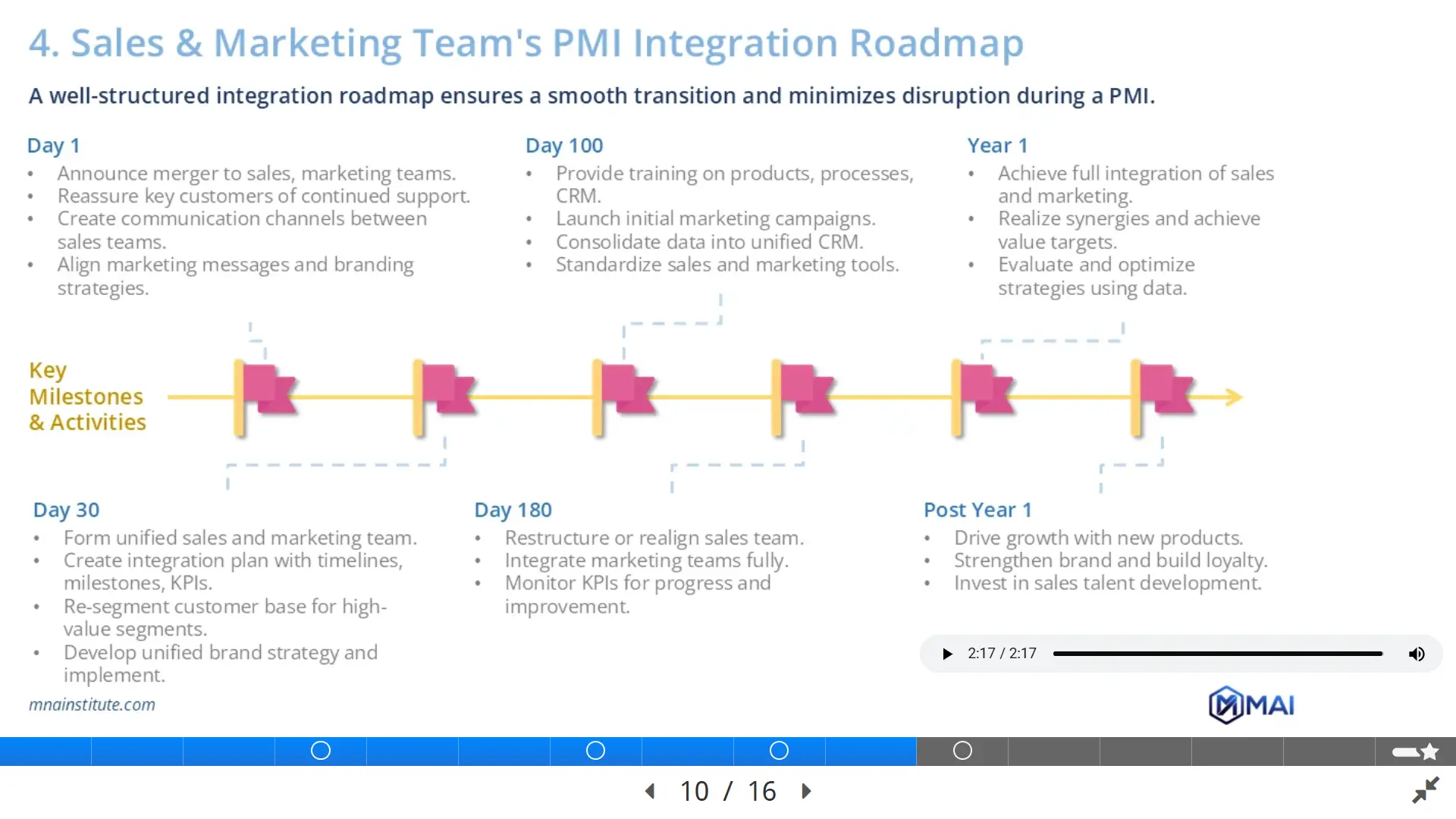
A practical sales integration roadmap must show what happens at each phase after close.
The roadmap should not be a generic project schedule.
It should connect customer stability, revenue protection, salesforce readiness, CRM integration, brand messaging, and measurable value creation.
Day 1: communication and alignment
Day 1 is about reassurance and control.
The company should announce the transaction to sales and marketing teams, explain the integration plan, and address immediate concerns.
Key customers should hear a clear message before rumors or competitors define the situation for them.
The message should confirm service continuity, account coverage, support channels, and the value proposition of the combined business.
Sales leadership from both companies should agree on immediate priorities, customer escalation paths, and communication cadence.
Marketing should align public-facing messages with internal talking points so that employees and customers hear the same story.
Day 30: strategic planning and customer segmentation
By Day 30, the company should have a unified sales and marketing leadership structure.
The team should re-segment the combined customer base and identify high-value segments, churn risks, cross-sell opportunities, and market gaps.
The team should also define a unified brand strategy and begin implementing the most urgent brand integration actions.
KPIs should be established for retention, new pipeline, cross-sell activity, campaign performance, customer satisfaction, and CRM data readiness.
This phase turns broad deal logic into measurable commercial priorities.

Day 100: execution and optimization
By Day 100, the focus should move from planning to execution.
Sales teams should receive training on new products, new sales processes, updated messaging, and CRM expectations.
Marketing should launch initial integrated campaigns targeted to specific segments rather than to the entire market.
Customer and market data should be consolidated into a unified CRM view where practical.
Sales processes, marketing tools, and customer communication standards should be standardized enough to support execution, while avoiding unnecessary disruption to customer-facing activities.
This is where Post-Merger Intergration and Value-Up Strategy becomes relevant as a broader operating discipline, because sales and marketing integration execution must connect revenue initiatives with organization design and value tracking.
Day 180, Year 1, and Post Year 1
By Day 180, the company should complete necessary sales team restructuring or realignment.
Marketing functions should be integrated where integration improves brand consistency, campaign efficiency, and customer insight.
Sales and marketing KPIs should be reviewed against the merger case, not only against historical standalone performance.
By Year 1, the company should aim for full integration of commercial teams, processes, and systems where integration supports the deal thesis.
Revenue synergy targets should be measured through actual customer behavior, not only through pipeline optimism.
After Year 1, the focus should shift to sustainable growth through new product development, market expansion, customer acquisition, brand strength, and talent development.
The roadmap should remain flexible because markets react, competitors respond, and customer needs evolve.
The best sales and marketing integration teams use the roadmap as a disciplined feedback loop, not as a fixed calendar.

Section 5. Sales and Marketing Integration Example for Teladoc
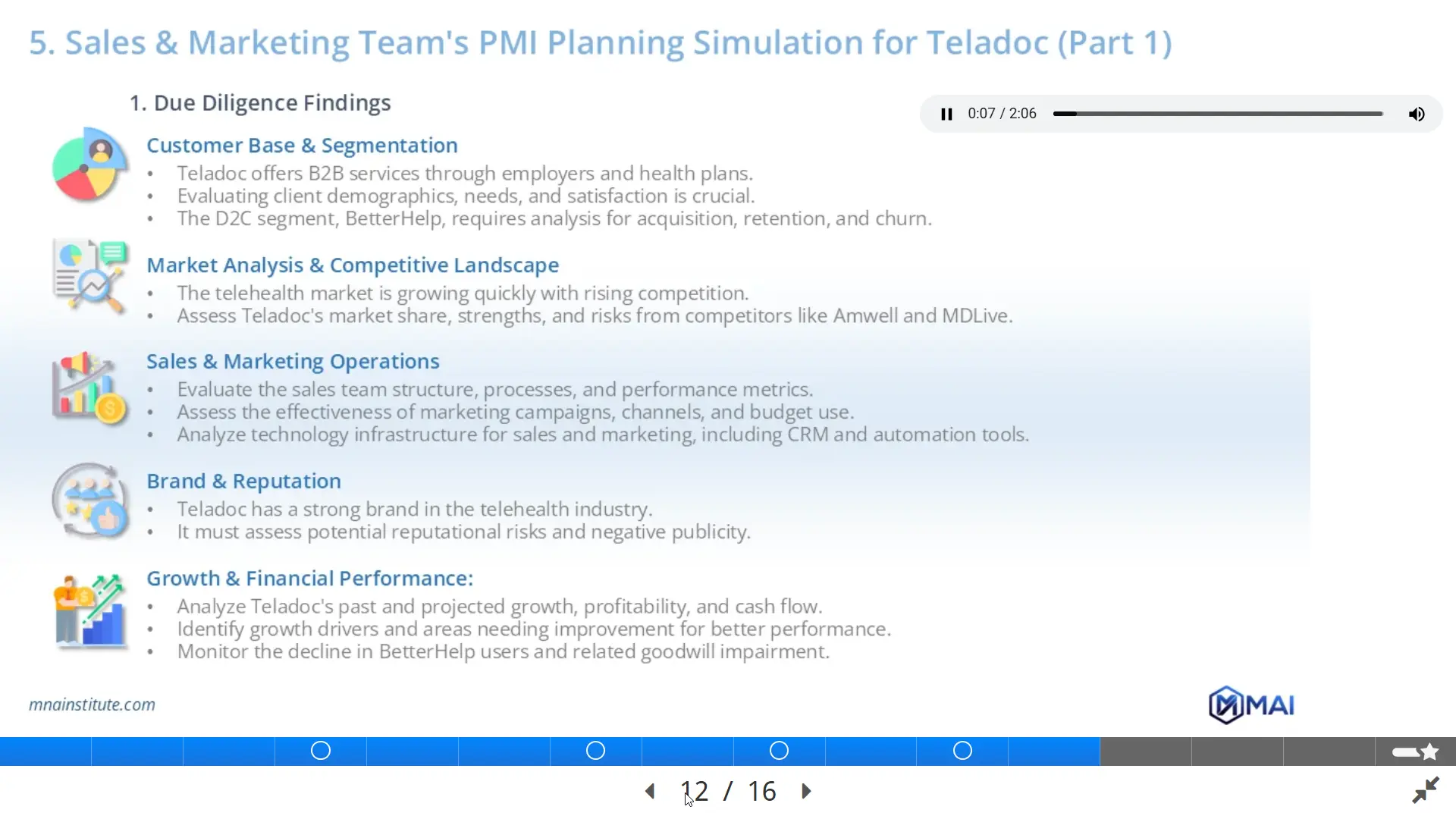
A Teladoc-style scenario helps show how sales and marketing integration can be applied in a real commercial setting.
This example assumes a private equity acquisition where the focus is value creation rather than a full merger of two equal operating companies.
The purpose is to illustrate how due diligence findings can flow into value-up strategy, KPIs, and roadmap execution.
Due diligence findings
Teladoc operates in virtual care and has historically served employers, health plans, and consumers through different offerings.
In the course scenario, the commercial team would first separate B2B customers from direct-to-consumer segments such as BetterHelp.
The B2B side requires analysis of employer and health plan needs, contract quality, member utilization, and client retention.
The direct-to-consumer side requires analysis of acquisition cost, churn, brand trust, conversion, and campaign efficiency.
Teladoc reported full-year 2023 revenue growth of 8 percent to 2.6 billion dollars and a full-year net loss of 220.4 million dollars, so a buyer would need to evaluate both growth potential and profitability pressure.
Reuters later reported that Teladoc withdrew forecasts after pressure in its BetterHelp mental health services unit, including higher customer acquisition expenses and a major impairment charge.
Those facts make the case a useful financial and commercial integration example.
The lesson is that growth, brand recognition, and category relevance do not remove the need for disciplined customer economics.
Value-up strategies and KPIs
The first value-up strategy would be customer expansion and retention.
The company could promote a broader virtual care suite to existing B2B clients, including primary care, mental health, and chronic care management.
The team could target higher adoption of virtual primary care offerings among existing clients and pursue new employers or health plans seeking comprehensive care access.
For the direct-to-consumer segment, marketing could test campaigns designed to reactivate lapsed users and reduce acquisition cost.
The relevant KPIs would include net revenue retention, customer acquisition cost, customer lifetime value, customer satisfaction, marketing ROI, sales cycle length, new client acquisition, and international revenue growth.
A good sales integration example must always connect strategy to KPIs.
Without KPIs, the team may confuse activity with progress.

Roadmap execution
On Day 1, the team should communicate the acquisition to sales and marketing staff, reassure customers and partners, and align leadership on immediate priorities.
By Day 30, the team should review customer segments, market share, competitive position, campaigns, CRM data, and sales process quality.
By Day 100, the team should equip sales teams with training and tools to cross-sell effectively and launch targeted campaigns for priority offerings.
By Day 180, the team should refine messaging, expand into selected segments or geographies, and review KPI performance against the value-up plan.
By Year 1, the team should show measurable progress toward revenue growth, profitability improvement, customer satisfaction, and commercial system integration.
After Year 1, the company should continue refining the growth model through data, partnerships, product development, and market expansion.
This approach shows how sales and marketing integration can move from diligence to execution without losing the customer viewpoint.
Related Courses
- Mergers and Acquisitions Online Course: end-to-end M&A process, deal logic, diligence, negotiation, and integration context.
- M&A Due Diligence: CDD, FDD, LDD, & HRDD: commercial, financial, legal, and HR diligence workstreams that support the sales and marketing plan.
- Post-Merger Intergration and Value-Up Strategy: post-close integration execution, value capture, and functional roadmap design.
Sources
- McKinsey, Capturing cross-selling synergies in M&A.
- Bain & Company, The 10 Steps to Successful M&A Integration.
- Teladoc Health, Fourth Quarter and Full Year 2023 Results.
- Reuters, Teladoc shares hit record low after telehealth firm withdraws 2024 forecast.