The 6-Step M&A Strategy Framework That Wins Deals
Most M&A failures do not begin in the data room.
They begin months or years earlier, when a company pursues a deal without a defined M&A strategy to anchor it.
The target looked financially attractive.
The synergy case was assembled after the price was agreed.
The Board approved based on momentum, not on a documented strategic rationale.
AOL paid 165 billion dollars to acquire Time Warner in 2000.
Two years later, the combined company wrote down 99 billion dollars, the largest write-down in corporate history at that point.
The deal had strong financial engineering behind it but lacked the disciplined merger and acquisition strategies that would have forced the acquiring team to confront the cultural, technological, and competitive realities before committing capital.
A clearly defined M&A strategy does not guarantee deal success, but the absence of one almost guarantees that poor deals will be pursued.
What Is an M&A Strategy and How Is It Built
Defining M&A Strategy
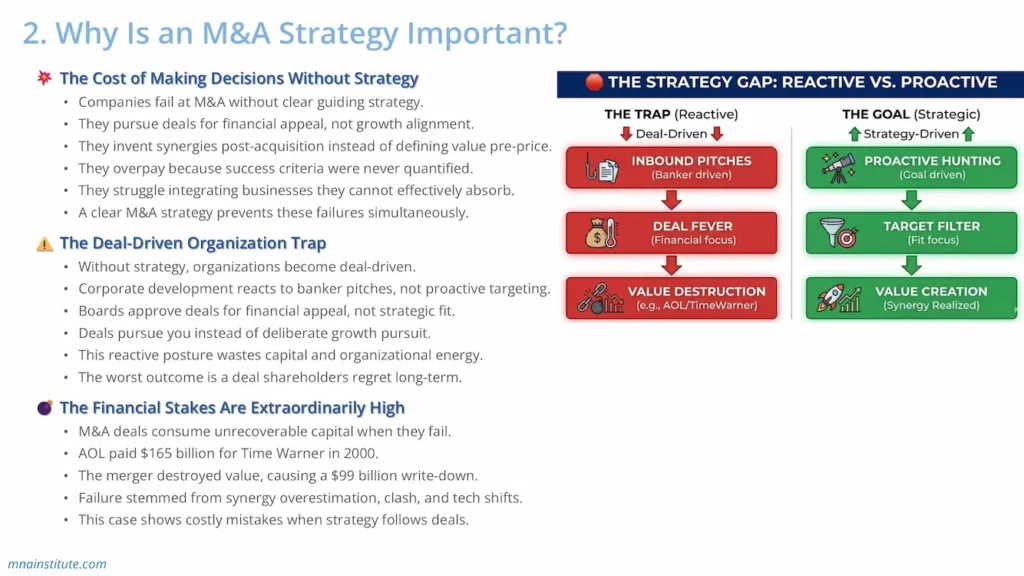
An M&A strategy is the intellectual framework a company builds before any target is identified, before any investment bank sends a pitch deck, and before any deal team is assigned.
It answers three fundamental questions: why is M&A necessary, which types of acquisitions should the company pursue, and under what financial and strategic constraints must it operate.
M&A strategy sits between corporate strategy and deal execution.
Corporate strategy defines the overall direction of the business.
M&A strategy is the upstream decision framework that determines which acquisitions are worth pursuing before deal execution teams spend a single hour on analysis.

M&A Strategy as a Governance Tool
In practice, a merger & acquisition strategy functions as the formal governance document that aligns the CEO, CFO, and Board before any capital is committed.
Top-tier consulting firms including McKinsey and BCG structure their corporate development advisory work around this exact framework.
This document does two things simultaneously: it authorizes the team to pursue specific sectors, and it explicitly prohibits others, preventing the deal-driven organization trap where every pitch looks strategically justifiable.
The Six-Step M&A Strategy Workflow
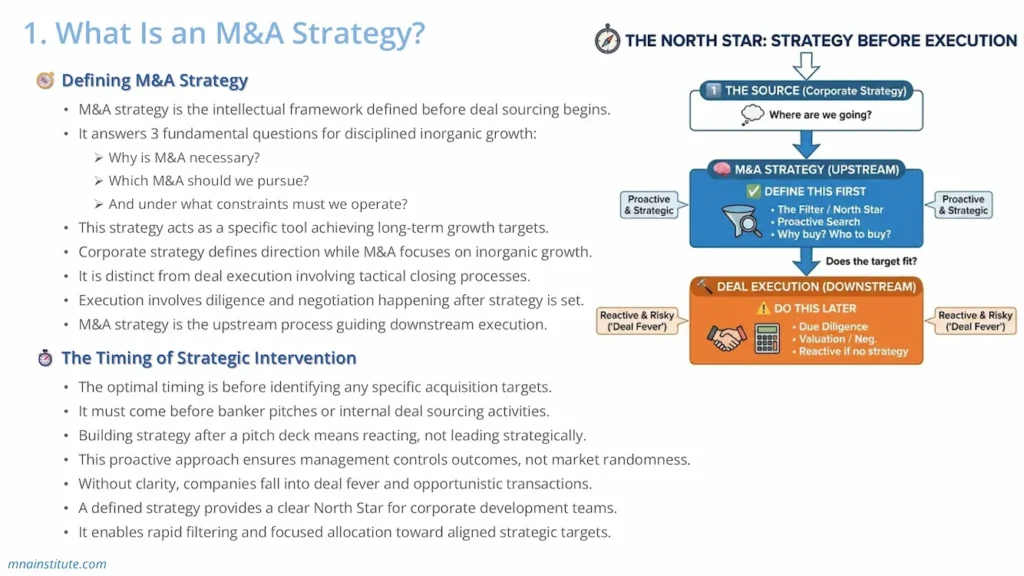
Building a robust M&A strategy follows six sequential steps.
This is the workflow that corporate development teams at companies like Microsoft, Google, and Cisco use in their annual planning cycles.
| Step | Activity | Output |
|---|---|---|
| 1 | Strategic Context and Growth Gap Analysis | Quantified gap between organic trajectory and Board ambition |
| 2 | Build vs. Buy vs. Partner Assessment | Justified rationale for why M&A is the right path |
| 3 | Investment Themes and Deal Archetypes | Defined deal types and expected synergies per theme |
| 4 | Target Screening Criteria | Financial and strategic filters for deal team sourcing |
| 5 | Financial Capacity and Guardrails | Capital deployment limits and deal structure parameters |
| 6 | Execution Roadmap | Governance structure, approval gates, and deal timeline |
Each step feeds directly into the next.
Steps 1 through 3 answer the why and what of the merger strategy.
Building this acquisition strategy from scratch, including the Board-ready strategy deck that formalizes the output, is covered step by step in the M&A Strategy and Board-Ready Report course.
Build vs. Buy vs. Partner: Choosing the Right Path
Step 2 of the M&A strategy workflow forces a discipline that many companies skip: explicitly comparing acquisition against building internally or partnering with another company.
Building means developing the capability organically through R&D, hiring, and product development.
Buying means acquiring a company that already has the capability, the customer base, or the market position.
Partnering means creating a joint venture, licensing agreement, or strategic alliance that provides access without full ownership.
The trade-off is not simply about cost.
It is fundamentally about time and control.
Organic product development cycles typically take 18 to 36 months from concept to market launch.
Customer acquisition in a new geography takes 12 to 24 months of building distribution and brand awareness.
Acquisition compresses that timeline to 6 to 12 months by buying proven product-market fit and an existing customer base.
The M&A strategy framework identifies the ownership trigger: the specific conditions under which acquisition becomes the only viable path because building is too slow and partnering does not provide sufficient control over a strategically essential asset.

Investment Themes and Deal Archetypes
Step 3 of the M&A strategy workflow defines the deal archetypes that translate the growth gap into specific target characteristics.
Each archetype addresses a different strategic need and generates a different synergy profile.
- Horizontal scale deals consolidate market share within the same industry, targeting cost synergies through headcount reduction and operational overlap elimination.
- Vertical chain control deals acquire suppliers or distribution channels upstream or downstream, capturing margin and securing supply chain resilience.
- Geographic entry deals provide immediate market presence in a new country or region, bypassing the 12 to 24 month organic entry timeline.
- Adjacent expansion deals move the acquirer into a related market where existing capabilities can be leveraged with moderate integration complexity.
- Technology and talent acquisition deals buy proven engineering teams or proprietary technology that would take years to replicate internally.
- Diversification deals reduce earnings volatility by adding a business with low correlation to the acquirer’s existing revenue streams.
Defining which archetypes are in scope before deal sourcing begins prevents the team from evaluating targets that are financially attractive but strategically disconnected from the growth gap mandate.

Strategic Context and Growth Gap Analysis
Diagnosing the Strategic Context
The starting point of any M&A strategy or merger strategy is a clear answer to one question: what structural forces are preventing the company from achieving its growth ambition through organic means alone.
Four structural triggers account for most cases where organic growth becomes insufficient.
Market maturation slows organic growth as the core market reaches peak penetration and new customer acquisition becomes progressively more expensive.
Intensifying competition erodes pricing power and forces the company to invest heavily just to maintain its current market position.
Technology transformation creates the risk of product obsolescence, where current business models become less competitive as new platforms emerge.
Regulatory change alters the competitive landscape in ways that create new barriers to entry or shift the cost structure of the industry.
Every M&A strategy presentation begins by diagnosing which of these four triggers applies to the company’s current situation.
The answer determines which deal archetypes are relevant and which target characteristics the screening criteria should prioritize.
A company facing market maturation should pursue geographic entry or adjacent expansion deals.
A company facing technology disruption should pursue technology and talent acquisition deals.
A company facing intensifying competition should evaluate horizontal consolidation.
Quantifying the Growth Gap
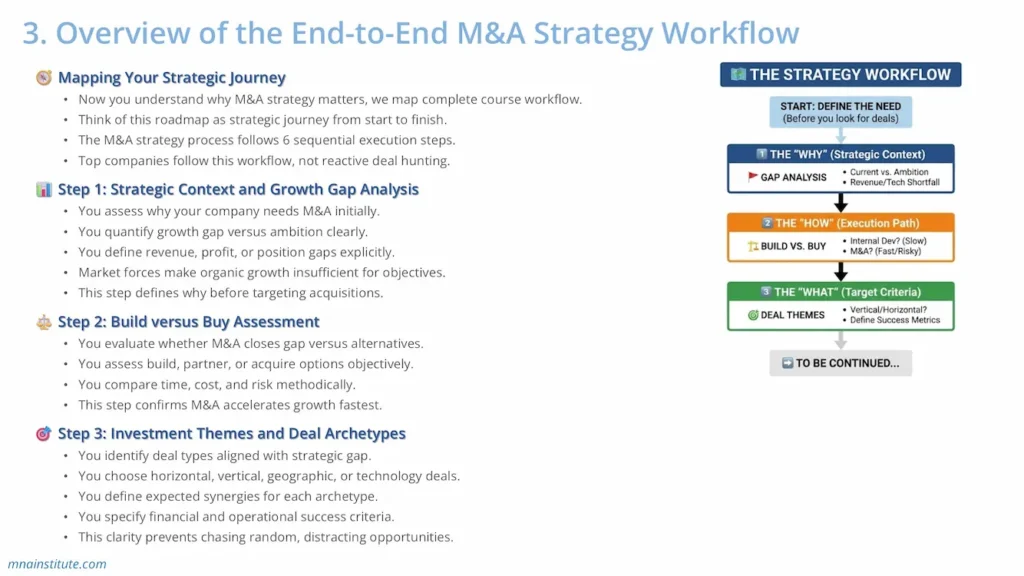
Once the strategic context is diagnosed, the next step is to quantify the growth gap with precision.
The growth gap is the difference between two specific numbers: the company’s organic growth trajectory and the Board’s strategic growth ambition.
The organic trajectory is calculated by analyzing current revenue composition by business segment, applying historical segment growth rates, and adjusting for the three structural constraints on organic growth: time, capital, and talent.
The Board ambition is typically expressed as a 3-year or 5-year revenue or EBITDA target reflecting shareholder expectations, competitive positioning requirements, and market opportunity assessment.
To make this concrete: suppose a technology company generates 10 billion dollars in annual revenue today.
The Board has set a 5-year growth ambition of 15% per year, targeting 20 billion dollars.
The organic trajectory, constrained by a maturing core product line and a 24-month product development cycle, projects only 13 billion dollars.
The growth gap is 7 billion dollars.
That 7 billion dollars is the exact mandate the merger strategy must address.
This discipline is what separates companies with effective merger and acquisition strategies from those that accumulate a portfolio of financially attractive but strategically disconnected acquisitions.
The growth gap must also be expressed in multiple metrics, not just revenue.
Software companies focus on annual recurring revenue or subscription growth rates.
Industrial companies track EBITDA margin expansion.
Consumer goods companies measure market share percentage points.
Healthcare companies quantify patient volume or treatment capacity.
Whatever metric the Board uses as its primary performance benchmark becomes the growth gap metric that the M&A mandate is designed to close.
Financial Capacity and Target Screening Guardrails
The M&A strategy framework does not end with identifying the growth gap.
It must also establish the financial guardrails that prevent the company from overextending its balance sheet to close that gap.
It produces a maximum deal size that the company can execute without compromising investment-grade credit ratings or minimum liquidity requirements.
Target screening criteria then translate the strategic mandate into a practical hunting guide.
Strategic filters define the product fit, customer overlap, geographic location, and technology maturity requirements.
With these criteria defined, the deal sourcing team has a mandate rather than a wish list. Building and executing the sourcing pipeline that flows from a defined M&A strategy is covered in the M&A Deal Sourcing and Pipeline Management course.

Applying the M&A Strategy Framework to Microsoft’s Acquisition of Activision Blizzard
Microsoft’s acquisition of Activision Blizzard for 68.7 billion dollars, announced in January 2022 and closed in October 2023, is one of the most clearly documented examples of a disciplined M&A strategy translated into a specific deal.
Working through each stage of the framework shows how the strategic logic flows from growth gap to final closing.
Strategic Context: Four Triggers Applied to Microsoft Gaming
Microsoft’s gaming division faced all four structural triggers by 2021.
The core console market was maturing, with Xbox consistently in third place behind PlayStation and Nintendo by global installed base.
Competition from Sony, which controlled approximately 70% of the premium console market, was intensifying.
Technology transformation was shifting gaming toward mobile and cloud platforms where Microsoft had minimal presence.
Microsoft’s Xbox Game Pass subscription service had strong unit economics but lacked the content library depth to drive subscriber growth at the scale needed to compete with Sony’s first-party studio output.

Growth Gap: From Console Revenue to Cloud Gaming Scale
Microsoft’s M&A strategy for gaming identified a specific growth gap: the company projected its gaming segment growing at single-digit organic rates through console hardware and existing studio output, while its Board ambition targeted cloud gaming leadership and Game Pass subscriber growth at a scale requiring content that would take a decade to build organically.
The gap was not just revenue.
It was a content gap, a mobile gap, and a subscriber growth gap simultaneously.
Activision Blizzard addressed all three.
On content: Activision owned Call of Duty, the best-selling franchise in console gaming history, World of Warcraft, Diablo, and Overwatch.
Adding these franchises to Game Pass would accelerate subscriber growth more than any combination of organic studio output Microsoft could deliver in the same timeframe.
On mobile: Activision’s King division owned Candy Crush, with approximately 240 million monthly active users.
Microsoft had essentially no mobile gaming presence before this acquisition.
On cloud: Microsoft’s Xbox Cloud Gaming service needed flagship titles to demonstrate the value proposition of streaming games over its Azure infrastructure.
Activision’s portfolio provided that content library at a scale no organic investment could replicate within a competitive window.
Build vs. Buy: Why Acquisition Was the Only Viable Path
Microsoft’s acquisition strategy team applied the build vs. buy vs. partner framework explicitly.
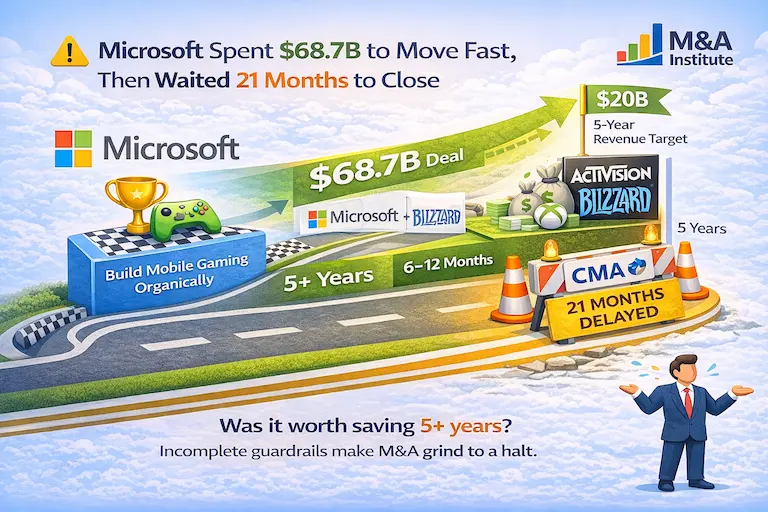
Building a competing mobile gaming franchise organically would require at minimum five years of product development, user acquisition investment, and platform iteration.
Partnering with Activision through a licensing or content exclusivity arrangement would not provide the full ownership control over content deployment that the Game Pass subscription model required.
Acquisition was the only path that delivered the content library, the mobile subscriber base, and the cloud gaming catalog simultaneously within the competitive window Microsoft’s M&A strategy had defined.
Microsoft became the world’s third-largest gaming company by revenue after Tencent and Sony upon closing.
Regulatory Complexity: The Cost of Incomplete Guardrails
The Activision deal also illustrates what happens when the financial capacity analysis is strong but the regulatory guardrails in the M&A strategy framework are underweighted.
The UK Competition and Markets Authority initially blocked the deal in April 2023 over cloud gaming competition concerns.
The deal that was expected to close in mid-2023 closed 21 months after announcement.
Any merger & acquisition strategy for large technology or media acquisitions must build regulatory scenario planning into the financial guardrails from the beginning, not after regulatory opposition materializes.

Build the M&A Strategy Skills That Practitioners Use
Understanding the M&A strategy framework conceptually and being able to build it from scratch for a Board presentation are two different skills.
The M&A Institute courses below take practitioners through every component of the framework with the level of detail that corporate development teams at top-tier firms actually apply.
M&A Strategy and Board-Ready Report teaches you to build the complete M&A strategy from growth gap quantification through target screening criteria and financial guardrails, producing a Board-ready strategy deck as the course deliverable. This is the foundation of every effective merger and acquisition strategies framework.
The Merger and Acquisition Process Course covers the end-to-end transaction process, from strategy through post-merger integration, giving practitioners the full context of how M&A strategy translates into deal execution.
M&A Deal Sourcing and Pipeline Management shows how the target screening criteria defined in the strategy framework become a live deal pipeline, with outreach and prioritization methodologies used by active corporate development teams.
Desktop Due Diligence and Quick Valuation teaches how deal teams screen targets against the strategy criteria before committing to full diligence resources.
M&A Due Diligence: CDD, FDD, LDD, and HRDD covers every workstream of the full due diligence process that validates whether a target actually fits the strategic mandate.
Additional courses cover every downstream transaction step:
-
Acquisition Financing and LBO Modelling – capital structure and leverage analysis
-
M&A Deal Negotiation Mastery – LOI and purchase agreement negotiation tactics
-
Stock Purchase Agreement Mastery – definitive agreement clause-by-clause analysis
-
Post-Merger Integration and Value-Up Strategy – 100-day plan execution and synergy capture
Explore the full course library at mnainstitute.com.
Sources
- Microsoft Corporation. (January 18, 2022). Microsoft to acquire Activision Blizzard. SEC Filing, Exhibit 99.1.
- Microsoft Corporation. (October 2024). One year on: Microsoft’s acquisition of Activision Blizzard is fueling gaming innovation and competition.
- CNBC. (April 28, 2023). Microsoft is betting its future on cloud gaming – but that’s what tripped up the Activision deal.