The 5-Stage Mergers and Acquisitions Procedure Explained
Picture a corporate development team at a consumer goods company that has been growing revenues at 6% per year while the Board has set a 15% annual growth target.
Organic expansion alone will not close that gap within the timeline the Board expects.
The team is given a mandate: identify and acquire a business that can bridge that shortfall.
From this point forward, every action follows a defined mergers and acquisitions procedure that Wall Street practitioners use on buy-side deals worldwide.
Whether you are navigating your first M&A transaction or managing a portfolio of concurrent deals, understanding the full merger and acquisition process from strategy through post-merger integration is what separates disciplined acquirers from those who overpay or underdeliver.
Each stage of the mergers and acquisitions procedure produces specific deliverables, requires defined approvals, and moves the deal toward a disciplined close.
The Five-Stage Mergers and Acquisitions Procedure
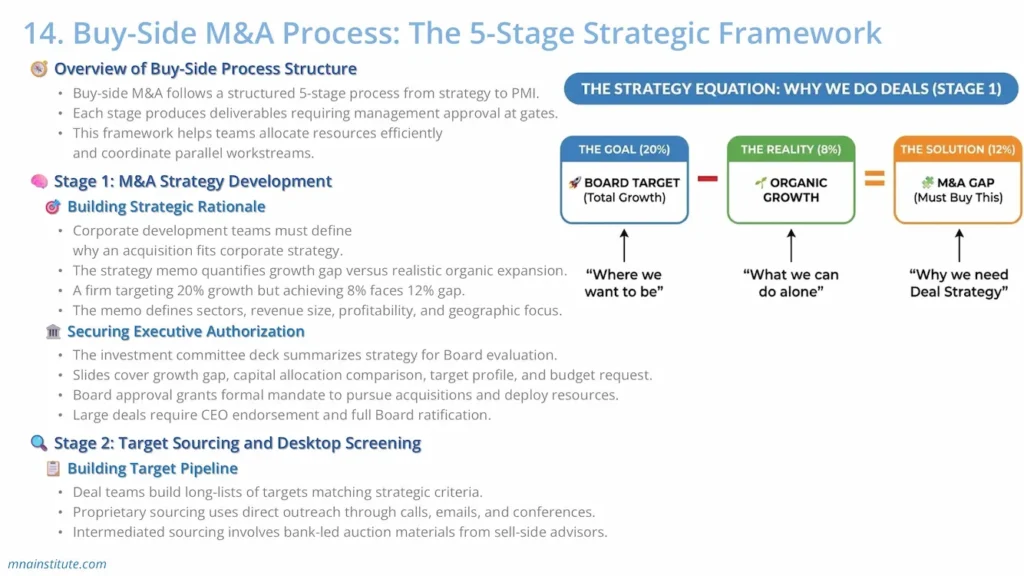
Stage 1: M&A Strategy Development
The corporate development team prepares an M&A strategy memorandum that quantifies the gap between the Board’s growth target and what the company can realistically achieve through organic investment alone.
For example, if a software company targets 20% annual revenue growth but its organic business grows at 8%, the acquisition strategy must bridge the 12% shortfall.
The memorandum specifies which industries to target, what revenue and EBITDA ranges make sense, which geographies are in scope, and why an acquisition beats the alternatives of partnerships or internal investment.
The team then prepares an investment committee presentation that distills this strategy into a format the Board can review and authorize.
Key slides address the growth gap quantification, a capital allocation comparison against other uses of cash, a target profile definition, a budget request, and an expected timeline.
Board approval at this gate provides the formal mandate to pursue deals and commit advisor fees and management time to the process.
Without this authorization, the mergers and acquisitions procedure cannot advance, because deal teams have no mandate to approach sellers or engage external advisors.
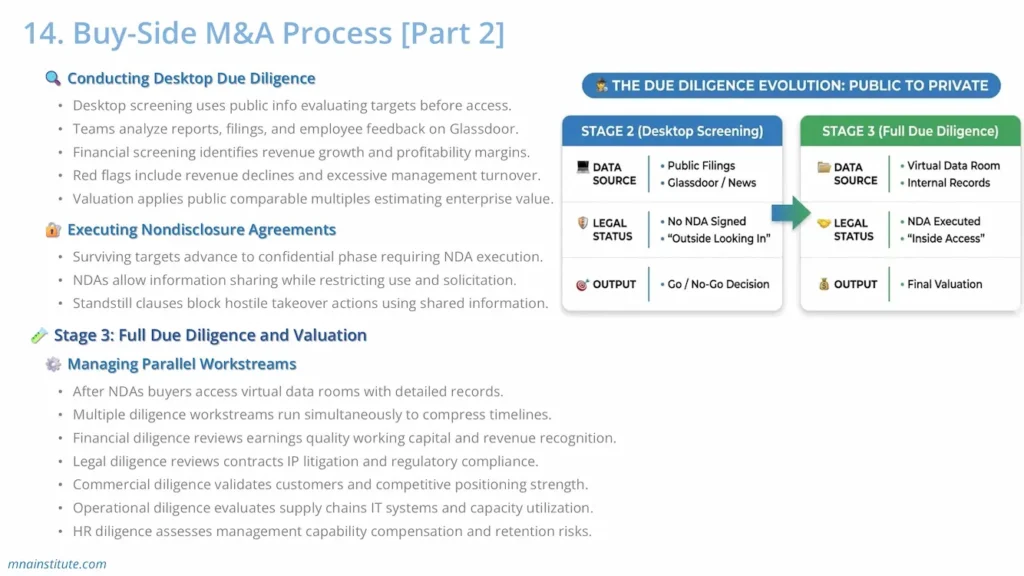
Stage 2: Target Sourcing and Desktop Screening
Sourcing happens two ways: proprietary outreach, where the team contacts target executives directly through cold calls, emails, and industry conferences; and intermediated sourcing, where investment banks running sell-side M&A processes send teaser documents to qualified buyers.
Financial screening looks at revenue growth trajectories, EBITDA margins, and working capital efficiency patterns.
Red flags that trigger elimination at this stage include consistent revenue declines, high customer concentration, excessive management turnover, or material pending litigation.
Preliminary valuation applies public comparable company multiples to estimate an enterprise value range for each surviving candidate.
The output of Stage 2 determines which targets will receive a confidential approach and move the mergers and acquisitions procedure into its most resource-intensive phase.
Targets that pass desktop screening advance to a confidential phase requiring a nondisclosure agreement.
The NDA permits the seller to share sensitive business information while restricting how the buyer can use that data and prohibiting the solicitation of target employees during the negotiation period.
Standstill provisions within the NDA prevent the buyer from launching any hostile takeover attempt using confidential information gained through the friendly process.
NDAs are a standard feature of every mergers and acquisitions procedure, and the quality of their drafting often reflects the sophistication of the buyer’s legal team.

Stage 3: Full Due Diligence and Valuation
This is the most intensive phase of the mergers and acquisitions procedure, requiring multiple workstreams to run simultaneously rather than sequentially.
Experienced practitioners distinguish a rigorous mergers and acquisitions procedure from a rushed one precisely at this stage, where quality of analysis directly determines whether the investment committee will approve the offer.
Compressing the due diligence timeline is itself a competitive advantage, because it keeps the seller engaged and reduces the window for competing bidders to emerge.
Financial due diligence examines whether reported EBITDA represents true sustainable earnings power.
The rigor applied here directly determines whether the mergers and acquisitions procedure produces a well-priced deal or an expensive mistake.
Analysts identify expenses that should be added back to normalized EBITDA, revenue recognition policies that may inflate current period results, working capital requirements that will need buyer funding after closing, and accounts receivable quality issues that signal collection risk.
Legal due diligence catalogs every material contract, pending litigation, intellectual property registration, and regulatory compliance issue.
Contracts containing change-of-control provisions are flagged, because they may terminate or require counterparty consent upon acquisition.
Commercial due diligence validates customer relationships through direct reference calls and reviews historical renewal rates, churn patterns, competitive positioning, and pricing power.
Operational due diligence assesses supply chain resilience, IT system compatibility, manufacturing capacity, and quality control history.
Valuation work runs in parallel with due diligence rather than after it.
A discounted cash flow model projects the target’s free cash flows over five to ten years and calculates their present value using an appropriate discount rate.
Comparable company analysis benchmarks the target’s trading multiples against public peers with similar business models and growth profiles.
Precedent transaction analysis reviews recent M&A transactions in the same sector to establish a valuation multiple range grounded in what buyers actually paid.
Integration planning also begins in Stage 3, not after closing.
Buyers who wait until after signing to think about integration routinely discover complexity they did not price into the deal.
The Day 1 operational playbook ensures payroll continuity, customer service maintenance, and supplier payment processing from the moment the deal closes.
A 100-day integration plan identifies quick-win synergy initiatives that demonstrate deal value to stakeholders early.
Deal structure decisions also crystallize during Stage 3, covering whether the transaction will be structured as a stock purchase or an asset purchase, and how tax considerations affect that choice for both sides.
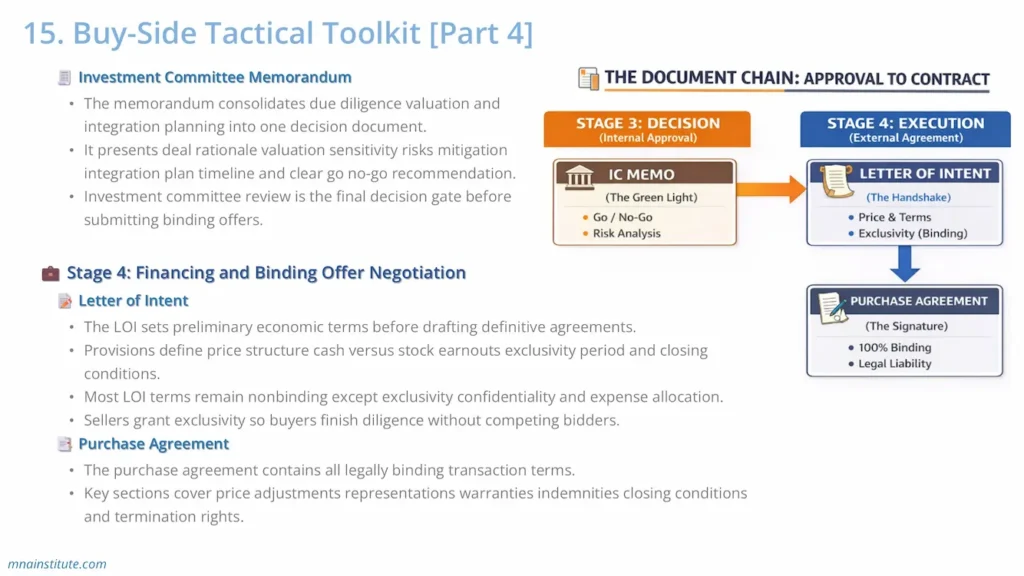
Stage 3 concludes with an investment committee memorandum that consolidates all due diligence findings, valuation analysis, and integration planning into a single decision document.
This memorandum presents the deal rationale, enterprise value range with sensitivity analysis, key risks and mitigation strategies, integration approach, and an explicit go or no-go recommendation.
Investment committee approval at this gate is required before the buyer submits any binding offer to the seller.
Teams that shortcut this approval step violate the governance structure that makes the mergers and acquisitions procedure defensible to shareholders and boards.

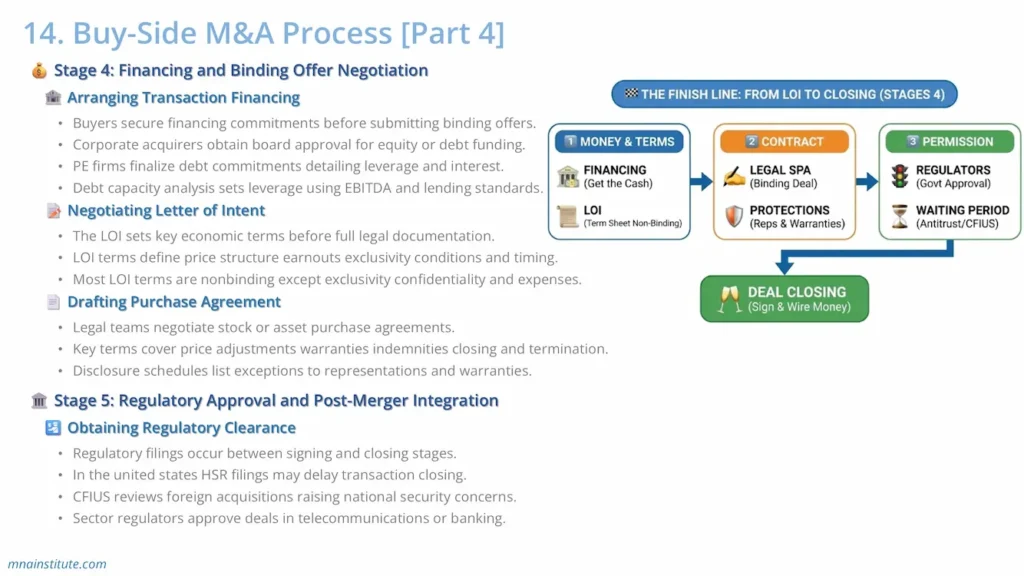
Stage 4: Financing and Binding Offer Negotiation
In most M&A transactions, buyers secure financing commitments before submitting binding offers so that sellers have confidence the deal will actually close.
Financing arrangement is Stage 4 of the mergers and acquisitions procedure and must be completed before the letter of intent is executed.
Corporate acquirers obtain Board approval for equity funding or arrange debt facilities with their banking relationships.
The letter of intent establishes preliminary agreement on key economic terms before both parties incur the legal costs of drafting full purchase agreements.
LOI provisions specify the proposed purchase price or valuation methodology, the payment structure across cash and stock components, any earnout provisions if a valuation gap exists between buyer and seller, the exclusivity period duration, and material closing conditions.
Most LOI terms are non-binding, but exclusivity, confidentiality obligations, and expense allocation provisions become legally enforceable once signed.
Legal teams then negotiate the Stock Purchase Agreement or Asset Purchase Agreement, which contains all binding transaction terms: purchase price and working capital adjustment mechanisms, representations and warranties about business condition, indemnification provisions capping seller liability, closing conditions precedent, and termination rights.
Disclosure schedules accompanying the agreement list every exception to each representation and warranty, and reviewing these schedules is where many overlooked risks first come to light.

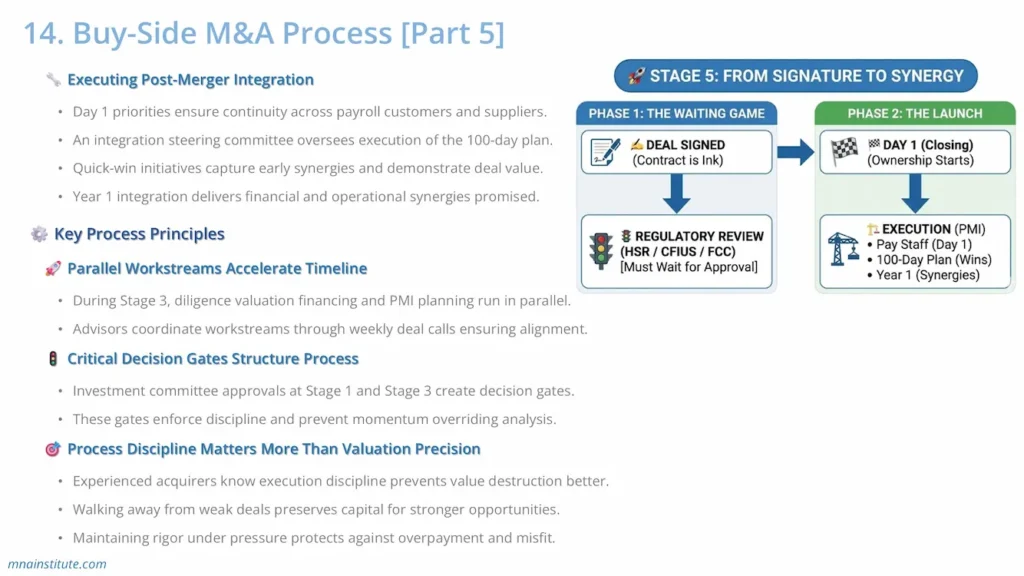
Stage 5: Regulatory Approval and Post-Merger Integration
The final stage of the mergers and acquisitions procedure covers the period between signing and closing, which is occupied by regulatory filings and approvals.
Duration and complexity depend on deal size, industry, and the jurisdictions involved.
In the United States, Hart-Scott-Rodino filings may trigger waiting periods before transactions can legally close.
The Committee on Foreign Investment in the United States reviews foreign acquisitions of US businesses that raise national security questions.
Industry regulators in sectors like telecommunications, banking, and media impose their own sector-specific approval processes.
Cross-border deals frequently require filings across dozens of jurisdictions, each with its own timeline and substantive review criteria.
Post-merger integration execution begins on Day 1, with the integration steering committee comprising senior leaders from both organizations overseeing the 100-day plan.
Day 1 priorities focus on operational continuity: payroll processing runs without interruption, customer-facing teams remain in place, and supplier payments continue on schedule.
Year 1 integration targets are the financial synergies and operational improvements that were presented in the original investment committee materials.
Whether those targets are achieved is ultimately the measure of whether the mergers and acquisitions procedure was executed with the discipline it requires.
Buy-Side M&A Practitioner Checklist
The table below maps each stage of the mergers and acquisitions procedure to its required deliverables and approval gates.
| Stage | Deliverable | Approval Gate |
|---|---|---|
| 1. Strategy | M&A strategy memorandum; investment committee presentation | Board authorization to pursue deals |
| 2. Sourcing | Long-list tracker; desktop DD summaries; internal prioritization memo | Management approval for confidential outreach |
| Nondisclosure agreement | NDA executed before data room access | |
| 3. Due Diligence | Financial, legal, commercial, and operational DD reports | Ongoing deal team review |
| Valuation memorandum with DCF, comps, and precedent transactions | Internal valuation sign-off | |
| Integration planning document; Day 1 playbook | Integration team alignment | |
| Investment committee memorandum | Investment committee approval for binding offer | |
| Financing commitment letters or Board equity authorization | Financing confirmed before LOI submission | |
| 4. Negotiation | Letter of intent | Both parties execute LOI; exclusivity period begins |
| Stock or asset purchase agreement; disclosure schedules | Legal sign-off; signing | |
| 5. Closing | Regulatory filings and approvals across all required jurisdictions | All clearances received |
| 100-day integration plan execution; Year 1 synergy tracking | Integration steering committee oversight |
Each checklist item should have an assigned owner, a target completion date, and a clear escalation path if issues arise during that stage.
Deal teams that do not assign individual accountability for each deliverable frequently experience coordination failures that delay signing or create post-close surprises.
Common Mistakes That Derail the Mergers and Acquisitions Procedure
Understanding the merger and acquisition process in theory is not the same as executing it without error under time pressure and competitive tension.
The mergers and acquisitions procedure is only as strong as the discipline applied at each stage, and the following mistakes appear repeatedly in failed or value-destroying transactions.
Skipping the growth gap analysis and jumping straight to targets
Teams that begin sourcing before establishing a rigorous strategic rationale often find themselves rationalizing targets rather than evaluating them objectively.
If the strategy memorandum cannot clearly explain why this specific acquisition solves a defined business problem, the process should restart at Stage 1.
Relying only on management-provided financial projections during due diligence
Seller management teams naturally present their businesses in the most favorable light, and their projections frequently reflect optimistic assumptions about growth, margin improvement, and synergy capture.
Financial due diligence that does not independently rebuild the earnings model from underlying drivers, and that does not stress-test revenue assumptions through customer reference calls, gives buyers false confidence in their valuation.
Delaying integration planning until after signing
Integration complexity discovered after signing but before closing has no practical remedy.
Buyers who begin integration planning during Stage 3 due diligence uncover system incompatibilities, cultural misalignment signals, and organizational design questions early enough to adjust valuation, request specific representations in the purchase agreement, or negotiate a transitional services arrangement.
Allowing deal momentum to override negative due diligence findings
After months of work and significant advisor fees, deal teams face enormous internal pressure to find a way to close rather than to walk away.
The investment committee memorandum exists precisely to force a structured re-evaluation of whether the original deal thesis still holds after full diligence.
Experienced acquirers treat a well-justified recommendation to terminate a deal as a success, not a failure.
Underestimating regulatory timeline and complexity on cross-border deals
A deal requiring approvals from 20 or more regulatory jurisdictions across multiple continents will take far longer to close than teams familiar only with domestic mergers and acquisitions procedures typically expect.
Regulatory risk assessment belongs in Stage 3, not after signing, so that the purchase agreement can include appropriate termination provisions and deal timelines reflect realistic regulatory durations.
Neglecting cultural integration in the 100-day plan
Acquirers that communicate clearly with target employees from Day 1, retain key talent deliberately, and treat cultural integration as a defined workstream with accountable owners outperform those that treat it as secondary to systems and process integration.
Avoiding these six mistakes is as much a part of the mergers and acquisitions procedure as any formal document or decision gate.
Applying the Mergers and Acquisitions Procedure to a Real Deal: Mars and Kellanova
The acquisition of Kellanova by Mars, Incorporated illustrates every stage of this mergers and acquisitions procedure at scale.
Few deals in recent memory demonstrate the full breadth of the mergers and acquisitions procedure as clearly as this one, from a well-defined growth gap through 28-jurisdiction regulatory clearance.
Mars, a privately held global food and confectionery company with approximately 55 billion dollars in annual revenues, identified a strategic rationale for expanding its snacking portfolio beyond candy and confectionery into salty snacks.
Kellanova, the publicly traded company formed from the 2023 split of Kellogg Company, owned brands including Pringles, Cheez-It, Pop-Tarts, Rice Krispies Treats, and RXBAR.
The deal originated from a Stage 1 growth gap that Mars had quantified: its existing snacking brands held strong positions in confectionery, but the fast-growing salty snacks segment required an acquisition to enter at scale.
Mars approached Kellanova in May 2024 with an initial proposal of 77 dollars per share, then increased through rounds of negotiation to 80, then 82, and finally 83.50 dollars per share.
The final offer represented a 44% premium to Kellanova’s unaffected 30-trading-day volume-weighted average price and an acquisition multiple of 16.4 times last twelve months adjusted EBITDA.
The total transaction consideration reached approximately 35.9 billion dollars, inclusive of assumed net leverage.
From a buy-side M&A process perspective, Mars and its advisors conducted financial, operational, commercial, and legal due diligence through a virtual data room and multiple in-person site visits across facilities in Michigan, Tennessee, Poland, and the United Kingdom.
Because Mars is a private company without a public equity float, the financing structure centered on a 29 billion dollar bridge loan facility, with the merger agreement containing no financing condition.
Kellanova’s Board, advised by Goldman Sachs and Lazard, reviewed the fairness of the offer, evaluated competing indications of interest from three other potential buyers, and determined that no competing bidder could realistically match the Mars proposal given regulatory constraints.
Among large-scale M&A transactions in the consumer sector, the regulatory burden on this deal was exceptional: clearance was required from 28 separate jurisdictions.
The U.S. Federal Trade Commission concluded its antitrust review in June 2025 without requiring any remedy or condition.
The European Commission, which opened a full investigation into potential competitive concerns, granted unconditional approval in December 2025.
The transaction closed on December 11, 2025, creating a combined snacking business expected to generate approximately 36 billion dollars in annual revenues, with nine brands each exceeding one billion dollars in annual sales.
Build the Skills That Make the Mergers and Acquisitions Procedure Work in Practice
Reading a framework and executing a live deal are two different things.
The M&A Institute was built to close that gap for finance professionals at every career stage, from analysts preparing their first deal memorandum to corporate development leads managing complex cross-border transactions.
Our courses cover every component of the merger and acquisition process, from financial statement analysis and valuation modeling through transaction structuring, due diligence execution, and post-merger integration.
Each course is built around the way practitioners at top-tier firms actually execute the mergers and acquisitions procedure, not simplified academic versions of it.
You will learn how to construct an investment committee memorandum, build a valuation that withstands Board scrutiny, navigate due diligence workstreams, and design an integration plan that captures the synergies the deal model promised.

Sources
- Mars, Incorporated. (August 14, 2024). Mars to acquire the Kellanova family of snack food brands.
- Mars, Incorporated. (December 11, 2025). Mars completes acquisition of Kellanova.
- Food Dive. (December 8, 2025). Mars to close $36B Kellanova acquisition following EU approval.