Purchase Price Adjustment in M&A: 4 Categories That Decide
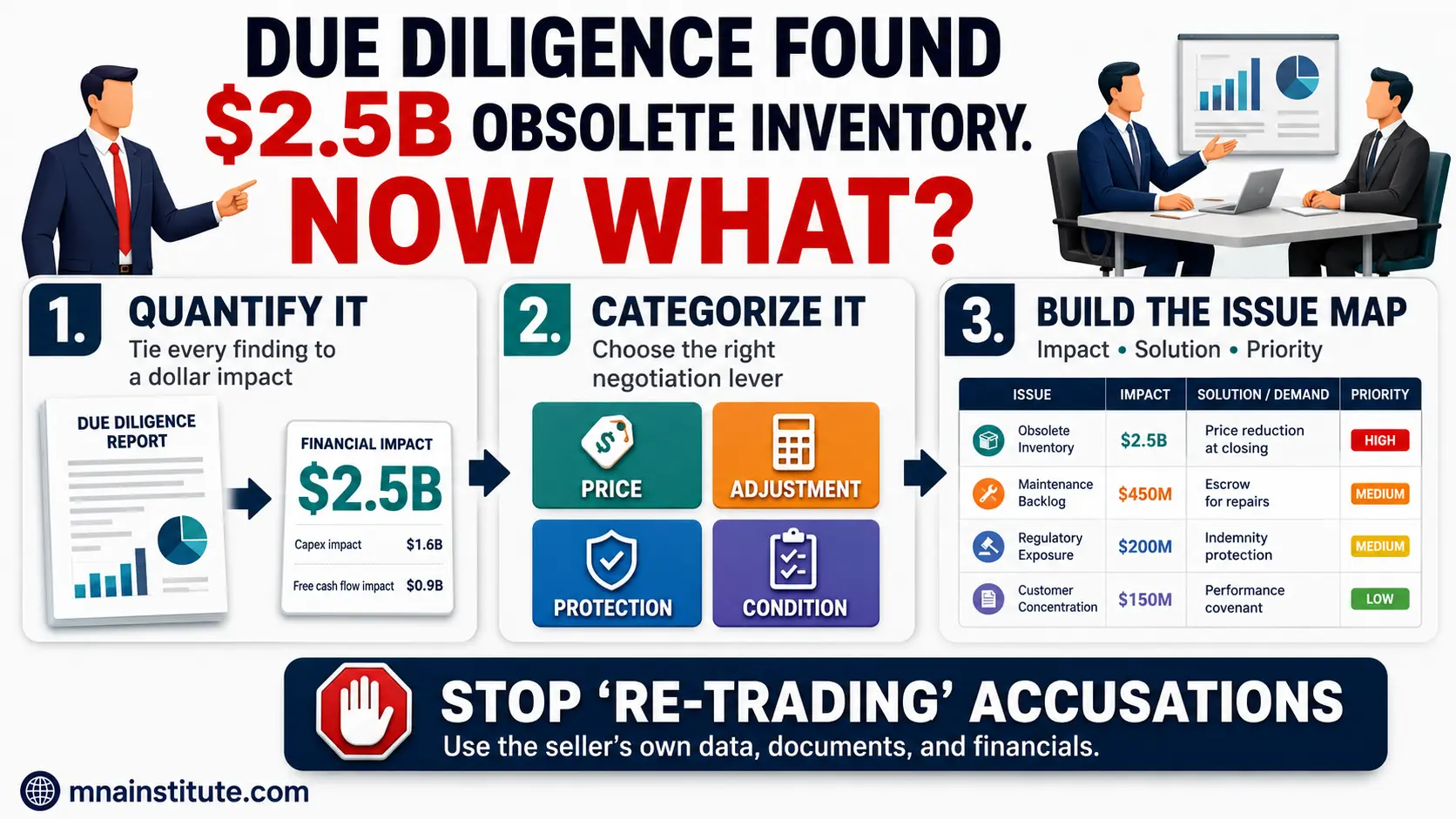
A buyer finishes due diligence and finds three issues that were not visible when the first valuation was agreed.
One issue is a customer concentration problem that may reduce future revenue.
A second issue is obsolete inventory that will probably need to be written down.
A third issue is a pending claim that could cost nothing or could become a large cash drain after closing.
The buyer now faces a practical question that defines many real M&A negotiations.
Which finding supports a purchase price adjustment, which finding belongs in an indemnity, which finding belongs in a closing adjustment, and which finding should become a condition to closing?
This is where post due diligence negotiation becomes more technical than a simple price debate.
The strongest buyers do not arrive with vague complaints about the target business.
They arrive with quantified exposures, financial statement links, proposed risk allocation, and a ranked issue map.
This article explains how a disciplined due diligence negotiation strategy turns findings into deal terms without creating the impression of opportunistic re-trading.

Section 1. Why Raw Due Diligence Findings Cannot Drive Negotiation
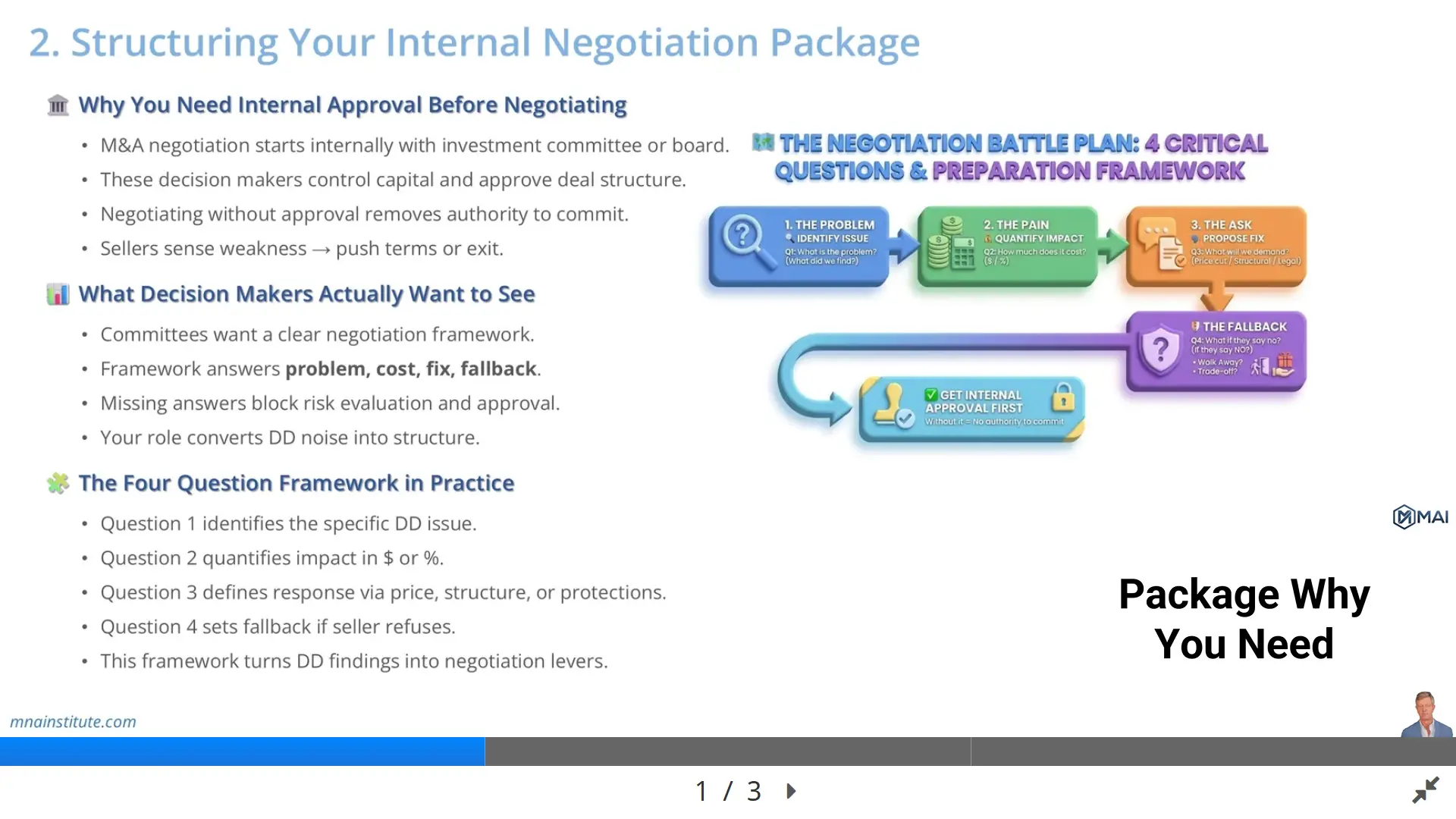
Due diligence reports often contain hundreds of observations, but observations alone do not create negotiation leverage.
A report might say that a factory has aging equipment, customer contracts have renewal risk, or the target has weak inventory controls.
Those statements may be accurate, but the seller can challenge them as normal business conditions unless the buyer shows financial impact.
A purchase price adjustment requires a bridge from discovery to value.
The bridge starts with one question.
How does this finding change the economic position that supported the original offer?
If the answer cannot be expressed through revenue, cost, assets, liabilities, working capital, debt, tax, or cash flow, the buyer will struggle to defend a price demand.
A vague operational issue may still matter, but it will not automatically justify a purchase price adjustment.
For example, a buyer may discover that a target has delayed maintenance on a production line.
The finding becomes negotiable only after the buyer estimates the cost to replace parts, the downtime required, and the margin loss during the repair period.
At that point, the issue changes from a complaint into a financial exposure.
This is the first lesson in how to use due diligence findings in negotiation.
Negotiation power comes from quantified impact, not from the existence of a diligence finding.

Section 2. Three Financial Statements That Reveal Impact
Every serious finding should be translated into at least one of the three financial statements.
This discipline prevents the negotiation from becoming subjective.
It also helps the buyer explain why a purchase price adjustment is the right response instead of a softer contractual protection.
Income statement impact
The income statement shows how the finding changes revenue, gross margin, operating expense, EBITDA, or recurring earnings.
A lost customer reduces sales and may reduce EBITDA if the customer contributed margin above fixed cost.
A pricing pressure issue reduces revenue per unit even if volume remains stable.
A new compliance cost increases recurring operating expense and lowers maintainable earnings.
If the value of the target was built on an EBITDA multiple, an income statement issue can create direct valuation pressure.
A buyer that proves a $5 million recurring EBITDA reduction in a business valued at 10 times EBITDA has a much stronger argument than a buyer that only says the customer base looks risky.
Balance sheet impact
The balance sheet shows how the finding changes assets, liabilities, debt-like items, or equity value.
Obsolete inventory may require a write-down that reduces asset value.
Unrecorded tax liabilities may become debt-like adjustments.
Understated payables may reduce working capital at closing.
These issues often sit close to purchase price adjustment mechanics because many private M&A transactions use cash, debt, and working capital definitions to move from enterprise value to equity value.
Completion accounts and locked box mechanisms also depend heavily on how balance sheet items are defined, measured, and protected in the sale agreement.
Cash flow impact
The cash flow statement shows when the problem consumes actual cash.
Warranty obligations may not hit immediately, but they can create cash outflows over several years.
A customer churn issue may appear first as lower billings and later as reduced operating cash flow.
A one-time systems remediation cost may not change long-term EBITDA, but it still affects near-term cash available to fund the business.
The timing of cash flow matters because the buyer may not always seek an immediate purchase price adjustment.
A delayed or uncertain cash outflow may be better handled through escrow, indemnity, or a specific covenant.
Section 3. Why This Translation Step Separates Professionals from Amateurs
Investment committees rarely approve negotiation demands based on broad dissatisfaction.
They want quantified exposure, probability, timing, and a recommended negotiating position.
A professional team can explain the financial line item affected, the evidence source, the calculation method, and the deal lever that should address the issue.
That level of analysis also changes how the seller receives the argument.
A seller may reject a buyer who says the business is riskier than expected.
The same seller may engage seriously when the buyer presents a data room document, connects it to seller forecasts, and calculates the precise economic impact.
This is why a due diligence negotiation strategy should not begin with the buyer’s preferred concession.
It should begin with the seller’s own data.
The buyer’s work is to turn that data into a financial statement effect and then into a rational negotiation demand.
This process also reduces the risk of appearing opportunistic.
A buyer that can show the same methodology across every issue looks disciplined.
A buyer that asks for a purchase price adjustment on every problem looks like it is simply trying to reduce the deal value after exclusivity.

Section 4. Four Categories That Determine Your Negotiation Approach
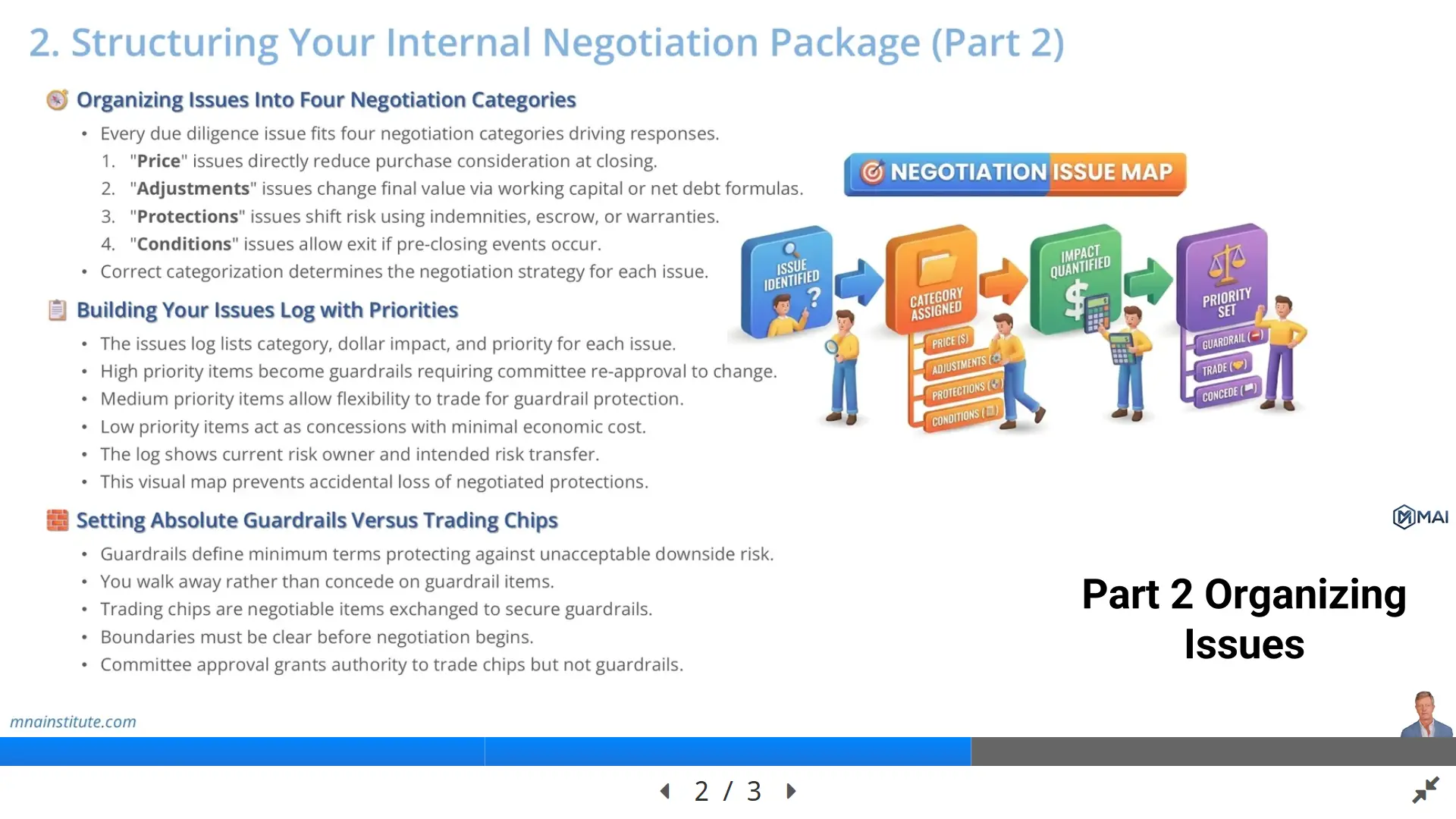
Once each finding has been quantified, the buyer needs to classify it into the correct negotiation category.
This classification determines whether the demand should be a purchase price adjustment, a closing formula, a legal protection, or a closing condition.
Treating all risks as price issues is usually a mistake.
Some issues reduce value permanently and should affect price.
Some issues fluctuate before closing and need an adjustment mechanism.
Some issues are uncertain and need seller-backed protection.
Some issues can change the entire deal rationale and need a termination right.
Negotiation category map
|
Category |
Problem type |
Typical response |
Example |
|
Price issue |
Certain and permanent value loss |
Purchase price adjustment |
Obsolete inventory that must be written down |
|
Adjustment issue |
Balance sheet amount that changes before closing |
Working capital or net debt true-up |
Receivables, payables, cash, debt, or normalized working capital |
|
Protection issue |
Large but uncertain future loss |
Indemnity, warranty, escrow, or holdback |
Litigation, tax exposure, warranty claims, or environmental claims |
|
Condition issue |
Risk that may destroy the deal rationale |
Condition precedent or walk-away right |
Regulatory approval, customer consent, financing failure, or material deterioration |
This category map turns post due diligence negotiation into a structured decision process.
It prevents the buyer from asking for a purchase price adjustment when a narrower protection would be more defensible.
It also prevents the buyer from accepting an indemnity when a known value reduction should reduce price immediately.
Section 5. Matching Category to Problem Characteristics
The category should follow the characteristics of the problem, not the buyer’s emotional reaction to the finding.
A large and certain loss belongs in price because both parties can identify the value reduction at signing.
A large but uncertain loss belongs in protection because the final outcome is not yet known.
A fluctuating balance sheet item belongs in an adjustment mechanism because the final amount depends on the closing date.
A deal-breaker belongs in conditions because the buyer should not be forced to close if the investment rationale fails.
Example of a price issue
Assume a target holds $30 million of inventory and diligence shows that $8 million is obsolete.
If the buyer confirms that the inventory cannot be sold through normal channels, the value reduction is not merely possible.
It has already happened economically, even if the accounting write-down has not yet been recorded.
That finding can support a purchase price adjustment because the asset value used to justify the deal was overstated.
Example of an adjustment issue
Assume the target’s working capital normally runs near $20 million, but closing may occur after a seasonal inventory build.
The correct response is not necessarily a permanent price reduction.
A working capital target and completion accounts process may be enough to ensure the buyer receives the normalized operating capital expected at closing.
This is why purchase price adjustment mechanics must be written with clear definitions of cash, debt, working capital, and the accounting policies used to calculate them.
Example of a protection issue
Assume the target has a tax dispute that could cost zero if the authority accepts the seller’s position or $12 million if the authority rejects it.
An immediate $12 million purchase price adjustment may be difficult to justify because the outcome is uncertain.
A specific tax indemnity, supported by an escrow or holdback, may match the risk more precisely.
The seller keeps the headline price if the claim never materializes, while the buyer has protection if the liability becomes real.
Example of a condition issue
Assume one customer represents 35 percent of revenue and that customer must consent to assignment of its contract before closing.
If consent fails, the deal thesis may no longer hold.
The buyer may need a condition precedent rather than a price adjustment because the issue is not only economic.
It may decide whether the buyer wants to close at all.

Section 6. Creating Your Negotiation Issue Map
A negotiation issue map is the practical tool that organizes the buyer’s position before the negotiation meeting.
It consolidates all due diligence findings into one document showing issue, evidence, quantified impact, category, and proposed demand.
The map forces the team to decide what it wants before the seller controls the discussion.
It also helps the buyer avoid inconsistent arguments across finance, legal, tax, commercial, operational, and HR workstreams.
A useful issue map should include the following fields.
- Issue name.
- Source document or interview evidence.
- Financial statement line affected.
- Estimated dollar impact.
- Probability and timing of loss.
- Negotiation category.
- Proposed solution.
- Priority level.
- Fallback position.
- Owner inside the buyer team.
This format is especially useful when the buyer must explain how to use due diligence findings in negotiation to an internal investment committee.
It shows that the buyer is not randomly collecting concessions.
It also gives the deal team a shared language for discussing whether a purchase price adjustment is more appropriate than an indemnity or closing condition.

Section 7. Prioritizing Must-Have, Tradeable, and Nice-to-Have Issues
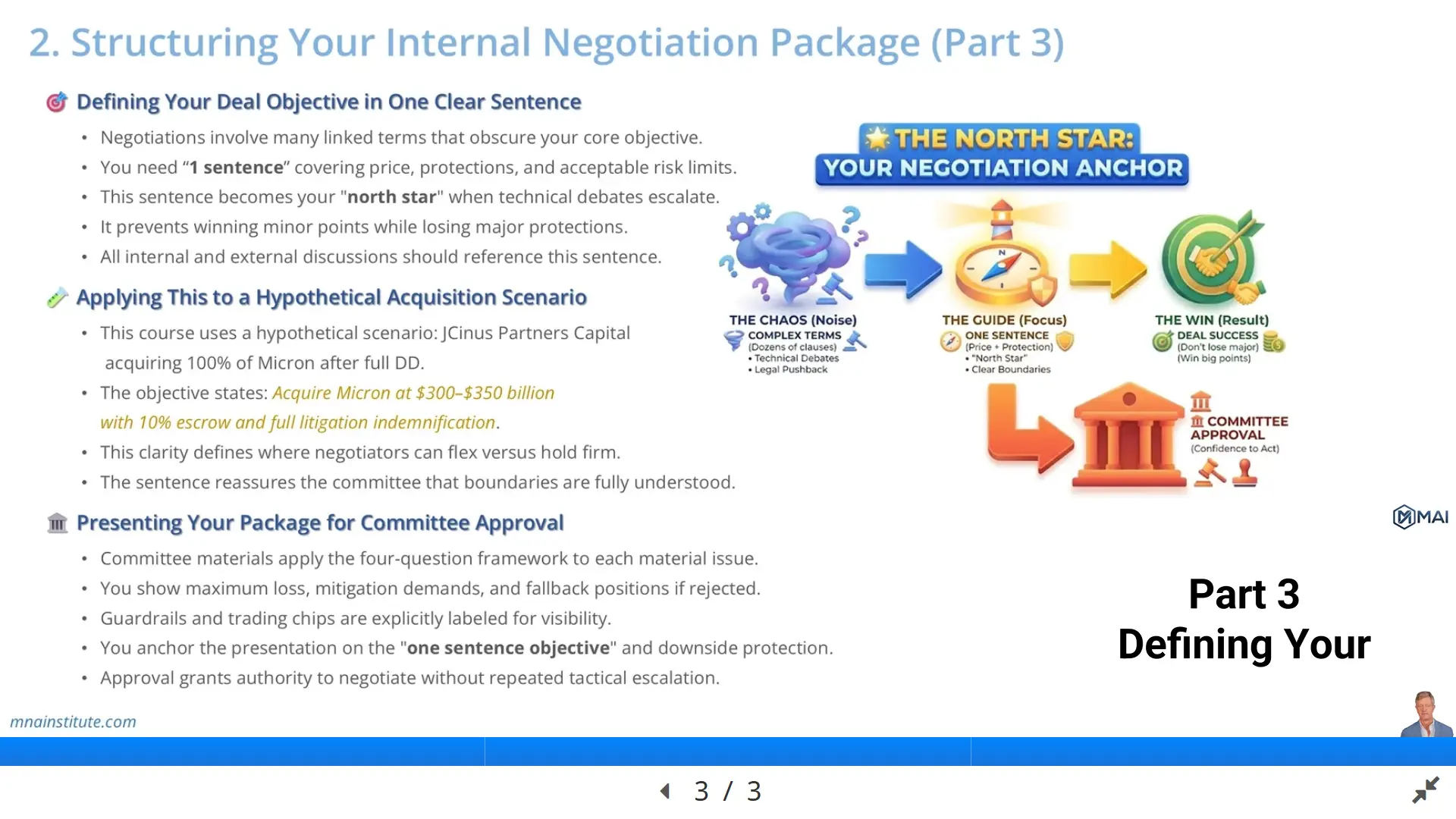
The issue map should also designate priority levels because not every issue deserves the same negotiating effort.
A buyer that treats every item as non-negotiable usually loses credibility.
The seller needs to see where the buyer is protecting the core deal logic and where the buyer has room to trade.
Must-have items
Must-have items are demands the buyer cannot drop without returning to the investment committee or materially changing the risk profile.
A confirmed $20 million inventory overstatement may be a must-have purchase price adjustment.
A required regulatory approval may be a must-have closing condition.
A known tax exposure may be a must-have indemnity if the buyer refuses to inherit that liability.
Tradeable items
Tradeable items matter, but the buyer can adjust the form or amount if it secures stronger protection elsewhere.
For example, the buyer may accept a smaller escrow if the seller agrees to a broader specific indemnity.
The buyer may accept a narrower working capital definition if the target working capital amount is set conservatively.
This is where due diligence negotiation strategy becomes a portfolio exercise rather than a list of separate demands.
Nice-to-have items
Nice-to-have items are concessions the buyer can give away to create movement without sacrificing the core protections.
They may include minor reporting covenants, extra closing deliverables, or softer commercial commitments.
These items help the seller claim a win while the buyer preserves its must-have protections.
Strong negotiators prepare these trade points before the meeting begins.

Section 8. Avoiding the Re-trading Trap
Sellers strongly resist price changes after an initial agreement.
They may call the buyer’s demand re-trading, which means the buyer is using diligence to renegotiate value after gaining exclusivity or process leverage.
This accusation can damage trust and slow the transaction.
The buyer can reduce that risk by presenting every issue through a disciplined three-step structure.
- First, state the factual discovery using information pulled directly from the seller’s data room.
- Second, calculate the financial impact using the seller’s own statements, forecasts, and business assumptions.
- Third, propose the solution as a logical risk allocation mechanism that matches the quantified exposure.
This structure reframes the discussion from opportunistic price pressure to fair risk allocation.
It also makes the buyer’s position easier for the seller’s advisers to evaluate.
The seller may still disagree with the amount, but the discussion moves to data and methodology rather than motives.
That is the core of post due diligence negotiation.
The buyer must show that the proposed purchase price adjustment is the consequence of a quantified exposure, not a tactical attempt to reopen the deal.

Section 9. Applying the Framework to a Case
Consider a hypothetical semiconductor acquisition based on a buyer named JCinus and a target named Micron.
The buyer completes diligence and discovers that the target holds $6 billion of DRAM chip inventory.
Further analysis of product specifications and customer order patterns shows that 42 percent consists of older DDR4 technology.
Market data for similar obsolete semiconductor inventory indicates that these units sell at discounts of 35 percent to 45 percent.
The buyer uses a 40 percent midpoint discount to estimate the exposure.
The calculation is straightforward.
$6 billion multiplied by 42 percent equals $2.52 billion of affected inventory.
$2.52 billion multiplied by a 40 percent discount equals $1.008 billion of estimated value erosion.
If the course example assumes a larger markdown exposure of $2.5 billion, the key discipline is still the same.
The buyer must show the exact data source, the affected inventory pool, the pricing evidence, and the implied economic reduction.
The issue then becomes a price issue if the inventory is clearly obsolete and the value loss is already embedded in the asset base.
The buyer can ask for a purchase price adjustment because the original valuation assumed inventory value that the buyer no longer accepts.
If the seller disputes the markdown percentage but accepts the inventory concern, the issue may become partially tradeable.
The buyer might accept a lower immediate price cut if the seller agrees to a special indemnity or escrow tied to inventory realization after closing.
If the dispute concerns whether the inventory will still be saleable by closing, the issue may require both a price argument and a post-closing true-up mechanism.
This is why the best negotiation teams do not treat the four categories as isolated boxes.
They use the categories to build an integrated negotiation position.
Related Courses
The topics in this article sit at the intersection of diligence, negotiation, purchase agreement drafting, and post-closing execution.
Mergers and Acquisitions Online Course provides the broader transaction workflow from strategy and sourcing to diligence, negotiation, and integration.
M&A Due Diligence: CDD, FDD, LDD, & HRDD connects diligence findings to commercial, financial, legal, and HR risk analysis.
M&A Deal Negotiation Mastery focuses on the practical use of price, structure, protections, and closing conditions in deal negotiation.
Stock Purchase Agreement Mastery explains how representations, warranties, indemnities, covenants, and closing conditions are reflected in the definitive agreement.
Post-Merger Intergration and Value-Up Strategy shows how deal assumptions and risk protections continue into execution after closing.
Sources
ICAEW, Completion Mechanisms.
EY, Locked box vs. completion accounts.
FTI Consulting, The Strategic Use of Purchase Price Adjustments in Share Purchase Agreements.
J.P. Morgan, Evaluating risk allocation mechanisms for M&A.