5 Essentials for a Sales and Purchase Agreement
Navigating M&A Agreements: Focus on Sales and Purchase Agreement
Welcome to the MAI blog, where we embark on an in-depth exploration of Mergers and Acquisitions Agreements, delving into the intricacies of the Sales and Purchase Agreement (SPA). Join us as we unravel the essential components of key M&A agreements, navigate the preliminary stages, dissect the SPA structure, and uncover the strategic essence of SPA negotiations. Get ready for a captivating journey through the dynamic realm of mergers and acquisitions.
Introduction to Key M&A Agreements
In the world of M&A, various agreements guide parties through complex processes. Among these, three stand out for their crucial roles:
- Sales & Purchase Agreement (SPA): This binding contract, central to our discussion, outlines the conditions for selling or buying a company’s shares. It’s integral in share-based acquisitions, detailing everything from representations and warranties to pricing mechanisms, where price negotiation plays a significant role.
- Asset Purchase Agreement (APA): Focused on the acquisition of a company’s assets, this agreement allows buyers to select specific assets and liabilities, offering flexibility beyond the scope of SPAs.
- Merger Agreement: This involves the fusion of two companies into a new entity, covering aspects like share exchange ratios and operational integrations.
Understanding the sales and purchase agreement is essential in M&A. With this knowledge, professionals can navigate these agreements with greater confidence and strategic insight.

Preliminary M&A Agreements
In the realm of business transactions, the sales and purchase agreement is often seen as the cornerstone document. However, before delving into the SPA’s complexities, it’s essential to grasp the foundational agreements that set the stage for this pivotal contract.
The Chronological Progression: MOU, LOI, and SPA
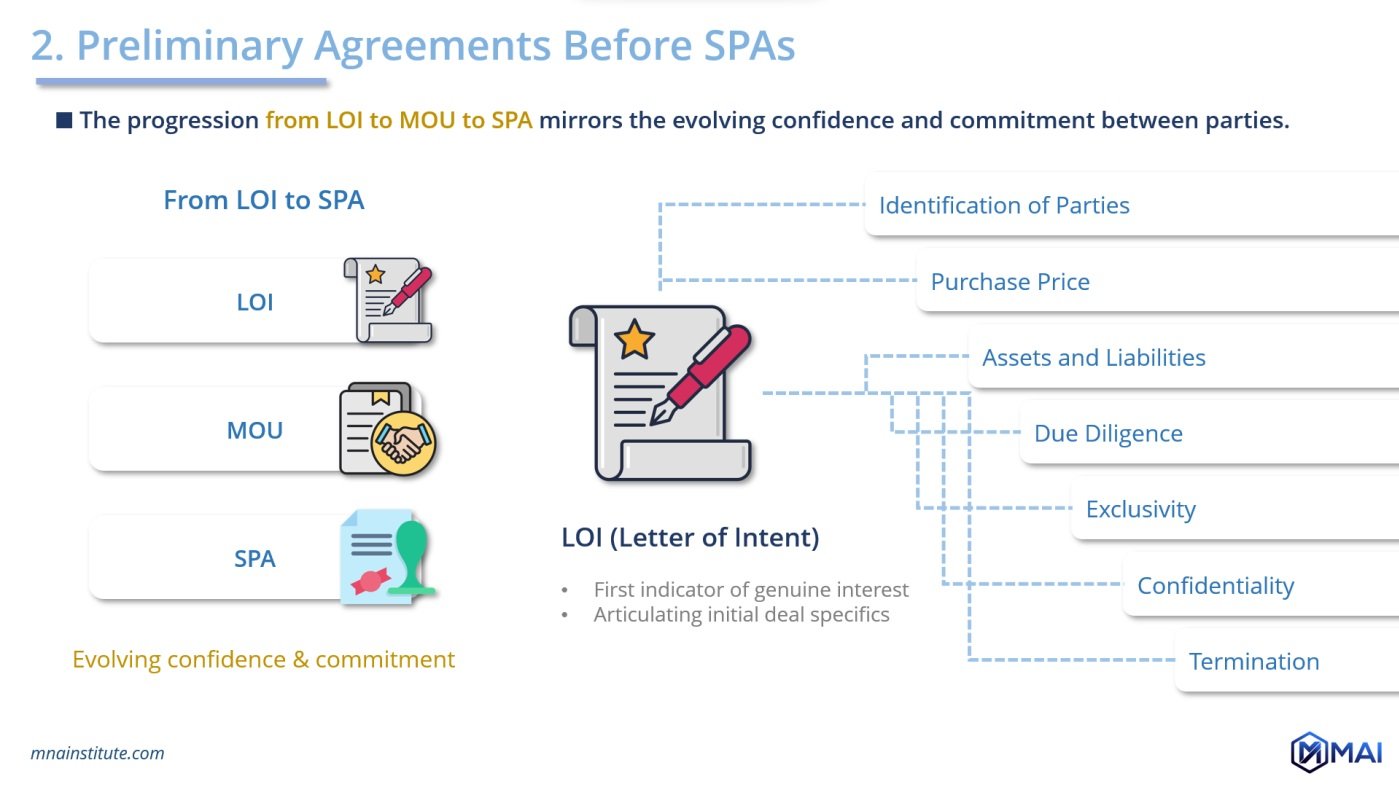
The journey toward a definitive sales and purchase agreement typically begins with the Letter of Intent (LOI), followed by the Memorandum of Understanding (MOU), and finally culminates in the M&A SPA. This sequence of documents reflects the deepening engagement and trust between the parties involved in a potential acquisition.
LOI (Letter of Intent): The Initial Signal
The LOI marks the first substantial step towards a potential sales and purchase agreement. It signals a sincere interest from both parties and lays out early terms that might eventually be fine-tuned within the M&A SPA. Key components of an LOI include:
- Identification of Parties: Clear definition of the involved entities.
- Purchase Price: A preliminary indication of the valuation, setting the groundwork for the SPA’s financial terms.
- Assets and Liabilities: Early identification of what will be included in the eventual sales and purchase agreement.
- Due Diligence: Setting expectations for the comprehensive due diligence process that precedes an SPA.
- Exclusivity: Often, the LOI grants a period during which the seller will not entertain other buyers, safeguarding the path to the SPA.
- Confidentiality: Protection of sensitive information that will be crucial in drafting the SPA.
- Termination: Conditions that might lead to withdrawing from the path to a sales and purchase agreement.
While an LOI is generally non-binding, its details reflect the parties’ commitment and serve as a prelude to the sales and purchase agreement.

MOU (Memorandum of Understanding): Solidifying Understandings
Moving beyond the LOI, the MOU begins to shape the contours of what will become the detailed sales and purchase agreement. An MOU typically includes:
- Identification of Parties: Similar to the LOI, yet moving closer to the SPA’s formal language.
- Strategic Rationale: A narrative that will resonate throughout the SPA’s terms.
- Potential Terms: A more detailed preview of the SPA’s structure.
- Preliminary Pricing: Insights into the pricing mechanism that will be crucial for the SPA.
- Anticipated Timelines: Outlining the journey towards finalizing the SPA.
- Areas for Further Exploration: Highlighting due diligence areas that will inform the SPA.
- Exclusivity and Confidentiality: Strengthened commitments as the parties move closer to an SPA.
- Termination and Renewal: Terms that may eventually be reflected in the sales and purchase agreement.
The MOU, with its detailed provisions, paves the way for the in-depth discussions that will culminate in the sales and purchase agreement.
MOU vs LOI – Nuances and Implications
The progression from LOI to MOU and ultimately to the sales and purchase agreement represents a journey from initial interest to final commitment. The LOI and MOU, while non-binding, are critical steps that define the path to the binding M&A SPA, each with its role in the dance towards a sealed deal.
SPA Structure: The Blueprint of a Sales and Purchase Agreement
The sales and purchase agreement is not just a document but the backbone of any transaction, setting forth the terms under which business changes hands. The buyer is typically at the helm of drafting the SPA components, which makes it crucial for both parties to understand its composition and the critical elements within.
Key Components of an SPA
Introduction and Definition of Scope
The SPA opens with a clear definition of the transaction’s scope, introducing the seller and buyer and, if applicable, any intermediaries. This initial segment ensures that anyone reading through the SPA components understands the nature of the transaction, laying a foundation for the detailed terms that follow.
Shares, Liabilities, and Considerations
Central to the sales and purchase agreement is the specification of shares and liabilities being transferred. A meticulous list of these, with all associated obligations, is crucial for transparency, ensuring that the buyer knows precisely what is being acquired.
Representations, Warranties, and Indemnities
These provisions are the armour of an M&A transaction, protecting the buyer from future risks and uncertainties. They include the seller’s assertions about the company’s condition and the indemnities that offer financial protection against any misrepresentations.
Shareholder Rights, Obligations, and Conditions Precedent
An SPA details the rights and obligations of both seller and buyer, alongside ‘conditions precedent’—the must-haves for the deal to proceed. This section of the SPA is about making sure all regulatory and due diligence boxes are checked before the transaction is sealed.
Detailed Analysis of SPA Stipulations
- Purchase Price and Its Nuances
- At the heart of the sales and purchase agreement is the purchase price, which might be subject to adjustments based on the business’s financial performance or asset values. Understanding these terms is vital as they directly affect the final amount paid.
- Earn-outs, Commitments, and Ensuring Stability
- The SPA governs the interim period between signing and closing, detailing the seller’s obligations to maintain the business’s operational stability. It also covers earn-outs, additional sums the seller may receive based on future business performance.
- Guidelines on Termination and Its Implications
- An SPA must outline procedures for potential termination, detailing the rights, remedies, and repercussions for both parties if the deal falls through. This section prepares both parties for the possibility that the transaction may not conclude as planned.
Special Clauses and Considerations
The flexibility of an SPA allows it to be customized with clauses like non-compete agreements or arrangements for post-acquisition support, essential for ensuring a smooth transition and protecting intellectual property rights when necessary.

The Strategic Essence of SPA Negotiations
At the heart of every merger and acquisition lies the sales and purchase agreement, a document that serves as a testament to the careful and often complex negotiations between buyer and seller.
The Allocation of Risk in SPAs
The primary purpose of SPA negotiations is to allocate potential economic risks. This is a critical process, as it determines who bears the brunt of any financial or legal surprises that might emerge after the transaction. The SPA’s clauses and stipulations become the battleground where this allocation of risk is negotiated and defined.
Balancing Interests Through Negotiation
Negotiating an SPA is a delicate balancing act. Sellers aim for a swift and clean break, minimizing post-deal obligations. Buyers, conversely, seek to build in protections against the unknown, including the right to back out if they uncover deal-breaking information. The SPA is the arena where these conflicting interests are reconciled.

The SPA: A Binding Commitment
An SPA is more than a contract; it’s a binding commitment with significant implications for breaches. The negotiations leading up to the final SPA are critical—they must be thorough and precise. The final agreement is not just a reflection of what has been agreed upon but also what will be enforced if commitments are not honoured.
Clarity: The Keystone of SPA
Clarity and mutual understanding are the foundations upon which an SPA is built. It’s essential that both parties fully comprehend the terms and the implications of their agreement, as this clarity will protect their respective interests and prevent disputes down the line.
Concluding the M&A Symphony with an SPA
In the symphony of M&A, the sales and purchase agreement is the crescendo. It’s the culmination of intense and purposeful negotiation, with every clause and every term carefully orchestrated to ensure the success and integrity of the entire transaction.