The 4-Stage Sell-Side M&A Process Explained
Imagine you are the CFO of a mid-sized industrial components company.
The founder wants to retire, the private equity sponsor is approaching the end of its fund life, and three unsolicited approaches from strategic buyers have arrived in the last eighteen months.
The Board decides it is time to sell, and your job is to manage the sell-side M&A process from start to finish.
That process looks very different depending on whether your company is publicly listed or privately held, and understanding that distinction shapes every decision from advisor selection through final closing.
A public company running the sell-side M&A process must comply with securities regulations, disclose material information to shareholders, and obtain shareholder approval before any deal can close.
For example, when Kellanova initiated its sale process in 2024, its Board was bound by fiduciary duties to shareholders, required an SEC proxy filing, and had to hold a formal shareholder vote before the transaction with Mars could proceed.
A privately held company running the sell-side M&A process faces none of those disclosure requirements and typically moves faster, with fewer parties involved and greater flexibility over process design.
Regardless of ownership structure, the sell-side M&A process fits within the broader mergers and acquisitions procedure and follows four defined stages: sale preparation, marketing and buyer outreach, due diligence management and bid evaluation, and final negotiation through closing.
Each stage of the sell-side M&A process has a direct counterpart on the buy side, and understanding both perspectives is what makes a practitioner effective at the negotiating table.
A privately held company running the sell-side M&A process faces none of those disclosure requirements and typically moves faster, with fewer parties involved and greater flexibility over process design.
Regardless of ownership structure, the sell-side M&A process fits within the broader mergers and acquisitions procedure and follows four defined stages: sale preparation, marketing and buyer outreach, due diligence management and bid evaluation, and final negotiation through closing.
Each stage of the sell-side M&A process has a direct counterpart on the buy side, and understanding both perspectives is what makes a practitioner effective at the negotiating table.
The Four Stages of the Sell-Side M&A Process
Stage 1: Sale Preparation and Advisor Selection
Management prepares an int/course/merger-and-acquisition-process-course/ernal sale rationale memorandum that explains why selling makes strategic sense now rather than later.
Common rationales include founder liquidity, private equity sponsor exit timelines, portfolio refocusing by a corporate parent, or simply taking advantage of favorable market valuations before conditions change.
The Board reviews and approves this memorandum, authorizing management to engage advisors and begin formal preparation.
Seller management then issues requests for proposals to potential investment bank advisors, evaluating them on sector expertise, recent comparable transactions, buyer relationships, and team chemistry.
Understanding how advisors position a business for sale is foundational to the full merger and acquisition process course, and it is also what connects the sell-side preparation stage to the broader mergers and acquisitions procedure that governs how both parties move from strategy to signed agreement.
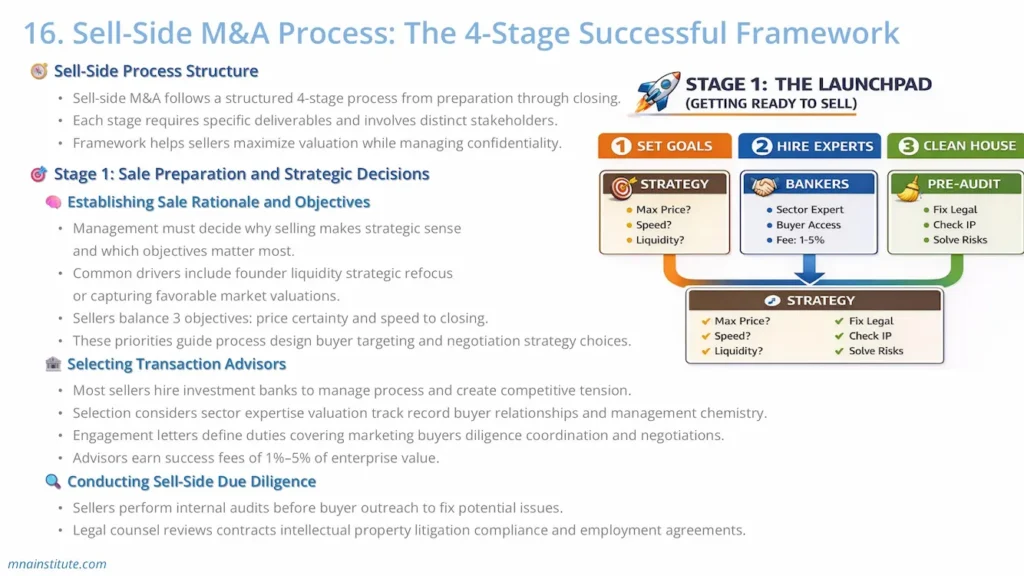
The engagement letter specifies advisor responsibilities: preparing marketing materials, identifying and contacting buyers, managing the data room, and negotiating transaction terms.
Advisor success fees on middle-market transactions typically range from 1% to 3% of enterprise value, calculated on a sliding scale that rewards larger deal sizes.
Before approaching any buyer, a disciplined sell-side M&A process requires the seller to conduct its own internal due diligence, called vendor due diligence or sell-side due diligence.
Accounting firms prepare a quality of earnings analysis normalizing EBITDA by identifying non-recurring expenses and unsustainable income items.
For example, if a company has paid above-market compensation to its founder CEO for ten years, the QoE report adds back the excess above a market replacement salary, producing a higher adjusted EBITDA that buyers will use for valuation.
Legal counsel conducts an internal audit identifying contracts needing amendment, intellectual property registrations requiring renewal, and compliance gaps needing correction before buyers arrive.
Resolving these issues proactively prevents buyers from using discovered problems as negotiating leverage.
Process design is also decided in Stage 1.
A broad auction contacts 50 to 100 potential buyers, maximizing competitive tension but creating significant confidentiality risk for the seller’s customers, employees, and suppliers.
A targeted auction approaches 15 to 30 carefully selected buyers, balancing competition with discretion.
A negotiated sale involves exclusive discussions with one buyer, prioritizing speed and transaction certainty over maximum price.
The sell-side M&A process type selected here determines the pace and intensity of every subsequent stage.

Stage 2: Marketing and Buyer Outreach
While the buy-side M&A process begins with sourcing and screening targets, Stage 2 of the sell-side M&A process reverses that dynamic: the seller creates the materials that buyers will use to evaluate the investment opportunity.
Advisors prepare a one-to-two-page teaser document providing an anonymous company overview, describing the industry sector, business model, revenue and EBITDA scale without exact figures, growth trajectory, and key investment highlights.
Teasers omit the company name, customer names, and specific locations to protect confidentiality until buyers demonstrate serious interest.
Interested buyers sign nondisclosure agreements before receiving the full Information Memorandum.
Seller NDAs include standstill provisions preventing hostile approaches and non-solicitation clauses prohibiting the buyer from recruiting target employees during the process.
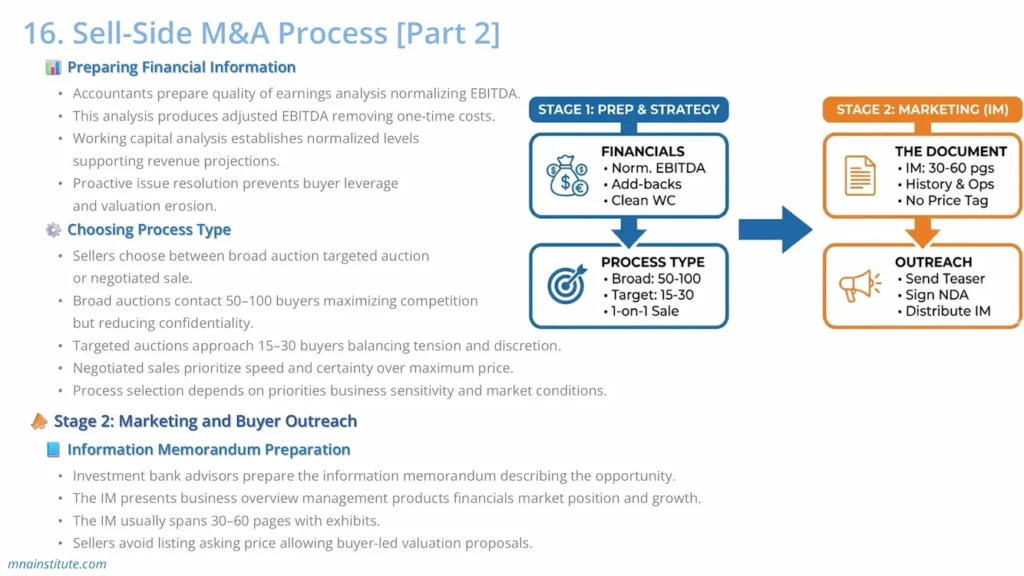
The Information Memorandum is the centerpiece marketing document of Stage 2.
A well-prepared IM spans 40 to 60 pages and covers company history and operations, management team profiles, financial performance with historical revenue and EBITDA trends, market position and competitive landscape, and strategic growth opportunities the buyer can pursue post-acquisition.
Sellers deliberately avoid specifying an asking price in the IM, allowing each buyer to propose a valuation based on their own strategic rationale and synergy assumptions.
A strategic acquirer who can eliminate the target’s entire SG&A through consolidation will rationally pay a higher price than a financial sponsor who cannot.
Leaving price open allows that difference in value creation to surface in the bids.
The sell-side M&A process in Stage 2 also includes management presentations, where seller executives meet serious buyers to expand on the IM content, answer operational questions, and build the interpersonal rapport that often influences buyer conviction.
Advisors coordinate site visits enabling buyers to assess facilities, meet key employees, and observe operations firsthand before submitting indicative bids.
A process letter issued by the advisors closes Stage 2, specifying the bid deadline, required Letter of Intent components, and timeline for the next stage of the sell-side M&A process.

Stage 3: Due Diligence Management and Bid Evaluation
Stage 3 of the buy-side M&A process is full due diligence, and its counterpart in the sell-side M&A process is managing that diligence while simultaneously evaluating competing bids.
Sellers establish virtual data rooms containing detailed financial statements, tax returns, material contracts, intellectual property documentation, employee agreements, and operational data organized by category.
Dedicated personnel respond to buyer information requests promptly and accurately, because delays or inconsistent answers erode buyer confidence and reduce final valuations.
Tracking every buyer question and every seller response in a request log is standard practice in well-run M&A due diligence processes, creating an auditable record and ensuring no information is selectively disclosed to some buyers but not others.
As buyers complete their diligence, they submit non-binding Letters of Intent proposing preliminary transaction terms.
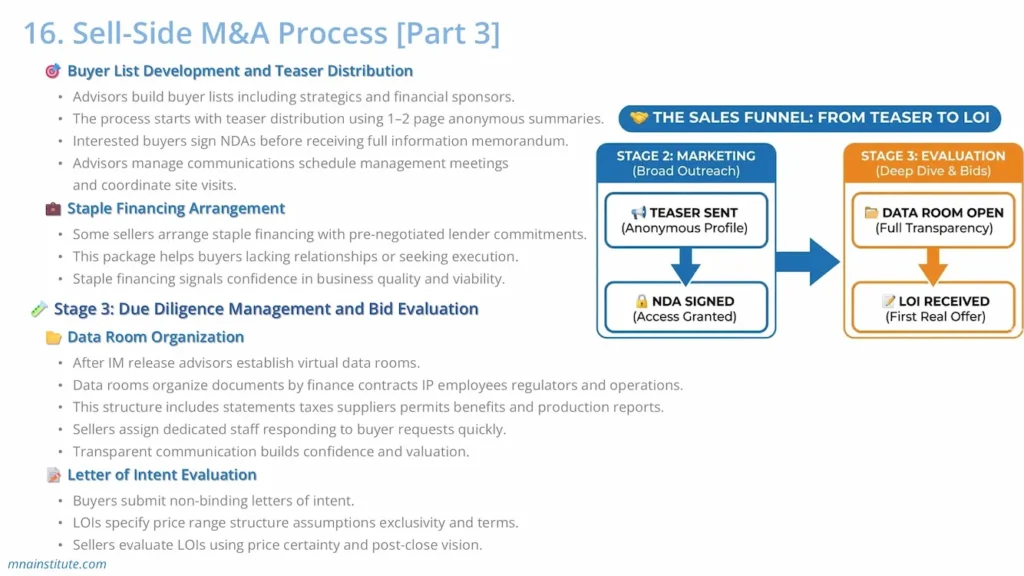
LOI provisions specify proposed purchase price or valuation range, payment structure across cash and stock components, earnout provisions if applicable, exclusivity period for final negotiations, and any financing contingencies.
Sellers evaluate these LOIs understanding that in competitive M&A transactions, headline price is only one variable.
A buyer offering 10% less than the highest bidder but with fully committed financing, no regulatory risk, and a reputation for closing quickly may represent a better outcome than the highest nominal offer subject to multiple conditions.
Understanding how buyers think about M&A transactions is precisely why sell-side advisors with buy-side execution experience command higher fees and achieve better outcomes for their clients.
Advisors prepare a bid comparison matrix covering proposed price, payment structure, earnout provisions, financing certainty, proposed timeline, and management’s assessment of each buyer’s credibility and cultural fit.
The buyer selection memorandum recommends which bidder should receive exclusivity, weighting both financial and non-financial factors.
This structured evaluation approach is what distinguishes a professionally managed sell-side M&A process from an ad hoc negotiation where sellers make decisions under competitive pressure without a framework.

Stage 4: Negotiation, Regulatory Approval, and Closing
Stage 4 of the sell-side M&A process begins when the seller grants exclusivity to the winning bidder and both legal teams begin drafting the definitive purchase agreement.
The Stock Purchase Agreement or Asset Purchase Agreement is the binding document that governs the transaction, and mastering its key provisions is what enables sellers to protect their interests through closing.
Sellers approach purchase agreement negotiations with specific objectives.
They resist broad representations and warranties, preferring narrow disclosures that limit future indemnification exposure.
They negotiate indemnification caps as low as possible, typically seeking caps at 10% to 15% of enterprise value rather than the full purchase price.
They push for short survival periods on representations, after which the buyer can no longer bring indemnification claims.
They minimize escrow holdback amounts, because every dollar held in escrow is a dollar not received at closing.
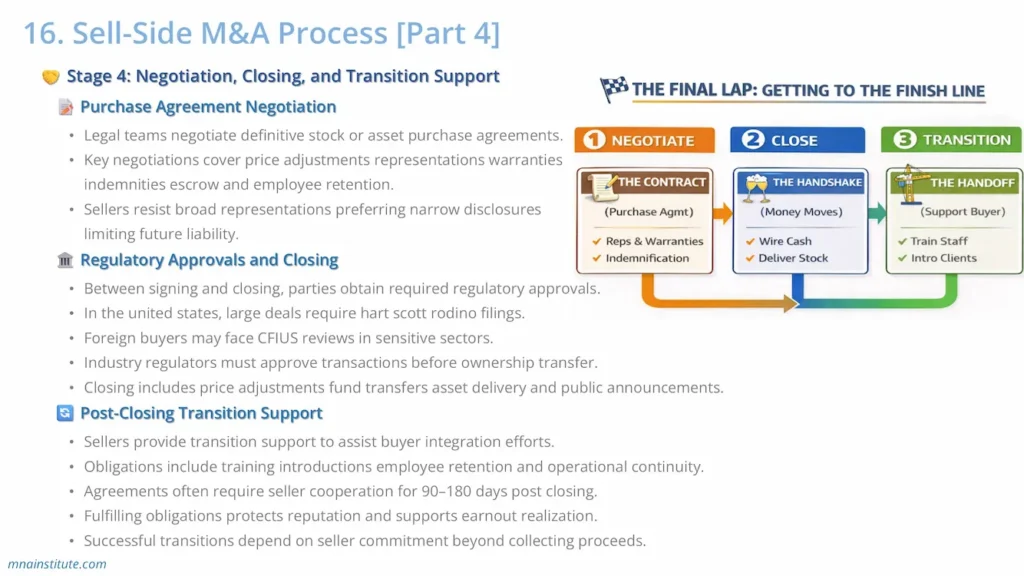
Disclosure schedules accompanying the purchase agreement are where the seller’s legal team does its most consequential work in the sell-side M&A process.
Each schedule lists exceptions to the representations made in the agreement, and thorough scheduling protects the seller from post-closing claims that a disclosed item was a breach.
Between signing and closing, parties obtain required regulatory approvals.
In the United States, transactions exceeding specified size thresholds require Hart-Scott-Rodino antitrust filings with waiting periods before closing.
Cross-border transactions involving sensitive industries may face national security reviews in multiple jurisdictions.
Sellers in publicly listed companies must also prepare SEC proxy filings and hold shareholder votes before M&A transactions involving their businesses can close.
This public company overlay adds disclosure obligations and shareholder approval steps that are absent from the mergers and acquisitions procedure for privately held sellers.
Closing in the sell-side M&A process involves final purchase price adjustments based on actual working capital at close, funds transfer to the seller, delivery of stock certificates or asset deeds, and coordinated public announcement.
Post-closing, sellers typically provide transition support for 90 to 180 days, including knowledge transfer, customer and supplier relationship introductions, and operational continuity assistance during system migrations.
Fulfilling post-closing obligations is part of the sell-side M&A process that sellers sometimes underestimate, but failure to cooperate can trigger indemnification claims or delay earnout payments.

Key Documents in the Sell-Side M&A Process
Every stage of the sell-side M&A process produces specific documents that serve defined purposes.
The table below maps each document to its stage, purpose, and the corresponding buy-side equivalent.
| Document | Stage | Sell-Side Purpose | Buy-Side Counterpart |
|---|---|---|---|
| Sale Rationale Memorandum | 1 | Secures Board approval to engage advisors and begin process | M&A Strategy Memorandum |
| Vendor Due Diligence Report | Normalizes EBITDA and resolves issues before buyer discovery | Financial DD Report | |
| Legal Clean-Up Memo | Catalogs and resolves contractual and compliance issues pre-marketing | Legal DD Report | |
| Teaser Document | 2 | Generates buyer interest without revealing seller identity | Target Pipeline Tracker |
| Nondisclosure Agreement | Enables confidential disclosure; includes standstill and non-solicitation | NDA | |
| Information Memorandum | Presents investment opportunity to generate binding bids | Desktop DD Summary | |
| Process Letter | Sets bid deadline and instructions ensuring comparable submissions | N/A – buy-side receives this | |
| Data Room | Provides detailed diligence materials to qualified buyers | Virtual Data Room Access | |
| Bid Comparison Matrix | 3 | Structures evaluation of competing LOIs across price and non-price factors | Investment Committee Memo |
| Buyer Selection Memo | Recommends exclusivity grant with supporting rationale | IC Approval to Submit Bid | |
| Stock or Asset Purchase Agreement | 4 | Binding document governing transaction terms and seller protections | Purchase Agreement |
| Disclosure Schedules | Lists exceptions to representations, limiting indemnification exposure | Disclosure Schedules |
Sellers who treat document preparation as a formality rather than a strategic exercise consistently leave value on the table.
A poorly prepared Information Memorandum forces buyers to fill information gaps with conservative assumptions, which compress their bids.
An incomplete disclosure schedule creates post-closing liability that offsets the proceeds received at signing.

Common Mistakes in the Sell-Side M&A Process
Sellers who have not previously run a formal sale process make predictable mistakes that reduce valuation, extend timelines, or compromise confidentiality.
Skipping vendor due diligence
Sellers who enter the sell-side M&A process without conducting their own financial and legal review consistently experience the same outcome: buyers discover issues during diligence, use them as negotiating leverage, and extract price reductions that exceed the cost of the vendor DD they avoided.
A proactive quality of earnings analysis resolves normalization disputes before they arise and builds buyer confidence in the financial data.
Selecting advisors on fee alone
Advisor selection based primarily on lowest success fee is one of the most value-destructive decisions sellers make.
An advisor who achieves a 10% higher valuation from a broader buyer universe more than offsets a fee differential of 0.5% of enterprise value.
The criteria that matter are sector deal flow, buyer relationships, and execution track record.
Running a broad auction for a business with high confidentiality sensitivity
Not every business should be sold through a broad auction contacting 80 potential buyers.
A technology company whose competitive advantage depends on undisclosed proprietary methods, or a business where customer relationships are personal to the founder, faces serious operational damage if a broad auction leaks.
Targeted auctions and negotiated sales exist precisely for these situations.
Allowing management distraction to compound throughout the process
A sell-side process typically runs six to twelve months, and management attention consumed by buyer meetings, data room responses, and advisor coordination is attention diverted from running the business.
Companies that experience revenue or margin deterioration during the sale process give buyers grounds to reduce their offers or invoke material adverse change provisions.
Sellers who designate a dedicated transaction team while protecting the broader management team from process demands consistently deliver stronger financial performance through closing.
This discipline distinguishes a well-run sell-side M&A process from one that follows the mergers and acquisitions procedure in structure but fails to protect the underlying business being sold.
Negotiating representations and warranties without specialist legal counsel
The indemnification provisions and stock purchase agreement terms that sellers accept in the first draft of the purchase agreement often remain close to what closes, because buyers resist reopening settled points.
Sellers who engage legal counsel experienced in M&A transaction negotiation, rather than generalists, consistently achieve narrower indemnification exposure and shorter survival periods.
Underestimating regulatory timelines on cross-border or concentrated-market transactions
A domestic transaction between companies with minimal market overlap may close within 60 to 90 days of signing.
A cross-border sell-side M&A process requiring approvals from 15 or more jurisdictions, or a transaction where the combined entity holds significant market share, can take 12 to 18 months from signing to closing.
Sellers who do not build regulatory risk into the purchase agreement, including appropriate termination provisions and reverse breakup fees, have limited remedies if a buyer walks away citing regulatory failure.

The Sell-Side M&A Process in Action: Kellanova’s Sale to Mars
The 2024 sale of Kellanova to Mars, Incorporated demonstrates the sell-side M&A process from the perspective of a publicly listed company running a targeted, advisor-managed sale.
Kellanova, formed from the 2023 split of Kellogg Company, owned brands including Pringles, Cheez-It, Pop-Tarts, Rice Krispies Treats, and RXBAR.
Mars approached Kellanova unsolicited in May 2024, and Kellanova’s Board engaged Goldman Sachs and Lazard as financial advisors to evaluate the approach and manage any subsequent process.
Kellanova’s Board did not run a broad auction.
Instead, it ran a targeted evaluation of competing indications of interest from three additional parties, identified in SEC regulatory filings as Party A, Party B, and Party C, before concluding that none could realistically match Mars’s proposal given their respective regulatory constraints and financial capacity.
This decision reflects a fundamental principle of the mergers and acquisitions procedure: competitive tension does not always require a large number of bidders, only a credible threat that alternatives exist.
Mars negotiated through multiple rounds, raising its offer from 77 dollars per share in May 2024 to a final 83.50 dollars per share in August 2024.
The final price represented a 44% premium to Kellanova’s unaffected 30-day volume-weighted average price and an acquisition multiple of 16.4 times last twelve months adjusted EBITDA.
Kellanova’s advisors determined this was the maximum price Mars was prepared to offer and recommended the Board accept.
The total transaction consideration reached approximately 35.9 billion dollars, inclusive of assumed net leverage.
From a sell-side perspective, what the buy-side M&A process describes as financial, operational, commercial, and legal due diligence workstreams, Kellanova managed as data room access across facilities in Michigan, Tennessee, Poland, and the United Kingdom.
Because Kellanova was publicly listed, its sell-side process also required SEC proxy statement preparation, a formal shareholder vote held on November 1, 2024, and disclosure filings throughout the process.
Regulatory clearance required approvals from 28 separate jurisdictions.
The US Federal Trade Commission cleared the transaction in June 2025 without conditions.
The European Commission completed its review in December 2025 and granted unconditional approval.
The transaction closed on December 11, 2025, approximately 16 months after the definitive agreement was signed, illustrating how the regulatory stage of the sell-side M&A process can extend timelines even after all commercial and legal terms are resolved.
Build the Skills to Execute the Sell-Side M&A Process
Running a sell-side M&A process is not a skill acquired by reading frameworks.
The judgment calls that determine whether a seller achieves a premium valuation or leaves money on the table come from understanding how buyers think, how advisors position businesses, and how purchase agreements actually work.
- The Merger and Acquisition Process Course covers both buy-side and sell-side mechanics end to end, giving practitioners the full picture of how transactions are structured, negotiated, and closed from both sides of the table.
- The M&A Deal Negotiation Mastery course teaches the negotiation frameworks that advisors and management teams use in live M&A transactions, including how to manage competitive tension in a sell-side auction, how to counter buyer price chip attempts during diligence, and how to negotiate indemnification caps and escrow terms that protect seller proceeds.
- The Stock Purchase Agreement Mastery course takes practitioners inside the definitive agreement clause by clause, covering representations and warranties, indemnification structures, disclosure schedule strategy, and working capital adjustment mechanisms.
For practitioners who want to understand the full lifecycle, the additional courses below cover every workstream that intersects with the sell-side M&A process:
- M&A Strategy and Board-Ready Report – how sellers frame strategic rationale for Board approval
- M&A Deal Sourcing and Pipeline Management – understanding how buyers source deals, which sharpens sell-side positioning
- Desktop Due Diligence and Quick Valuation – how buyers screen sellers before signing NDAs
- M&A Due Diligence: CDD, FDD, LDD, and HRDD – what buyers examine in the data room and how sellers should prepare for it
- Acquisition Financing and LBO Modelling – how financial sponsors finance acquisitions, relevant for sellers negotiating with private equity buyers
- Post-Merger Integration and Value-Up Strategy – understanding the integration obligations sellers accept post-closing
Explore the full course library at mnainstitute.com.
Sources
- Mars, Incorporated. (August 14, 2024). Mars to acquire the Kellanova family of snack food brands,
- Mars, Incorporated. (December 11, 2025). Mars completes acquisition of Kellanova.
- Trading Calendar. (December 9, 2025). Mars receives final regulatory approval for Kellanova acquisition.