Carve Out Due Diligence Checklist: Test the Deal Structure
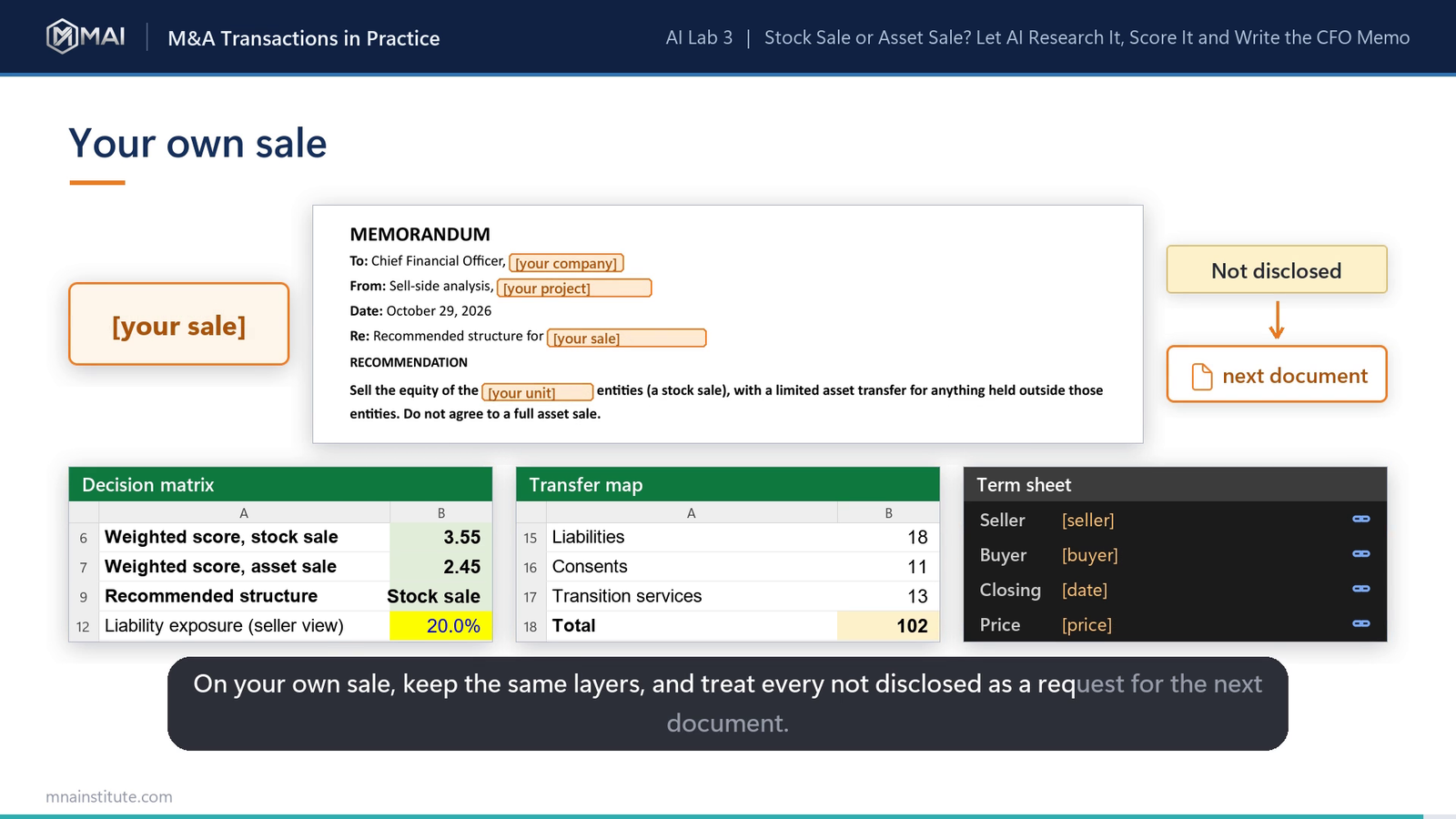
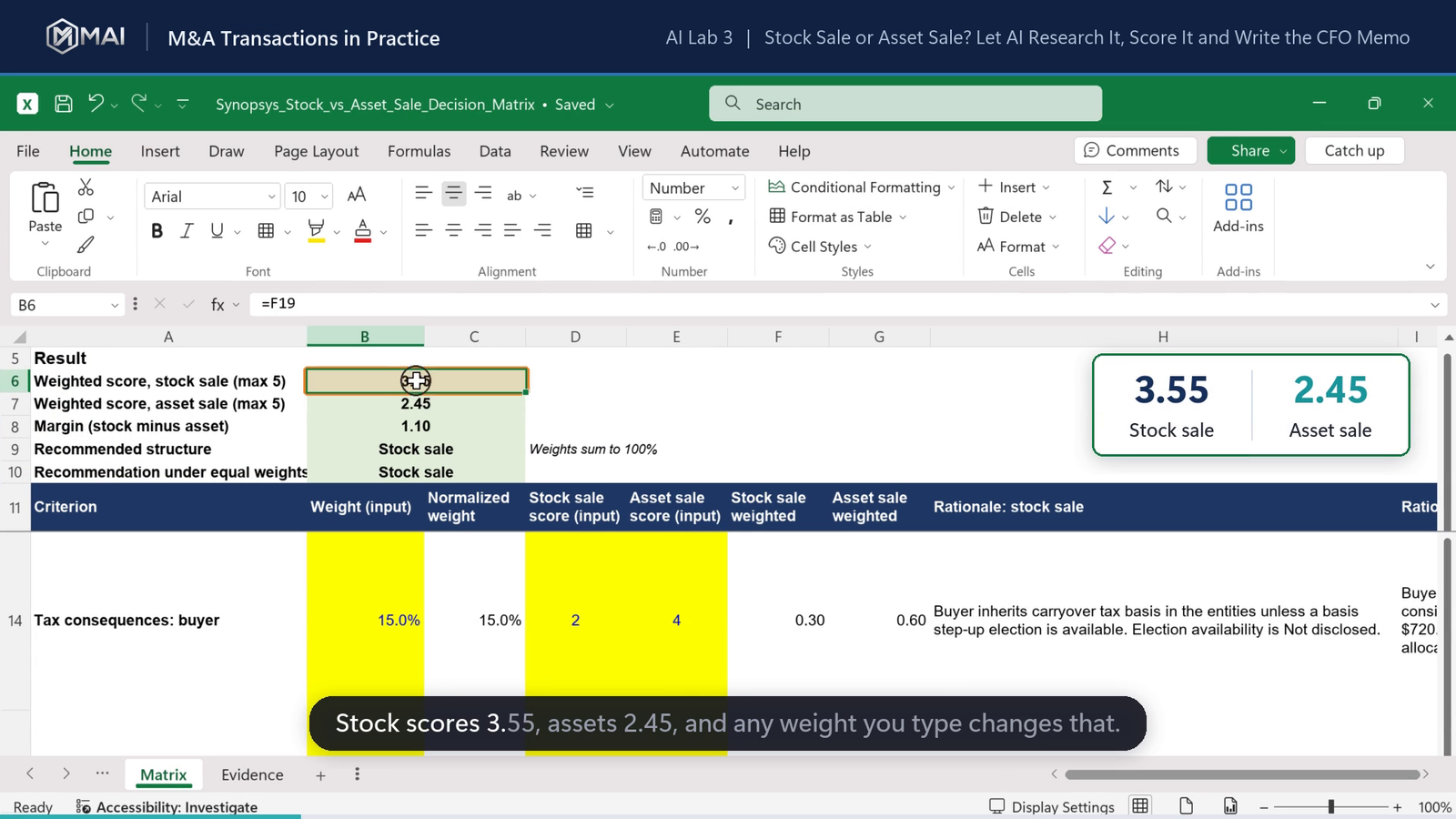
A carve out due diligence checklist should give a deal team enough evidence to compare structures and tell the CFO what still needs to be confirmed. In this historical Synopsys Software Integrity exercise, AI scored the stock sale 3.55 out of 5 and the asset sale 2.45. A separate search for the executed agreement left all 102 “Not disclosed” cells in the transfer workbook untouched.
Those figures answer different questions. The matrix shows which option leads under the selected scores and weights. The transfer workbook shows which details the carve out due diligence checklist could establish from its source set. Keep both open when you prepare the recommendation.
1. Set the scope of the carve out due diligence checklist
This checklist covers the decision about deal structure. Start the carve out due diligence checklist with the transaction identity, dated evidence and an item-level transfer map. The first part of the case shows how to prepare those two files. The May 2024 filing names Sapphire Software Buyer, Inc. and an Equity Purchase Agreement dated May 5. Synopsys reported that the sale closed on September 30, 2024. The agreement title and completion date are useful evidence, while the schedules are needed to settle which items moved and which obligations stayed behind.
Create one row per criterion in the carve out due diligence checklist. Include the source document and section, the fact it supports, the score you assigned to each option, and the question still open. A disclosed figure, an analyst judgment and an unresolved question belong in separate fields.
Watch the Excel matrix, CFO memo and agreement search
2. Apply the carve out due diligence checklist to both options
The recorded workbook uses seven criteria and adjustable weights. Every score is a judgment. Read the source and rationale before accepting a high score, especially where the source supports only a general observation. Use this carve out due diligence checklist to turn each judgment into a document request.
| Criterion | Evidence to request or verify | Case scores, stock / asset |
|---|---|---|
| Liability exposure | Compare assumed and retained liability definitions, exclusions, indemnities and their schedules. | 4 / 2 |
| Seller tax | Identify the seller’s basis and the tax treatment of consideration. Keep the reported provision separate from a transaction tax calculation. | 3 / 3 |
| Buyer tax | Ask which basis, allocation and elections the buyer assumes. Test any proposed step-up with advisers and the deal facts. | 2 / 4 |
| Third-party consents | List named contracts and check assignment and change-of-control clauses for each structure. | 4 / 2 |
| Employee transfer | Identify employing entities, affected employees, benefits and any required transfer or consultation steps. | 4 / 2 |
| Speed to close | Compare the approvals and separation work each option would require. The actual elapsed time describes the executed deal only. | 4 / 2 |
| Separation complexity | Map shared services, IP, systems, stranded costs, transition services and the agreed timetable. | 4 / 2 |
Use the carve out due diligence checklist to compare each option against the same evidence. For a contract that could constrain closing, log the counterparty and clause, then mark the action as required, not required, or unresolved. Assign an owner and date for open items. The scored row can then point to an operational decision instead of leaving the reviewer with a number and no way to check it.
2.1 Check what drives the weighted result
In the Matrix sheet, the default weights sum to 100%. Column C normalises each input in column B, then the formulas multiply by the option scores in D and E. B6 and B7 pull the totals from F19 and G19. Open one line and recompute it. The buyer-tax row contributes 0.30 to stock and 0.60 to assets at its 15% default weight.
Test a second set of weights in a copy of the carve out due diligence checklist and write down why you changed them. Increasing the weight on buyer tax can change the ranking. Giving both options 3 for seller tax leaves that row neutral in the model because the available documents do not establish the seller’s tax basis. Reopen the row when you obtain it. For the general scoring method, see the weighted decision matrix exercise.
Consider a reviewer who raises buyer tax to 40% and scales the other weights proportionally. Keeping every score unchanged gives the stock option about 3.09 and the asset option about 2.91. The margin narrows from 1.10 to about 0.19 points. This is a separate sensitivity calculation using the recorded inputs, not another result claimed from the video. Write down what evidence could justify the new weight before sharing it.
A second sensitivity in the carve out due diligence checklist makes the boundary easier to see. At 50% buyer-tax weight, holding the other scores fixed and again scaling their weights proportionally, the stock option scores about 2.91 and the asset option about 3.09. The two illustrations put a tie between 40% and 50% under those assumptions. In the actual deal, further evidence might also change one or both scores. Keep the effect of changing weights separate from the effect of changing the underlying facts.
Review the workbook for ties and invalid inputs. A weight of zero removes a criterion from the comparison, even when the underlying issue is still material to closing. Reject an all-zero case as an input error. Keep all scores on the same scale and ask the deal team to agree which direction means better. Show the original and revised values beside each other so another reviewer can reproduce the result.
2.2 Track gaps in the carve out due diligence checklist
Assign an owner and a document to material unknowns in the carve out due diligence checklist. The Q3 filing reports $331.3 million of held-for-sale liabilities at July 31, 2024, in rounded terms. That is a carrying amount. In the carve out due diligence checklist, use the executed agreement and schedules to verify which liabilities were assumed, retained or indemnified. Treat the same distinction as a rule for every other row in the checklist.
2.3 Trace liabilities and contracts to their documents
Start the liability part of the carve out due diligence checklist with the buyer and seller’s proposed definitions. Compare the liabilities and exclusions section with schedules for litigation, deferred revenue and customer commitments. Record whether each source is an accounting note, an agreement clause, a schedule or a management statement. Those documents support different conclusions. For example, accounting amounts can confirm a population exists while an assumed-liabilities clause governs whether an obligation moves under the deal.
Next take a named contract and read the assignment and change-of-control provisions side by side. An entity sale and an assignment of the contract can raise different questions. The customer relationship may also depend on a shared contract that the seller needs after closing. Enter the counterparty, the clause, the triggered event and the person who will secure the consent. If a document is missing, label the conclusion open and keep the request specific.
2.4 Separate tax assumptions from operating continuity
For tax, create separate buyer and seller lines in the carve out due diligence checklist. Write the basis assumption, the evidence for it and the person who can confirm it. If an election is proposed, record the eligibility question, who would make it and the economics the parties still need to agree. The filing’s tax provision can be useful context for the historical case. A separate comparison would require the relevant basis, jurisdictions, actual allocations and the tax treatment of each structure.
For employees, identify the employing entities and reconcile the list to the operating perimeter. Ask which people and benefits are in scope, whether any employment steps are required and what must happen before Day 1. An open workforce issue can affect both a consent timetable and the ability of the business to operate. Keep the effect visible across those rows, and make clear when more than one row refers to the same open issue.
2.5 Test the Day 1 and closing timetable
Walk through a Day 1 transaction with the carve out due diligence checklist beside the proposed services schedule. For example, ask how an employee would access payroll and how a customer would raise a support ticket. Record who owns each dependency, which service would bridge it and how long the bridge is needed. For a shared software licence, identify the scope of permitted use and the replacement plan, then assign the decision to the right owner.
Build the timing comparison from concrete dependencies. A fast close on paper may rely on approvals, system access or people moves that have yet to be agreed. Separate steps that are legal closing conditions from those the team needs for Day 1 operations. Give each a due date and evidence status, and flag delays that would change the recommended structure. The historical signing-to-closing interval describes what happened in one case; use your own dependencies when modelling another.
For each open line in the carve out due diligence checklist, write down what would resolve it. A legal entity schedule can clarify perimeter, a signed consent can clear a closing requirement, and a draft transition services schedule can show what still needs negotiation. Keep the source status and review date next to each entry so the team can tell an agreed obligation from a request.
3. Write a one-page CFO memo with three conditions
The recorded memo proposes an equity sale with a limited transfer of assets outside the entities. It gives the scores and states three negotiation conditions. Read these as proposals in the exercise. The accounting provision does not establish the seller’s tax cost under each option, and a possible buyer step-up depends on structure, eligibility and allocation.
- Liability allocation. Schedule retained matters and define the scope, cap and duration of any indemnity.
- Tax election. If an eligible election adds incremental seller tax, agree who bears it before committing.
- Consents and separation. Identify the actual consents and agree arrangements for misplaced assets, shared contracts and time-limited transition services.
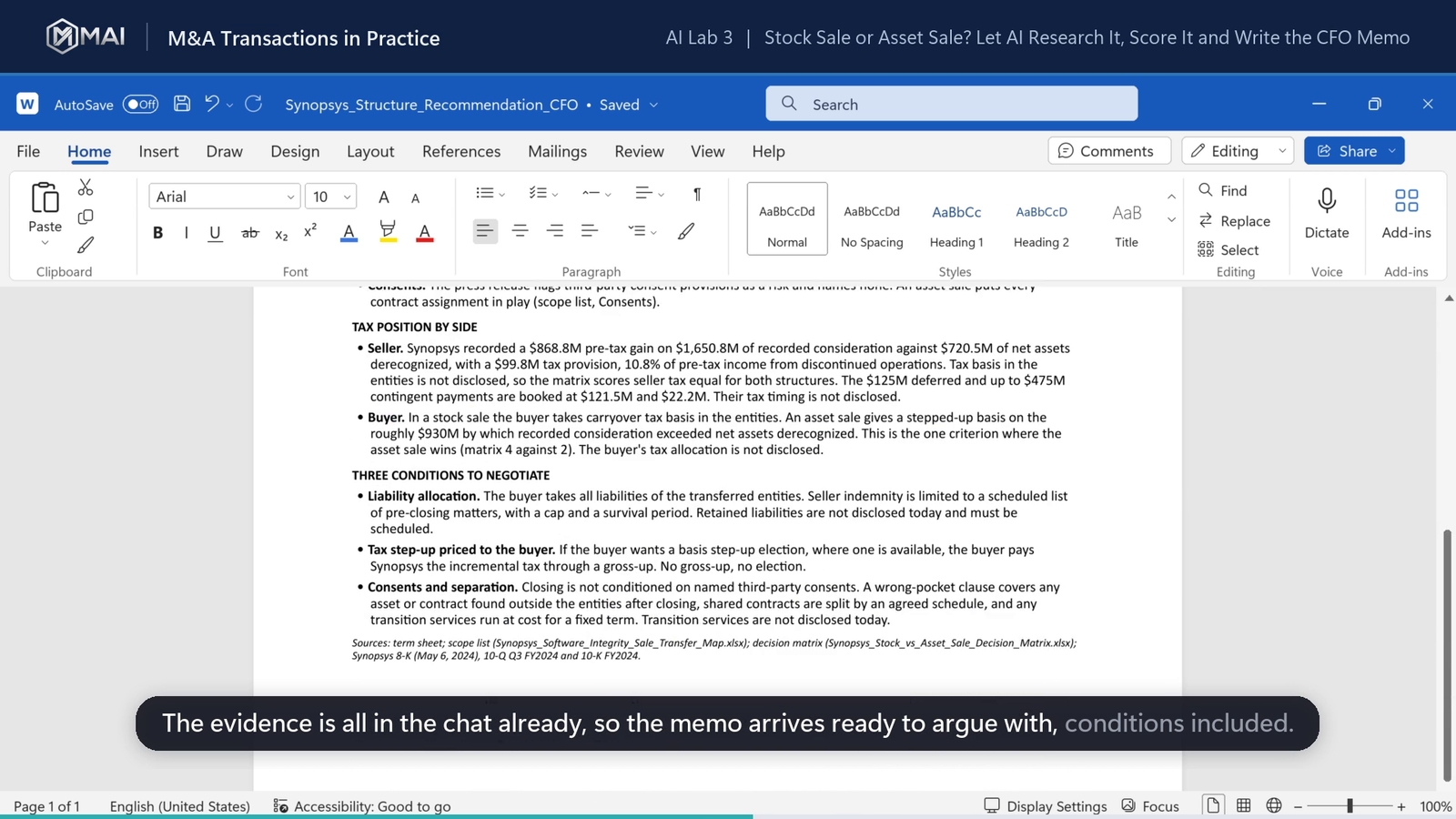
Using the carve out due diligence checklist as support, put the recommendation in the first sentence of the memo, then give the score and the two or three facts that drive it. Follow with the conditions and the uncertainties that could change the answer. Use the carve out due diligence checklist as the memo’s supporting record, so a reviewer can move from a claim to the underlying document without repeating the entire analysis.
3.1 Make the memo usable in a decision meeting
A reviewer should be able to read the first paragraph and identify the decision, the alternatives and the strongest reason for the ranking. Keep the carve out due diligence checklist and the weighting sheet next to the memo as supporting documents. A short evidence label beside each of the main facts helps the CFO distinguish a filing fact from an assumption about how the deal would operate.
Write each negotiation condition as something a deal team could accept, reject or revise. If the team needs a retained-liabilities schedule, name who will produce it and what the schedule must contain. If tax is unresolved, specify the information the adviser needs before commenting. If a shared service is material, identify the service, the exit test and the escalation route. This format gives the CFO something concrete to decide without hiding the unanswered questions.
4. Search for the agreement and audit every update
The recorded follow-up asked Claude to retrieve the executed agreement on SEC EDGAR and replace only the entries it could substantiate. The run did not retrieve the document and left the workbook unchanged. Its 102 entries are a count of cells across eight detail sheets, with repeated or related issues possible. The result describes the recorded run’s access to evidence.
If you obtain the document, record the specific clause or schedule beside each changed cell. Recount by sheet and compare with the workbook summary. Keep the prior version available to trace the change. Any cell still open should identify the next document or decision owner.
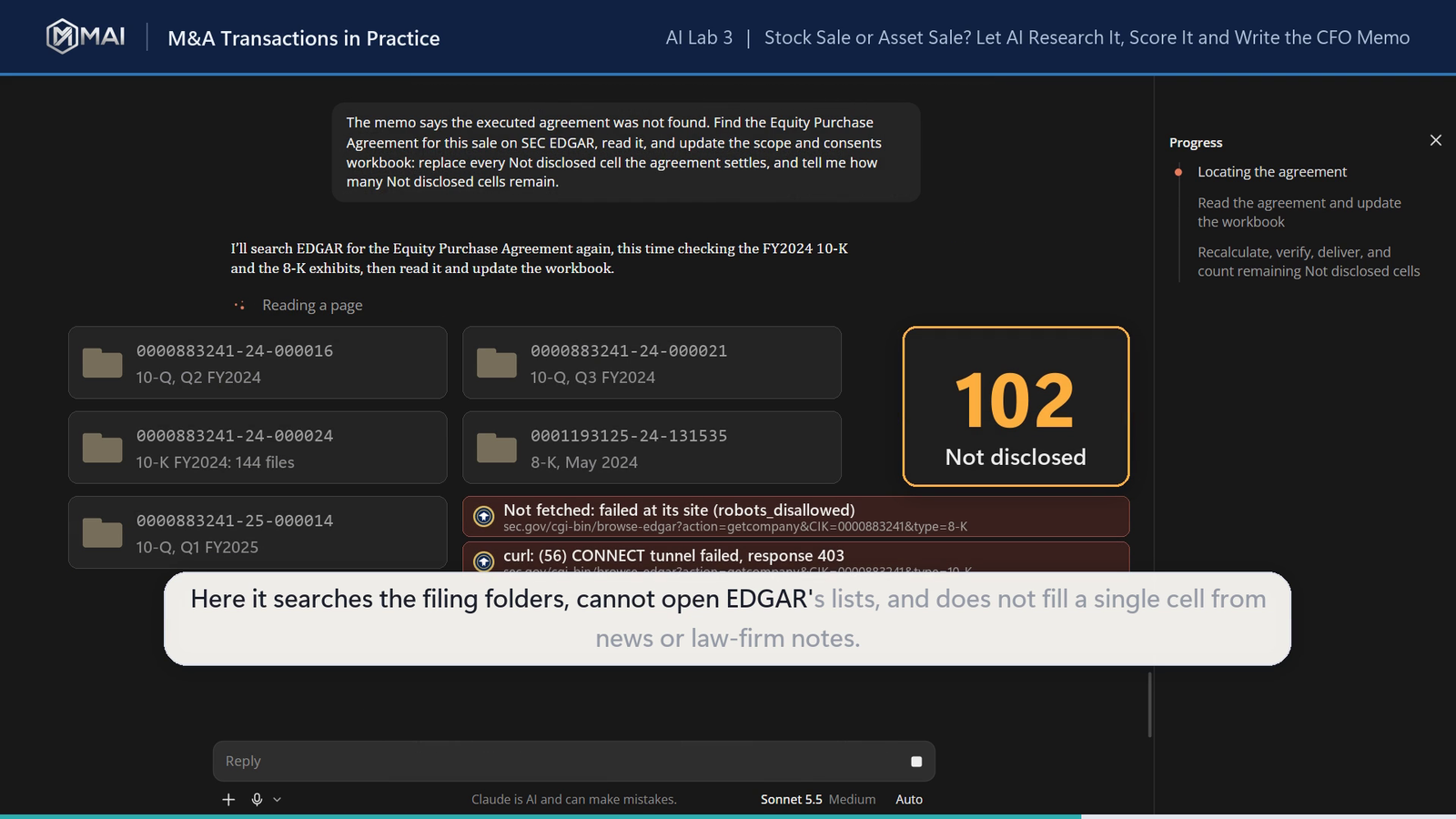
The final step of this carve out due diligence checklist is to record both the change and the evidence. A row may stay open even after the main agreement is found if the relevant schedule is absent. Note whether the team needs a schedule, a consent letter, a service schedule or a tax analysis. Use the count in the carve out due diligence checklist to track changes to the workbook over time.
4.1 Record changes to the carve out due diligence checklist
Use the carve out due diligence checklist to build a short change log: date, sheet and cell, old entry, new entry, source and reviewer. For an agreement clause, preserve the exact section number and record whether the supporting schedule was available. For a copied accounting value, keep the date and units. A clear change log is especially useful when several spreadsheet cells are revised from the same source.
Before accepting the updated file, open a changed row, an unchanged open row and the summary. Check the source for the change, confirm that the open row was left intact and reconcile the count. If a revised score affects the recommendation, record why and update the CFO memo as well. This review completes the loop from the initial term sheet to the decision that will be presented.
FAQs
Does the higher score establish which structure the parties used?
The score ranks two illustrative options under selected assumptions. The filing reports an Equity Purchase Agreement. Confirm the precise equity and asset mix from operative documents.
Why does seller tax receive the same score on both sides?
The source set leaves the seller’s tax basis open. The exercise uses a neutral 3 / 3 pending the basis and tax analysis.
What should I do with a cell marked “Not disclosed”?
Identify the clause, schedule or adviser analysis that would resolve it. Record the owner and update the cell when you have the evidence.
At the handoff, pair the carve out due diligence checklist with the supporting files in the same version. Give the reviewer the term sheet, the transfer workbook, the score sheet and the memo together. Mark the decision date and name the person who can verify each material assumption. If the agreement search changes nothing, log that outcome and retain the original count. If it resolves a material issue, record whether it also changes the score or a proposed condition.
Your next carve-out task: identify one fact that could change the ranking
Use the carve out due diligence checklist on one open item. Pick one criterion, name the exact document you need and model the range of plausible outcomes. Ask a colleague to trace the assumption back to the term sheet and transfer map before using the recommendation.
Sources and scope
- Synopsys May 2024 announcement filing
- Synopsys October 2024 completion filing
- Synopsys Q3 FY2024 filing, Note 3
- Synopsys FY2024 annual filing
- Original M&A Institute AI Lab 3 guide, exercises 3–5, recorded Excel decision matrix, CFO memo and search log. The case is a historical practice exercise.