HR Integration in M&A: PMI Planning From Day 1 to Year 1
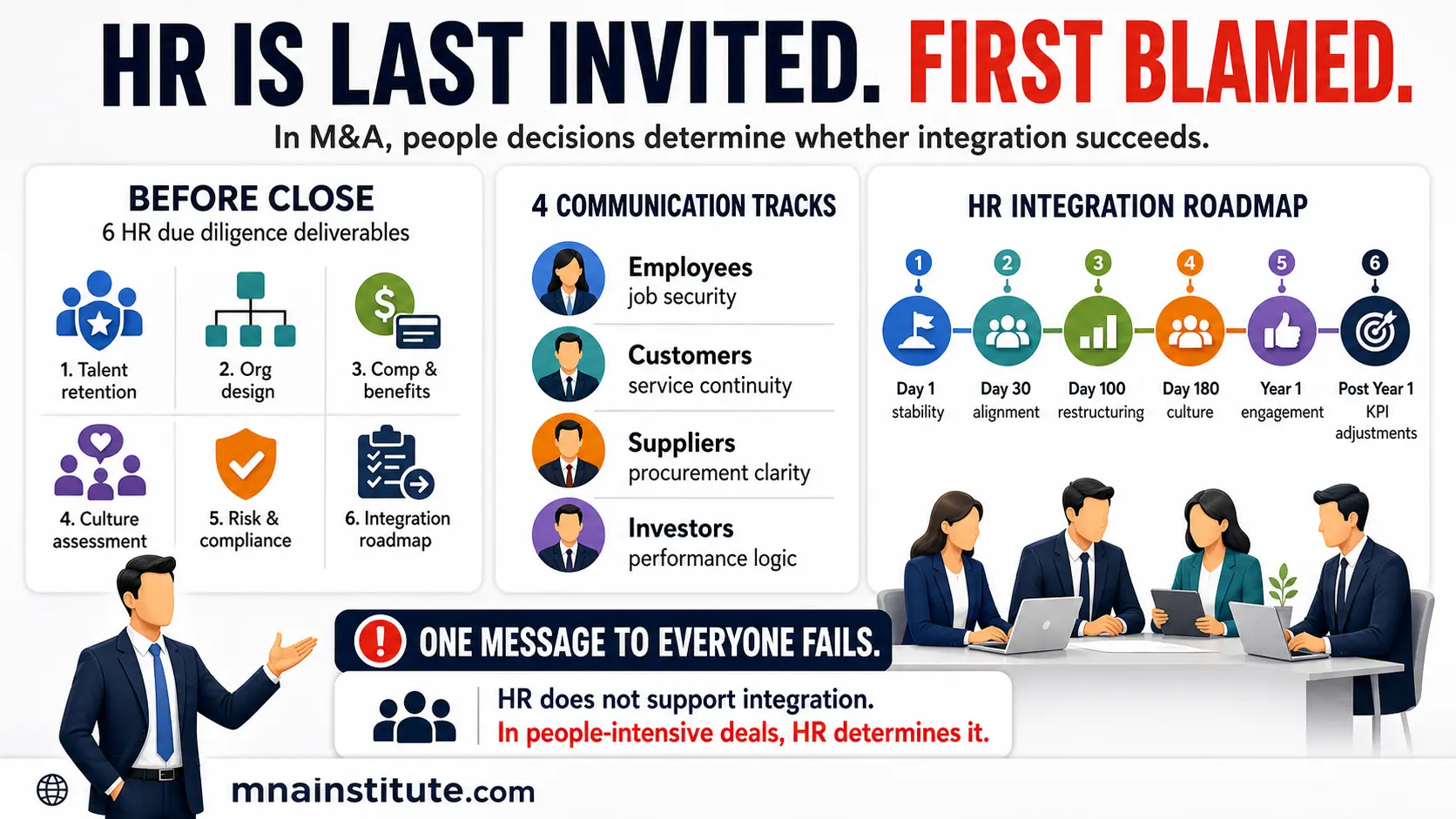
HR integration in M&A becomes visible when uncertainty hits employees, customers, suppliers, and investors at the same time.
The deal announcement may sound strategic, but people hear practical questions first.
- Will my role change.
- Will the leadership team change.
- Will customer service continue without disruption.
- Will suppliers face new payment terms or procurement rules.
That is why HR integration in M&A cannot be treated as administrative support after the transaction closes.
It is a planning discipline that connects communication, due diligence, talent retention, culture, organization design, and execution roadmap.
A good HR team does not merely explain the integration after decisions have already been made.
It helps shape the integration plan by identifying people risks before they become business risks.
This article follows the practical flow of HR PMI planning, from communication planning to HR due diligence, then from Day 1 to Year 1 execution.
It also explains how a Teladoc-style private equity acquisition scenario can be used to simulate HR integration decisions in a realistic transaction setting.

Effective Communication Planning in HR Integration in M&A
The first task in HR integration in M&A is to reduce uncertainty without pretending that every answer is already known.
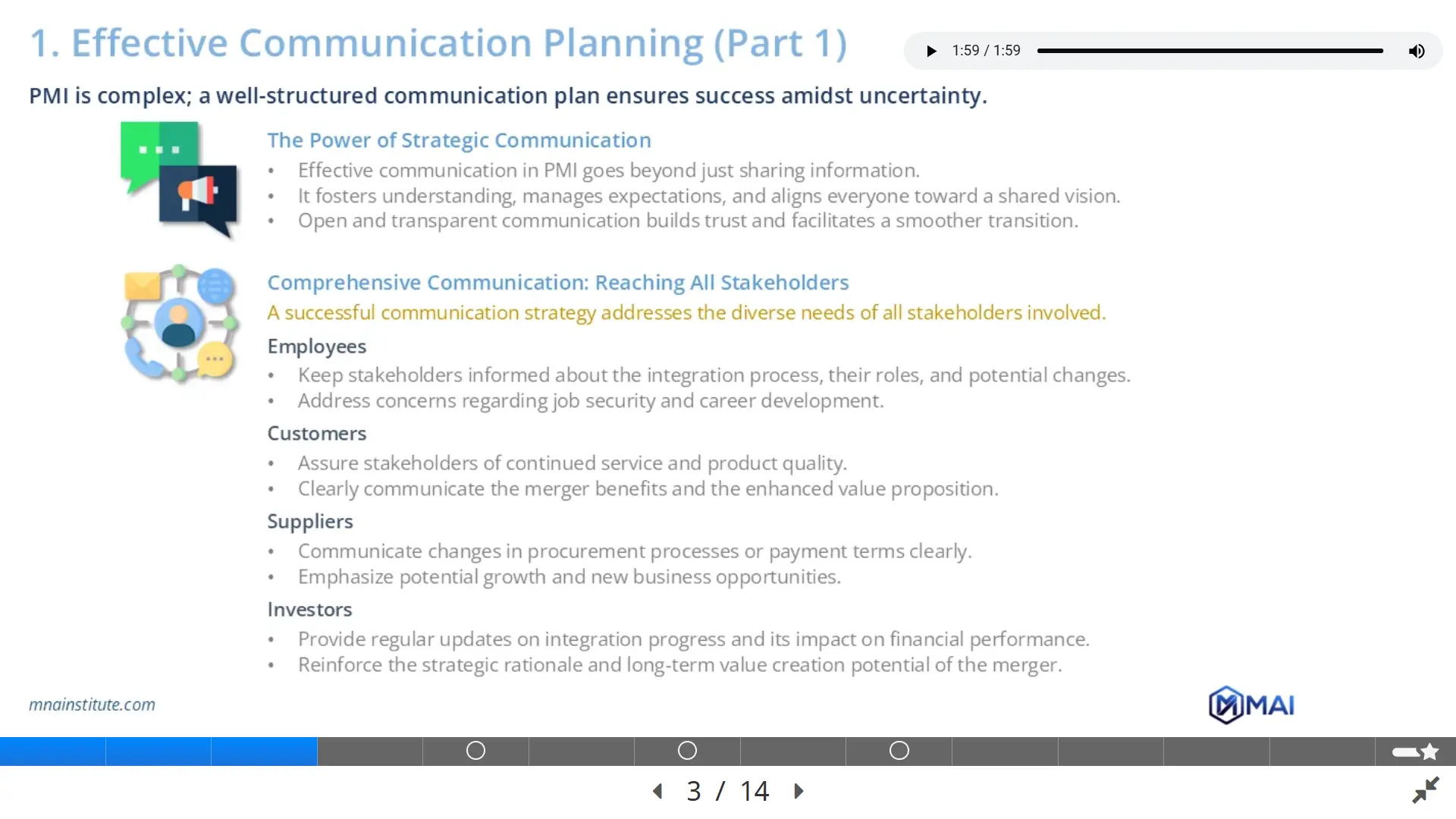
Employees, customers, suppliers, and investors do not need the same message because they do not face the same risk.
Employees worry about jobs, reporting lines, career paths, compensation, and workplace culture.
Customers worry about service quality, account ownership, contract continuity, and whether the combined company will still deliver what they bought.
Suppliers worry about purchase orders, procurement systems, payment terms, and whether existing relationships will be replaced.
Investors worry about integration progress, cost to capture, synergy timing, and the effect on financial performance.
A serious M&A communication plan separates these audiences from the beginning.
The message architecture should answer what changes, what stays the same, what is not yet decided, and when the next update will come.
That last point matters because silence creates speculation.
If the company cannot answer a question yet, it should say when and how the answer will be provided.
This is more credible than over-promising certainty on Day 1.
The power of strategic communication
Communication in post merger integration HR work is not a broadcasting exercise.
It is a mechanism for building understanding, managing expectations, and protecting operating continuity.
Open and transparent communication reduces resistance because stakeholders can see the logic behind changes.
Two-way communication also gives the integration team early warning signals.
A town hall question about job security may reveal a retention issue.
A customer account manager may hear that service uncertainty is already affecting renewal discussions.
A supplier portal question may reveal operational friction before it becomes a delivery problem.
For this reason, HR integration in M&A should include feedback channels, not only announcements.
How messages and channels should differ by audience
A practical M&A communication plan usually separates audience, message, channel, owner, timing, and feedback mechanism.
Employees need a mix of formal and informal communication.
Town halls, team huddles, manager briefings, email updates, intranet pages, and FAQ documents each serve a different purpose.
The employee message should address role clarity, leadership changes, career continuity, and the integration timeline.
Customers need direct reassurance from people they already trust.
Account managers and relationship owners should explain service continuity, points of contact, and any expected benefit from the transaction.
Suppliers need operational clarity.
The supplier message should cover procurement changes, payment terms, system migration, escalation contacts, and expected timing.
Investors need formal, consistent updates through press releases, investor presentations, earnings calls, and management commentary.
The investor message should connect integration progress to financial performance and the original deal rationale.
This is where HR PMI planning overlaps with corporate communications, investor relations, legal, and operational leadership.
HR cannot own every message alone, but HR should ensure people risk and stakeholder reaction are built into the communication plan.

PMI Due Diligence in Practice
Effective HR integration in M&A begins before closing because people risks are often embedded in contracts, roles, incentives, culture, and compliance history.
Deloitte describes HR as relevant across the M&A lifecycle, from due diligence through integration, because human capital issues affect smoother integration, engagement, and value creation.
That is the correct framing for HR due diligence.
It is not only a legal document review.
It is a structured effort to understand the workforce that will carry the post-close strategy.
Key documents HR should review
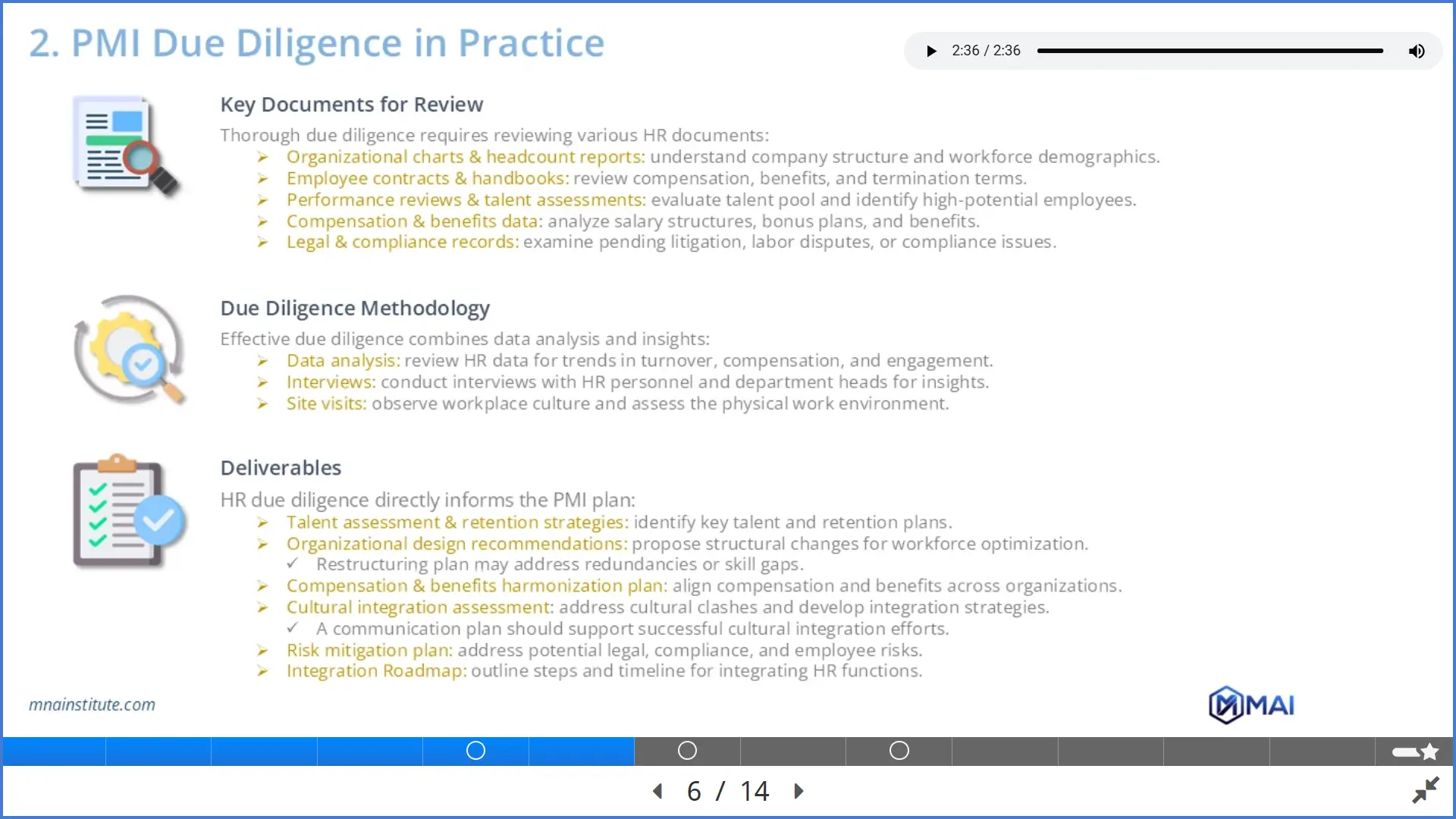
The HR team should review organization charts and headcount reports to understand structure, spans of control, workforce demographics, and location footprint.
Employee contracts and handbooks show compensation terms, termination provisions, benefits obligations, restrictive covenants, and policy differences.
Performance reviews and talent assessments help identify high-potential employees, weak leadership gaps, and succession risk.
Compensation and benefits data shows salary ranges, bonus programs, equity incentives, benefit obligations, and harmonization complexity.
Legal and compliance records show labor disputes, employee claims, regulatory issues, works council obligations, union influence, and pending employment litigation.
In a global workforce, the review must also address local labor laws and market-specific employment practices.
That is especially relevant when the buyer is integrating a company with employees across several countries.
Due diligence methodology
The best HR due diligence combines data analysis with human insight.
Data analysis can show turnover trends, compensation outliers, engagement scores, absenteeism, and promotion patterns.
Interviews with HR leaders and department heads reveal informal power structures, leadership credibility, retention concerns, and likely resistance points.
Site visits help the team observe workplace culture, management style, collaboration patterns, and physical work environment.
The point is not to collect more data for its own sake.
The point is to convert the data into specific integration decisions.
For example, if due diligence shows that a product engineering team has high turnover risk and owns a core platform roadmap, the buyer should not wait until Day 100 to design a retention package.
The retention plan should be built before close, aligned with leadership decisions, and communicated carefully after signing or closing depending on legal and commercial constraints.
Deliverables from HR due diligence
HR due diligence should produce deliverables that directly feed the integration roadmap.
A talent assessment and retention strategy identifies who must be retained, why they matter, and what incentives or career commitments are needed.
Organization design recommendations define the future reporting structure, leadership roles, duplicated positions, and decision rights.
A compensation and benefits harmonization plan outlines how pay, bonus, benefits, equity, and employment terms will be aligned over time.
A cultural integration assessment identifies where working styles, leadership norms, values, and communication habits may collide.
A risk mitigation plan addresses compliance, labor relations, employee relations, and legal exposure.
An HR integration roadmap converts all of these outputs into milestones, owners, dependencies, and timing.
This is one of the reasons M&A Due Diligence: CDD, FDD, LDD, & HRDD is naturally connected to post-close execution.
Due diligence is not complete until the buyer can explain what the findings mean for the integration plan.
The Six-Stage Roadmap for Post Merger Integration HR
A good post merger integration HR roadmap should not be a generic calendar.
It should show what the organization must stabilize first, what can change quickly, and what should wait until people and systems are ready.
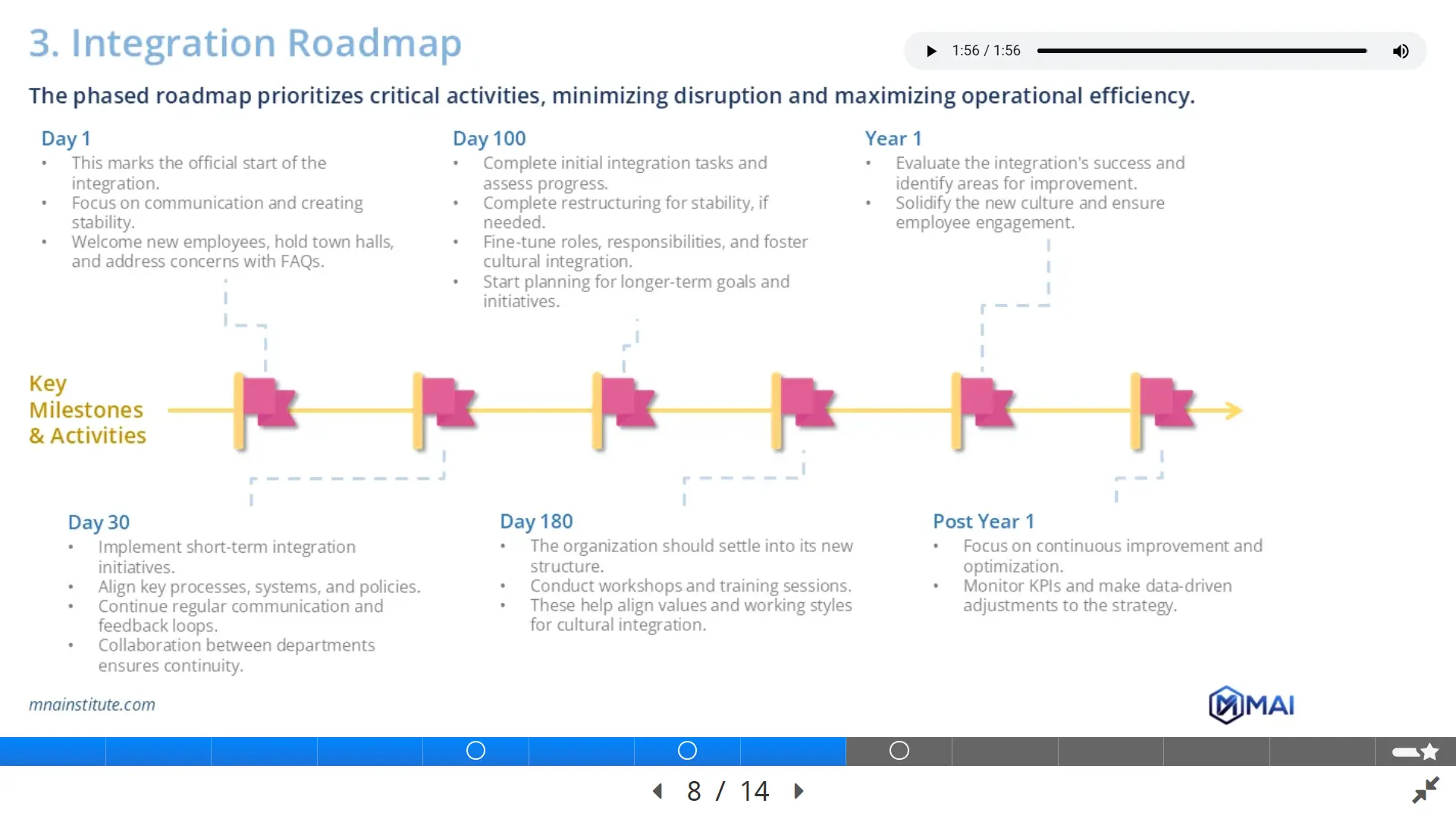
The six-stage roadmap below gives HR integration in M&A a practical sequence from Day 1 to Post Year 1.
|
Milestone |
HR Focus |
Practical Activities |
|
Day 1 |
Communication and stability |
Announce the transaction, welcome employees, introduce leaders, explain immediate continuity measures, and issue FAQs for the most likely concerns. |
|
Day 30 |
Short-term integration |
Begin aligning key processes, policies, and systems where possible while keeping feedback loops open across HR, IT, strategy, and operations. |
|
Day 100 |
Initial completion and reassessment |
Complete early integration tasks, assess progress, finalize immediate role changes, and continue cultural integration. |
|
Day 180 |
Culture and capability build |
Run workshops, training sessions, and engagement reviews to align working styles, leadership expectations, and operating practices. |
|
Year 1 |
Stabilization and evaluation |
Evaluate integration success, measure retention and engagement, and refine the future organization model. |
|
Post Year 1 |
Continuous improvement |
Monitor KPIs, adjust talent and culture plans, and institutionalize lessons learned for future transactions. |

Teladoc-Style HR PMI Planning Simulation
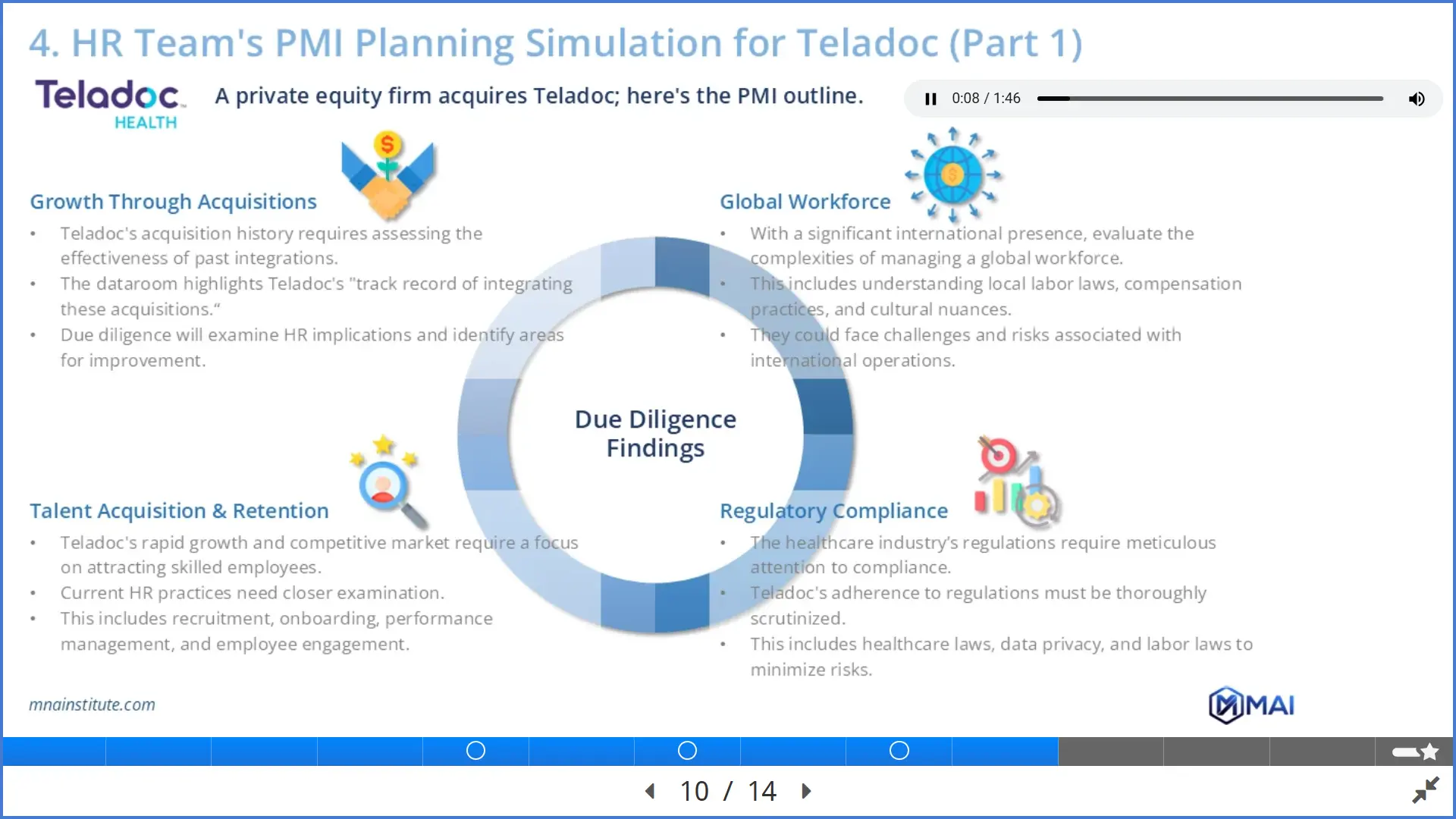
A practical simulation helps learners understand how HR integration in M&A changes when the target is a technology-enabled healthcare company under private equity ownership.
Teladoc provides a useful hypothetical case structure because it combines digital health, regulated operations, technology talent, global workforce complexity, and a history of acquisition-driven growth.
The point is not to claim a live transaction outcome.
The point is to show how HR would translate diligence findings into PMI planning actions.
Due diligence findings
First, a history of growth through acquisitions would require review of prior integration effectiveness.
The HR team would ask whether previous acquisitions were integrated consistently, whether duplicated roles remain, and whether acquired teams retained critical talent.
Second, a global workforce would require review of local employment laws, compensation structures, employee relations issues, and cultural differences across regions.
Third, talent acquisition and retention would be a central issue because healthcare technology companies compete for engineers, clinicians, product managers, compliance specialists, and commercial leaders.
Fourth, regulatory compliance would shape HR planning because healthcare, data privacy, telemedicine, and labor laws can create jurisdiction-specific obligations.
These findings show why post merger integration HR work must connect legal compliance, talent strategy, and operating model design.
Talent confirmation and retention planning
Leadership assessment should identify which executives can execute the new ownership strategy and which roles may require replacement or stronger support.
Key talent identification should not focus only on title.
It should identify individuals who control customer relationships, product knowledge, regulatory know-how, engineering continuity, and operational credibility.
Retention packages can include cash incentives, equity participation, career advancement, clear role commitments, or performance-based rewards.
The design depends on what the deal needs the employee to preserve or build.
Workforce optimization should also identify redundancies and skill gaps.
If restructuring is needed, HR should sequence it carefully so that the organization does not lose key people before stabilizing the operating model.
Culture, change management, and communication
Even when there is no classic merger of equals, cultural assessment still matters.
A private equity buyer may not fully integrate the target into another operating company, but the ownership model, performance cadence, reporting expectations, and leadership style may still change.
That creates cultural pressure.
HR should assess values, communication habits, working style, decision speed, and performance management norms.
If misalignment exists, HR should design a change management plan that explains what will change, why it will change, and how employees will be supported.
The M&A communication plan should be explicit about leadership, strategy, employee concerns, and external stakeholder messaging.
Regular town halls, open Q&A sessions, manager toolkits, and direct updates can reduce uncertainty when employees are most likely to speculate.
How HR Integration in M&A Protects Deal Value
The commercial value of HR integration in M&A is often underestimated because the outputs look softer than valuation models or legal documents.
In reality, people decisions determine whether the model can be executed.
McKinsey emphasizes that during M&A transactions companies should prepare for integration before announcement, identify high-potential performers, communicate effectively, empower frontline managers, and sustain changes through onboarding and development programs.
PwC also highlights the need to communicate early and often with stakeholders and to plan Day One actions before closing.
Those points match the operating logic of this lesson.
HR integration in M&A works best when it connects four workstreams.
First, communication reduces uncertainty and creates feedback loops.
Second, due diligence identifies risks in contracts, culture, compensation, leadership, compliance, and retention.
Third, the roadmap sequences Day 1, Day 30, Day 100, Day 180, Year 1, and Post Year 1 actions.
Fourth, simulation practice helps teams convert data into decisions before they face a live transaction.
The lesson for executives is direct.
HR should not enter PMI after the deal team has already defined the integration plan.
HR should help design the plan because people risk, cultural risk, and communication risk are all transaction risks.

Common Mistakes in HR Integration in M&A
The most common mistake in HR integration in M&A is treating communication as a single announcement rather than a continuing operating rhythm.
A Day 1 announcement may create attention, but it does not create trust by itself.
Trust is built when employees hear consistent messages from executives, managers, HR leaders, and direct supervisors.
The second mistake is starting retention planning too late.
If key employees receive vague promises while competitors offer clear packages, the buyer may lose talent before the integration plan is ready.
The third mistake is harmonizing compensation and benefits too aggressively before the buyer understands which differences are legally required, culturally accepted, or commercially useful.
Equalization sounds clean, but premature equalization can increase cost, create unfairness, or trigger employee dissatisfaction.
The fourth mistake is separating culture from the operating model.
Culture is not only values language.
It appears in decision speed, risk tolerance, manager behavior, meeting discipline, customer responsiveness, and accountability.
HR integration in M&A must therefore test culture through actual work practices, not only employee survey language.
The fifth mistake is building a roadmap that lacks decision rights.
If HR, legal, finance, IT, and business leaders do not know who approves role changes, retention offers, severance actions, employee communications, and policy exceptions, the roadmap will slow down quickly.
A practical post merger integration HR plan should show who decides, who executes, who reviews, and who communicates.

A Practical HR PMI Planning Checklist
A useful HR PMI planning checklist should be short enough to use in meetings and specific enough to change decisions.
The checklist below can be used before close, on Day 1, during the first 100 days, and through Year 1.
Before close
Confirm the full employee population by location, function, contract type, and business-critical role.
Identify leadership roles that must be retained, replaced, clarified, or supported.
Review compensation, benefits, bonus arrangements, equity plans, and severance obligations.
Identify employee relations issues, labor law constraints, union influence, consultation obligations, and compliance exposure.
Draft the M&A communication plan for employees, customers, suppliers, and investors so that the Day 1 message is not improvised.
Day 1 to Day 30
Deliver the first employee communication through leaders and managers, not only through written announcements.
Confirm business continuity for payroll, benefits, HR systems, customer-facing teams, and essential employee support channels.
Activate retention discussions for critical employees where legally and commercially appropriate.
Open feedback channels through town halls, Q&A sessions, manager briefings, surveys, and direct HR contact points.
Day 30 to Day 100
Begin policy alignment where low-risk changes can be implemented without disrupting the workforce.
Finalize the first version of the future organization design.
Assess whether restructuring is required and sequence it with legal, operational, and cultural considerations.
Track retention, engagement, absenteeism, voluntary turnover, and manager feedback as leading indicators.
Day 100 to Year 1
Move from stabilization to deeper cultural integration and capability building.
Run workshops, leadership alignment sessions, training programs, and values-to-behavior exercises.
Reassess the employee value proposition so the combined organization can explain why people should stay and grow.
By Year 1, HR integration in M&A should no longer be framed as transition management alone.
It should become the people operating model of the combined organization.
For that reason, HR integration in M&A should be reviewed by the deal sponsor, not only by the HR function.
When HR integration in M&A is tied to the investment thesis, the people plan becomes part of value creation rather than a compliance appendix.
When HR integration in M&A is separated from commercial and operational decisions, the organization may communicate one message while executing another.
The practical test is whether HR integration in M&A gives leaders enough clarity to protect talent, explain change, and keep the business stable.

Related Courses
- The Mergers and Acquisitions Online Course provides the broader transaction context for HR integration, diligence, negotiation, and post-close execution.
- M&A Due Diligence: CDD, FDD, LDD, & HRDD is directly relevant when HR findings must be connected with commercial, financial, legal, and operational diligence.
- Post-Merger Intergration and Value-Up Strategy is the natural continuation when the focus moves from HR planning to enterprise-wide integration and value capture.

Sources
- Deloitte, The future of human capital in M&A: Why HR is key to success
- PwC, Seven fundamental tenets of successful integration
- McKinsey, Retain, integrate, thrive: A strategy for managing talent during M&A transactions
- McKinsey, Organizational culture in mergers: Addressing the unseen forces