Post Merger Integration Readiness: 4-Step Assessment
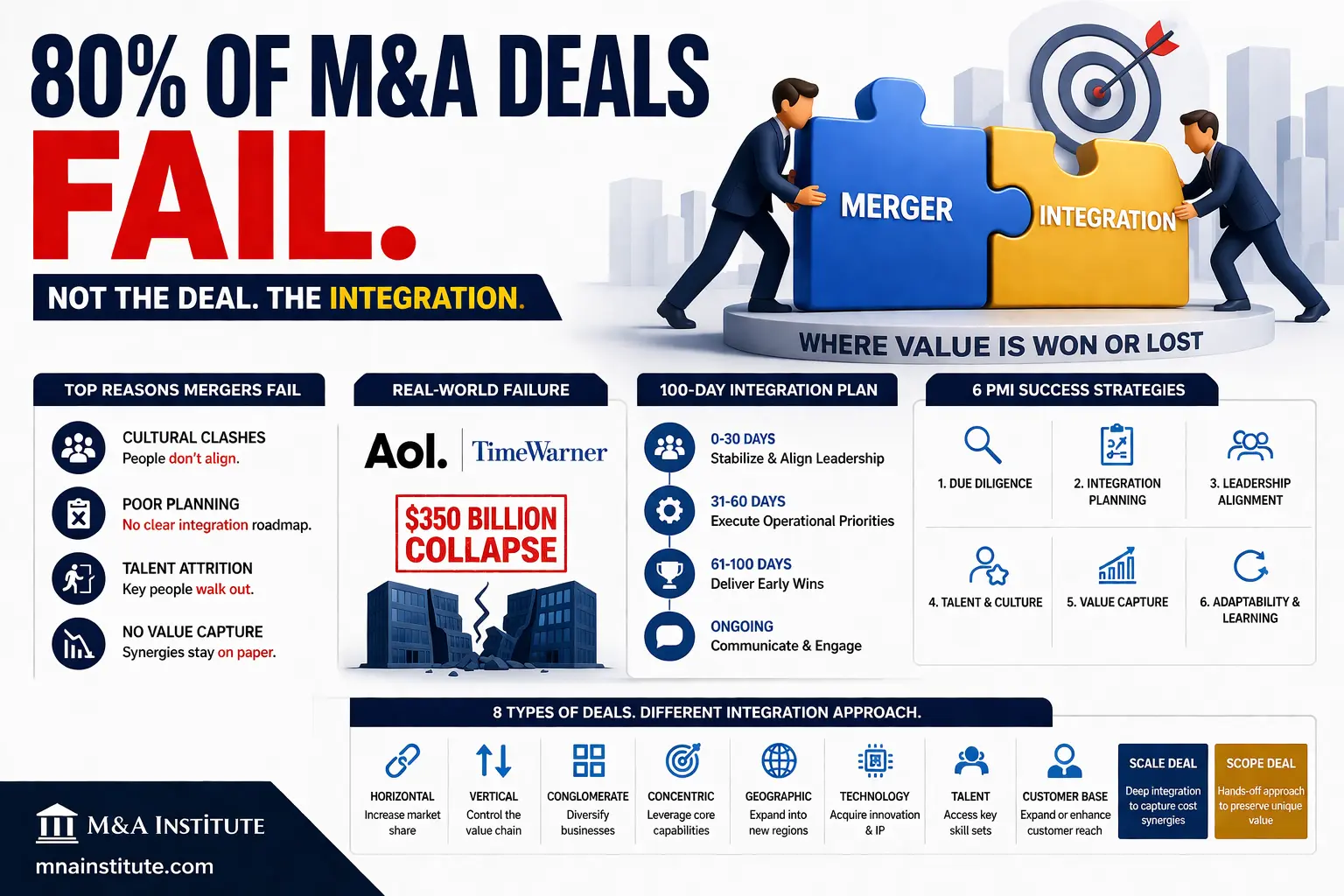
From integration readiness to Day 1 execution: how to assess the target, choose the right integration speed and model, and structure the first 100 days without turning PMI into a generic checklist.
A post merger integration readiness review should start before the integration team becomes busy with task lists, workstream decks, and Day 1 announcements.
The practical question is simple.
Is this target actually ready to be integrated, and is the buyer actually ready to integrate it?
Many integration plans fail because they answer the second question too late.
A buyer may have a credible deal thesis, a reasonable valuation, and a well-negotiated purchase agreement, but still lack the people, budget, systems, and cultural understanding required to execute the plan.
That is why post merger integration readiness should be treated as an execution gate, not as an administrative pre-close exercise.
The goal is to decide how difficult the integration will be, what resources are missing, how fast the buyer should move, and what must be protected on Day 1.
A strong post merger integration 100 day plan is only useful after those readiness questions have been answered.
This article follows a practical sequence.
- Assess integration readiness across four dimensions.
- Allocate the right team, budget, tools, and decision rights.
- Select the right integration speed and model using a quadrant view of operational and cultural differences.
- Translate that diagnosis into a focused 100 day integration plan and Day 1 execution agenda.

Why Post Merger Integration Readiness Comes Before the Plan
A post merger integration readiness assessment answers a harder question than whether a target is strategically attractive.
It asks whether the target can be integrated without damaging customer service, employee stability, system reliability, and the deal thesis.
It also asks whether the buyer has enough internal capability to carry the integration without relying on consultants to compensate for unclear ownership.
Bain argues that integration planning should start during diligence, not after close, because diligence should test synergy feasibility, risks, sequencing, and timing before the buyer commits to the deal path.
That point matters because post merger integration readiness is not a separate workstream from due diligence.
It is the bridge between deal underwriting and execution.
If diligence identifies system incompatibility, labor resistance, customer disruption risk, or missing management capacity, those findings should shape the integration model immediately.
They should not appear as surprises after the closing press release.
The first practical output should be a readiness scorecard.
The scorecard should not be complicated.
It should create an honest view of four areas that determine execution difficulty.
- Cultural and operational compatibility
- Critical business continuity
- Resource and capability gaps
- Data-driven decision making
Those four areas are the foundation of post merger integration readiness because they determine whether integration can move quickly, slowly, partially, or not at all in certain functions.
For example, a buyer acquiring a small software business may see strong strategic fit because the product fills a capability gap.
However, readiness may be weak if the target has fragile customer support processes, undocumented code dependencies, and a founder-led culture that rejects corporate approval layers.
In that case, a fast integration plan could destroy the asset.
The better answer may be selective integration, with finance, reporting, and security controls moving quickly while product and engineering remain more autonomous during the first phase.
That decision cannot be made properly without post merger integration readiness work.

The 4-Step Post Merger Integration Readiness Assessment
A practical post merger integration readiness assessment should be simple enough for a deal team to use before close, but rigorous enough to influence integration speed, budget, and governance.
The following four-step structure gives the buyer a clear way to move from diagnosis to action.
Step 1: Cultural and Operational Compatibility
Culture should not be treated as a soft topic that can be solved after the legal documents are signed.
Cultural differences affect decision speed, management trust, employee retention, labor relations, customer behavior, and resistance to new processes.
McKinsey has written that culture has a large impact on M&A success, and that cultural alignment can improve integration outcomes when managed deliberately.
That does not mean every culture must be merged into one uniform model.
It means the buyer must know which cultural differences matter for the deal thesis.
A sales-led entrepreneurial target may need speed and customer autonomy.
A regulated manufacturing target may need process discipline, safety compliance, and tighter operating controls.
A unionized workforce may require a slower communication cadence and earlier stakeholder mapping.
Post merger integration readiness begins by identifying those differences before the buyer chooses the wrong integration posture.
Step 2: Critical Business Continuity
Business continuity is the part of post merger integration readiness that protects the revenue base while integration work is underway.
The buyer should identify which functions cannot be interrupted, even for a short period.
Typical examples include customer service, order processing, billing, manufacturing operations, cybersecurity monitoring, regulatory reporting, and core IT access.
Day 1 should never be the first time the buyer asks who owns those functions.
EY describes Day One readiness as detailed workstream planning and readiness simulations in the weeks before close.
That means the buyer needs a Day 1 operating view before the first public announcement after closing.
The question is not only whether systems are technically available.
The question is whether customers, suppliers, employees, and managers know what changes and what does not change on Day 1.
Step 3: Resource and Capability Assessment
Post merger integration readiness also requires a realistic review of the buyer’s own capacity.
A buyer can underestimate integration effort because the acquisition price receives more attention than the integration budget.
That is a common execution error.
The integration budget should be separate from the purchase price and should cover workstream support, training, systems migration, retention packages, interim leadership, external specialists, and communication activity.
If the buyer lacks project management capability, HR integration experience, IT migration leadership, or finance transformation resources, those gaps should be addressed before integration begins.
The post merger integration 100 day plan should not pretend those gaps will solve themselves during execution.
Step 4: Data-Driven Decision Making
Accurate data makes post merger integration readiness measurable.
Without baseline data, the buyer cannot know whether the integration is improving performance, creating disruption, or simply generating activity.
Baseline data should cover revenue by customer segment, employee retention, service levels, order cycle time, IT incidents, working capital, cost run-rate, and synergy tracking.
PwC describes integration playbooks as both business plans and field guides that keep teams focused on value creation while giving tactical guidance.
That is only possible when data, owners, and milestones are defined before execution starts.
A readiness review should therefore identify the data owners, system sources, reporting cadence, and KPI definitions before the integration team starts making claims about progress.
A Practical Readiness Scorecard
The following scorecard converts the readiness assessment into decisions the integration team can actually use.
|
Readiness Area |
What to Test |
Warning Signal |
Decision Impact |
|
Culture and operations |
Management style, labor influence, process fit |
Strong resistance or incompatible ways of working |
Slow the integration or preserve autonomy |
|
Business continuity |
Customer service, billing, IT access, operations |
No clear owner for critical processes |
Protect Day 1 operations before synergy work |
|
Resources and capability |
Team capacity, budget, tools, external support |
Missing HR, IT, finance, or IMO capability |
Increase budget or narrow scope |
|
Data quality |
Baseline KPIs, system sources, reporting owners |
No reliable baseline for synergy tracking |
Delay claims of progress until data is fixed |
Choosing the Right Integration Speed and Model
Integration speed and model should be chosen after the readiness assessment, not before it.
A common mistake is to assume that faster integration is always better because faster action appears more disciplined.
That is not always true.
Bain has warned that overintegrating an acquisition can block value creation just as underintegrating can.
The right question is not whether to integrate fast.
The right question is where speed creates value and where speed creates damage.
The integration speed and model should reflect four factors.
- Strategic goals
- Organizational culture
- Operational processes and IT systems
- Financial resources and expected return
If the strategic goal is rapid market expansion in the same industry, faster operational integration may be justified.
If the strategic goal is capability acquisition, technology access, or talent retention, slower and more selective integration may protect the value being acquired.
If the target uses similar systems, similar processes, and a compatible culture, the buyer can move more confidently.
If the target has very different systems, a different culture, and fragile business continuity points, integration should move in phases.
That is the practical use of the integration speed and model concept.
It converts readiness findings into integration posture.
The Quadrant Framework for Integration Decisions
A simple quadrant can help leaders make the integration speed and model decision more clearly.
The first axis is operational complexity.
The second axis is cultural difference.
The combination tells the buyer whether the integration should be fast, phased, cautious, or partially standalone.
|
Scenario |
Profile |
Best Integration Posture |
Typical Deal Fit |
|
Low work, low culture difference |
Similar operations and similar ways of working |
Swift and comprehensive integration |
Horizontal scale deal |
|
High work, low culture difference |
Operational gap but manageable people fit |
Cultural alignment first, then phased operational alignment |
Vertical or concentric deal |
|
Low work, high culture difference |
Operational fit but different behaviors and norms |
Phased integration with focus on alignment zones |
Geographic expansion |
|
High work, high culture difference |
Major operational and cultural gap |
Cautious integration or standalone model |
Conglomerate, technology, or R&D acquisition |
This model keeps integration from becoming a default template.
A horizontal acquisition with similar branches, customers, and systems may need deep integration to capture cost synergies.
A technology acquisition may need security controls and finance reporting quickly, but product culture and engineering autonomy may need more protection.
A geographic expansion deal may require a hybrid model where core processes are standardized but customer-facing practices remain local.
In each case, post merger integration readiness determines the correct integration speed and model.

How Readiness Shapes the Post Merger Integration 100 Day Plan
A post merger integration 100 day plan should not be a generic list of tasks copied from a prior transaction.
It should be the execution version of the readiness assessment.
The plan should show exactly what the buyer will do in the first three months to stabilize the business, protect continuity, capture early wins, and establish the long-term operating model.
That is why the post merger integration 100 day plan must be established during diligence, not only after closing.
The 100 day integration plan gives the integration team a time-bound execution path.
It also forces management to make choices.
Which initiatives are urgent?
Which initiatives are valuable but should wait?
Which functions need deep integration?
Which functions should remain separate during the first phase?
What the Plan Should Contain
A practical post merger integration 100 day plan should include ten components.
- Integration strategy, including degree of integration and timeline.
- Governance structure, including decision rights and escalation paths.
- Quick wins that can create visible benefits early.
- Baseline assessment across financial, operational, cultural, and customer metrics.
- Cultural integration plan that defines what should align and what should be preserved.
- Communication plan for employees, customers, suppliers, and other stakeholders.
- Risk mitigation plan for business continuity, technology, talent, and customer disruption.
- Financial model showing integration cost, synergy timing, and expected benefits.
- Resource allocation plan covering people, tools, budget, and external support.
- High-level organization design with leadership roles and reporting lines.
The plan should be specific enough to assign owners and deadlines.
For example, a broad statement such as “improve sales effectiveness” is not a 100-day action.
A better action would be “identify the top 30 overlapping customers by Day 15, assign relationship owners by Day 25, and complete renewal risk calls by Day 45.”
That level of detail is what separates a real post merger integration 100 day plan from a slide title.
The same logic applies to cost synergies.
A vague target to “reduce procurement costs” does not tell the team what to do.
A practical 100 day integration plan would specify supplier categories, baseline spend, decision owners, contract review deadlines, and expected first-wave savings.
Why Private Equity Teams Often Move Faster
Private equity teams often approach the first 100 days with more discipline because they usually enter with a clear value-creation thesis, a shorter ownership horizon, and a stronger bias toward measurable actions.
That does not mean every corporate acquirer should copy a private equity model.
It means corporate acquirers can borrow the discipline of pre-identified playbooks, rapid leadership assessment, financial tracking, and early operating initiatives.
A post merger integration readiness review should therefore ask whether the buyer has repeatable playbooks or whether every integration is being rebuilt from scratch.
Over time, companies that document integration lessons build institutional M&A capability.
Day 1 Execution: Where Readiness Becomes Visible
Day 1 is where post merger integration readiness becomes visible to the organization.
Employees, customers, suppliers, and managers do not judge readiness by the existence of a planning deck.
They judge it by whether leadership is clear, operations continue, communication is calm, and the first questions receive consistent answers.
EY notes that Day One readiness sessions and simulations are typically performed shortly before close, with each workstream developing detailed Day One plans.
This confirms a practical principle.
Day 1 should be rehearsed, not improvised.
Typical Day 1 activities include four categories.
- Official announcement to employees, customers, suppliers, and key stakeholders.
- Introduction of the new leadership structure and decision authority.
- Confirmation that essential operations will continue without interruption.
- Communication of the strategic rationale, immediate priorities, and what does not change.
The communication message should be clear enough for different audiences.
Employees want to know whether their roles, managers, compensation, and systems are changing.
Customers want to know whether service quality, contracts, pricing, and account contacts are changing.
Suppliers want to know whether ordering, payment, and contract terms are changing.
Managers want to know which decisions they can make and which decisions require integration governance approval.
That is why communication is part of execution, not public relations.
A weak Day 1 can create uncertainty that slows the entire 100 day integration plan.

Planning Tools, Workstreams, and Resource Control
The post merger integration 100 day plan should be supported by tools that make execution visible.
A spreadsheet with names and deadlines is not enough when multiple functions have dependencies across HR, IT, finance, operations, commercial, legal, and communications.
Each workstream should have both a strategic leader and an operational leader.
The strategic leader owns the purpose and decision logic.
The operational leader owns task execution, issue tracking, dependencies, and reporting.
This structure prevents senior executives from assuming progress exists simply because meetings are happening.
A basic integration dashboard should include the following fields.
- Workstream name
- Initiative owner
- Day 1 action
- Day 30 milestone
- Day 60 milestone
- Day 100 milestone
- Dependencies
- Risk level
- Budget requirement
- KPI or success measure
The dashboard should distinguish between activity and value.
Completing a meeting is an activity.
Retaining a critical customer, reducing duplicate spend, stabilizing service levels, and filling a leadership role are value-linked outcomes.
The 100 day integration plan should therefore show which actions create momentum, which protect continuity, and which build the platform for longer-term integration.

A Practical Execution Sequence
The following sequence can be used to connect post merger integration readiness with the first 100 days.
- During diligence, identify cultural, operational, resource, data, and continuity gaps.
- Before signing, agree the integration thesis and define which areas require deep integration, phased integration, or temporary separation.
- Between signing and close, form the integration management structure and confirm Day 1 readiness.
- By Day 1, communicate leadership, business continuity, customer impact, and governance clearly.
- By Day 30, validate baseline data, finalize quick wins, and resolve urgent resource bottlenecks.
- By Day 60, track early KPI movement, complete first-wave operating decisions, and adjust the integration speed and model if needed.
- By Day 100, confirm whether the integration is on track, behind plan, or structurally misaligned with the original deal thesis.
This sequence keeps the post merger integration 100 day plan tied to facts.
It also makes the plan adaptable.
If readiness findings show that culture and operations are close, the team may move faster.
If readiness findings show major system gaps and heavy cultural friction, the team should protect business continuity first and delay deeper integration where needed.
The practical value of integration readiness is that it prevents management from forcing the same model onto every deal.

Related Courses
The following courses fit naturally with the topics covered in this article.
- Mergers and Acquisitions Online Course covers the full M&A sequence from strategy and structure through execution.
- M&A Due Diligence: CDD, FDD, LDD, & HRDD connects pre-close findings with integration risks and value-creation logic.
- Post-Merger Intergration and Value-Up Strategy focuses on PMI execution, value capture, and post-close operating discipline.

Sources
- Bain & Company, The 10 Steps to Successful M&A Integration
- Bain & Company, Integrate Where It Matters
- EY, Nine Steps to Setting Up an M&A Integration Program
- McKinsey, Unlocking Merger Value Through Operating Model Design
- PwC, M&A Integration Playbooks