M&A Checklist: 7 Essential Checks for Deal Documents
An M&A checklist should tell the buyer and seller what to do, who owns the next action, and which document supports the decision. In the Synopsys–Ansys exercise, Claude turned the definitive proxy into a map of 32 documents, then drafted separate Word checklists for both sides. When the proxy named the parties to the exclusivity agreement but left the drafter unstated, that gap belonged in the checklist.
Use these seven checks to move from the filing to a working list. The earlier M&A timeline exercise explains how to date the events. This exercise follows the documents and decisions attached to them.
1. Set the scope of your M&A checklist
At the top of the M&A checklist, record the deal, the side you advise, the source and the sections you examined. The recorded map draws on the Background of the Merger in the Ansys definitive proxy. Use the printed proxy page, since it can differ from the PDF viewer’s counter.
Keep a separate row for later evidence. The recorded map omitted the final vote result and antitrust filing dates from its coverage. A later Form 8-K confirms completion on 17 July 2025. If a gate depends on a vote or a clearance, open the relevant filing before marking it complete.
1.1 Record what the proxy covers
Start the M&A checklist’s scope note with the filing title and date, then record the page span you actually read. The background narrative describes the sequence of negotiations from the target’s perspective. It can tell you that an agreement was entered into on a date and describe some of its terms, while leaving out the complete signed text. If the next task calls for the agreement itself, record the narrative as an initial reference and keep the request for the agreement open.
Give every source a short identifier that a reviewer can use without reopening the AI conversation. An entry such as “Ansys definitive proxy, Background of the Merger, printed p. 63” points to an identifiable page. An entry such as “Claude output” only points to the analysis. If the filing cites an annex or an exhibit, add a second reference for that document. Keeping the reference with the row helps a reviewer spot differences between the public description and the actual terms.
Watch the document map and checklist exercise
2. Map documents to decisions in the M&A checklist
Start the M&A checklist with a map by stage and document type. For each card, record the page, parties, drafter if disclosed and purpose at that stage. The recorded map lets the reader filter by document type and inspect the source reference behind a card.
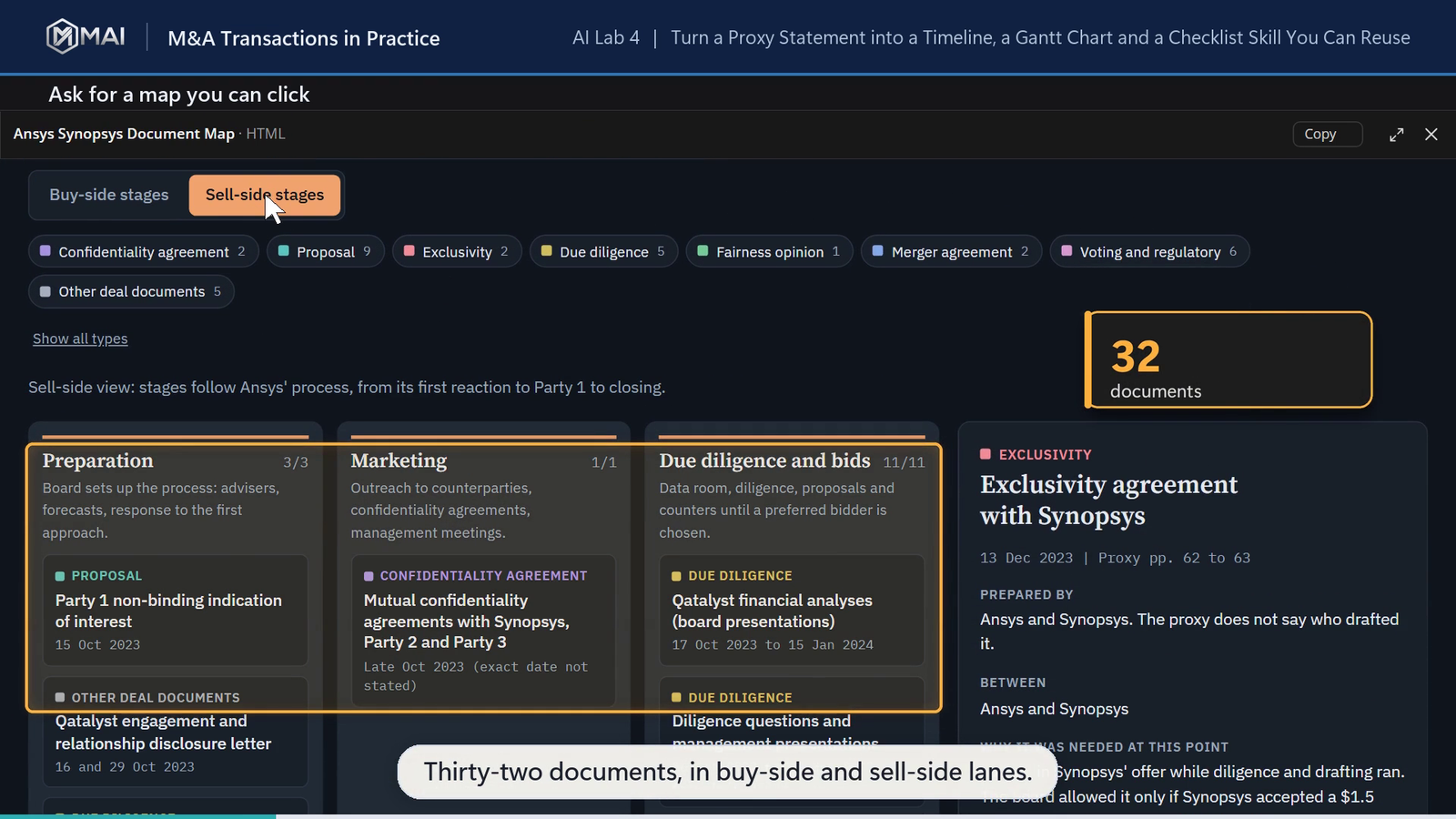
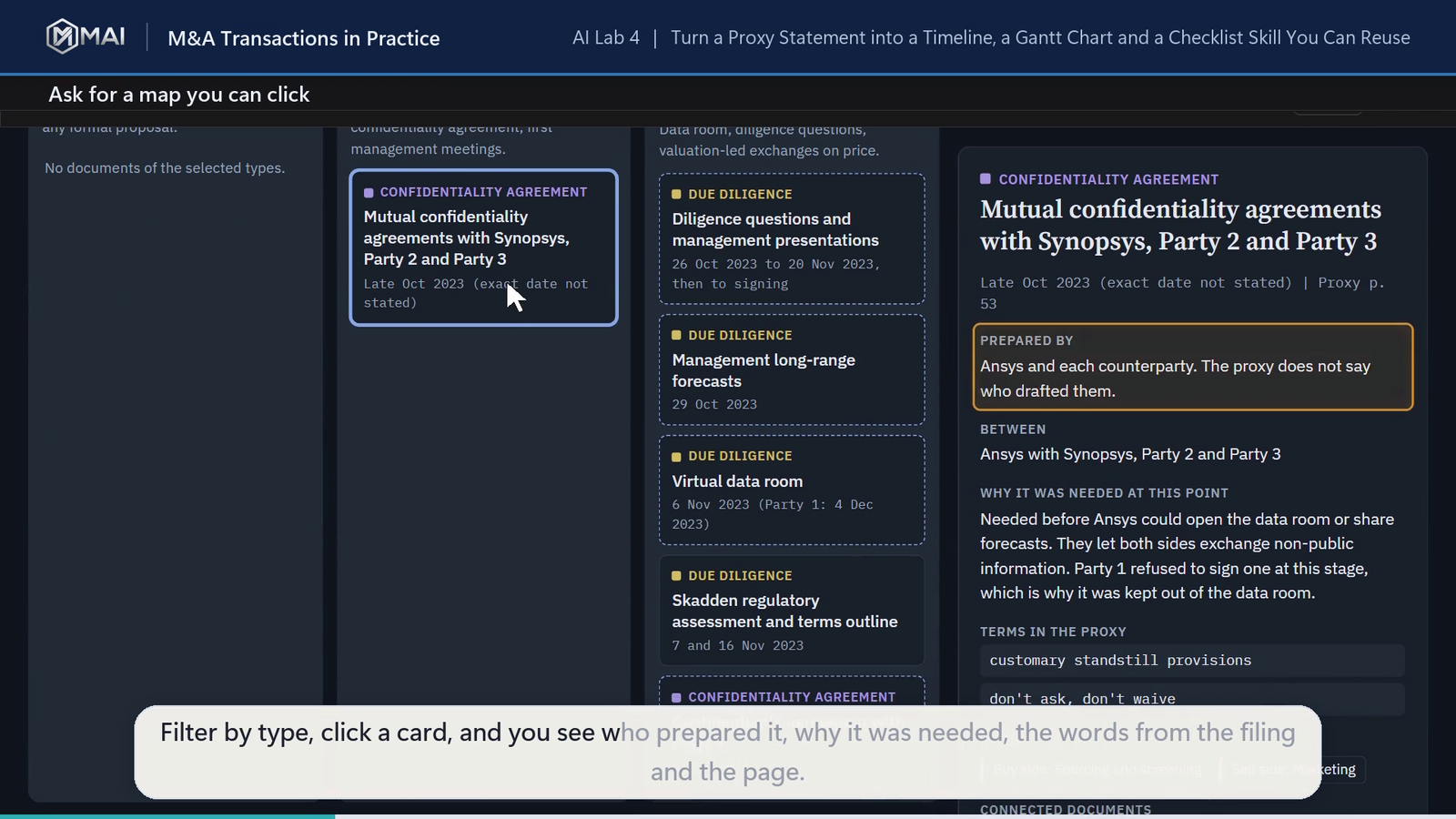
Open two cited pages before using the map. Read the surrounding paragraph to establish who did what and whether the document was proposed, signed or delivered. A term requested during negotiation and a term accepted by both parties belong in different rows if they support different decisions.
2.1 Distinguish proposals from signed documents
Give document status its own column in the M&A checklist. A proposal may offer a price or ask for a period of exclusivity. A signed agreement may put restrictions in place. An opinion may be delivered to the board for a particular purpose. Each verb points to different evidence. For the exclusivity card, compare the date the parties entered into the agreement with the date the restrictions were due to end. If an output records only one date, the reader cannot tell which event it means.
Use the stage filter to find related cards, then review their source references together. A confidentiality agreement can appear near the start of diligence because it governs information sharing. The same agreement can matter later when the team considers who can receive the material. Keep the signed document as a single register item and link it from each relevant task. If there are genuinely different versions or counterparties, give them distinct entries and say which version the reviewer should open.
3. Assign one accountable role per task
A historical party, a document drafter and the person accountable for a new task are three separate fields. In the case, the proxy names Synopsys and Ansys as parties to the exclusivity agreement. The document register leaves the drafter unstated. Your working M&A checklist can still assign a role to get the agreement reviewed for a new deal.
Check the output against the skill. The rule calls for exactly one accountable owner role per task. One buy-side row actually says CEO and counsel for negotiating exclusivity. Decide which role is accountable in your deal, then list the other as support. Escalate authority to the relevant decision maker under your own process.
3.1 Turn a shared role into a reviewable assignment
Open the buy-side M&A checklist at the row for negotiating exclusivity. Its two-role entry is a useful test because the task can involve both business judgment and legal drafting. In a new deal, you might assign the commercial negotiation to the deal lead and ask counsel to review the restriction language. Record any separate approval required to sign. Write the handoff so a colleague can tell who brings back the agreed terms and who verifies that the terms match the draft.
Apply the same test to the sell-side document. The recorded row about considering exclusivity identifies the board and counsel together. Board approval and legal advice can each have a place in the work, but the M&A checklist should still name the role responsible for bringing the decision to the board. Keep the board’s decision, the advice it receives and the task owner in separate fields. If the process for your deal assigns authority differently, change the example and preserve the reason for the change.
| Case document | Source evidence | Checklist action |
|---|---|---|
| Confidentiality agreements | The source identifies counterparties. The recorded card leaves the drafter unstated. | Ask legal counsel to identify the signed version and check access restrictions before sending diligence material. |
| Exclusivity agreement | The proxy describes the agreement and restrictions through 16 January 2024, printed p. 63. | Record when the restrictions end, who can approve an exception and what the deal team may do if another bid arrives. |
| Fairness opinion | Qatalyst delivered its opinion to the Ansys board on 15 January 2024. Read the proxy and Annex B. | Record the audience, date and scope. Put any board action in its own row with its own evidence. |
4. Define the evidence that clears each gate
Give each stage of the M&A checklist a decision, a decision maker and the evidence needed to proceed. Add a fallback when the evidence is missing. For example, a proposed exclusivity period can lead to a review of bid terms, timing and restrictions. The signed agreement and the relevant internal decision record support a separate confirmation that the gate has been cleared.
Keep buy-side and sell-side decisions visible. In the original exercise, the buy-side document follows five stages and the sell-side document follows four. Both contain five gates because the sell-side checklist includes two gates in its last stage. Review those gates against the transaction structure, jurisdiction and authority in the deal you are working on.
4.1 Write a gate that can fail
In the M&A checklist, give each gate a short record with the decision, required evidence, decision authority and next step if evidence is missing. For a team considering exclusivity, a practical question is whether the proposed restriction, end date and exceptions have been reviewed before the deal lead seeks internal approval. Evidence might include the relevant draft and a record of the review. If the end date is ambiguous, leave the gate open and ask the owner to reconcile the draft with the term sheet.
Keep a history when the gate changes. If a later draft shortens the restriction or adds an exception, record the version and update the decision evidence. A checkmark on the earlier draft should not carry forward automatically. When reviewing the sell-side checklist, compare the approval to sign with the later evidence that the deal closed. A signing record and a completion filing answer different questions. The recorded completion Form 8-K illustrates the second check without resolving the first.
5. Review the AI instructions before saving them
The recorded skill draft sets out the stage frameworks, task columns, document register, owner key and missing-source rule. Review the instructions on the save card. The saved skill can carry a method into the next transaction, so check how it asks for the deal, the side and the source each time.
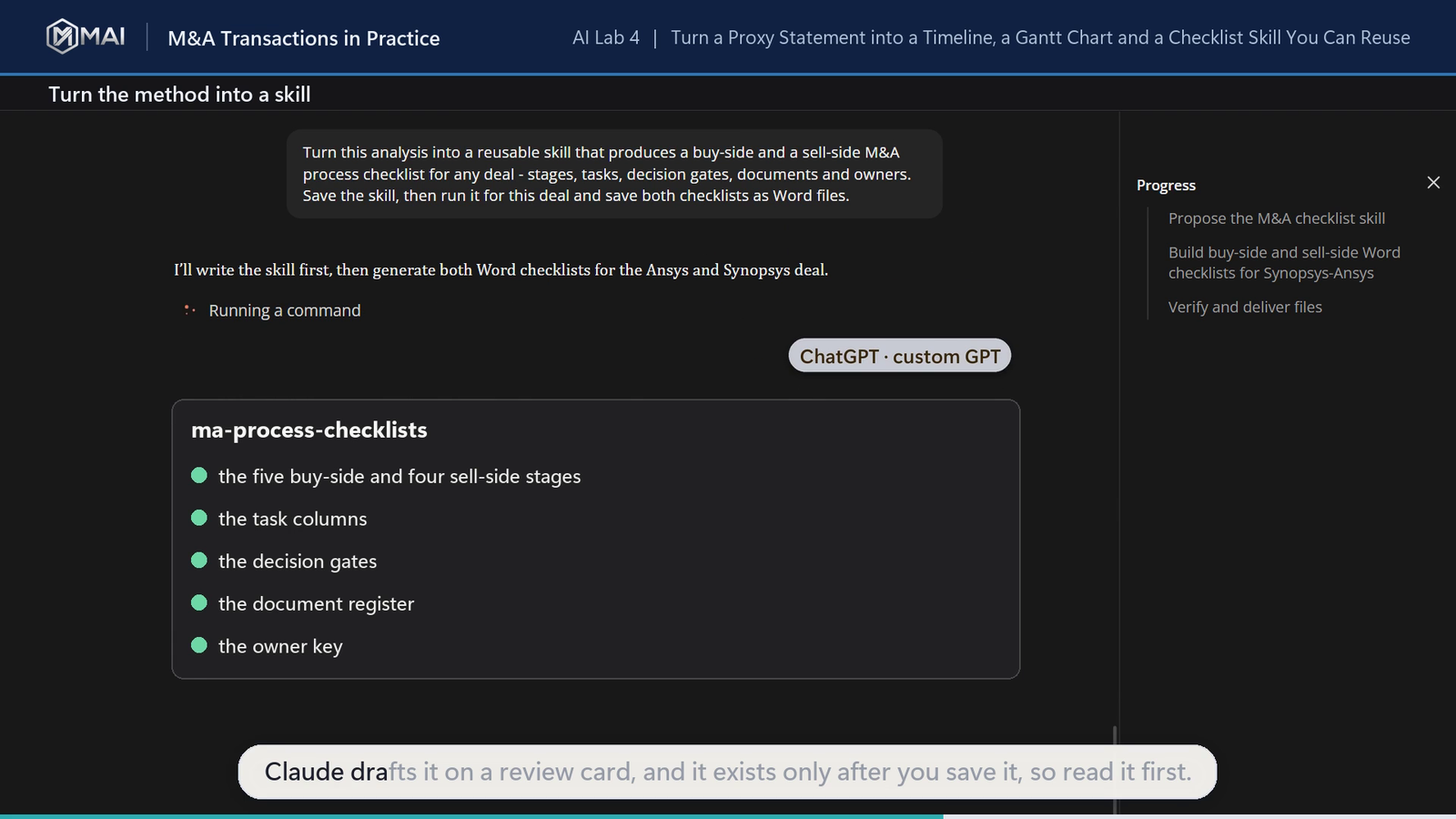
Ask for the source behind each deal-specific fact and keep an open-items list. When the source is silent, preserve the label Not stated in source. Add an owner and a document request so that the missing field has a next action.
5.1 Test the instructions with a missing fact
Before saving the skill, try the instructions on a passage that names parties without identifying the drafter. The M&A checklist should leave that field open and retain the page reference. It should also suggest a specific request, such as asking counsel for the signed version or the relevant drafting history if that history matters to the task. When the draft fills the gap with a likely name, revise the instruction and test the same passage again.
Make the M&A checklist easy to inspect. Keep deal facts in the evidence field and future actions in the task field. Ask the skill to state which side it is working for and which source pages were supplied. Keep the case example separate from the reusable rules so that a future run does not carry over the Ansys parties, dates or document titles. Before bringing in a new deal, check which documents the team is permitted to submit to its AI tool.
6. Audit the two M&A checklists
In the recorded run, Claude delivered an eight-page buy-side checklist and a seven-page sell-side checklist. Each has a 31-row document register. The interactive map has 32 cards. Before treating the two views as equivalent, match rows by document, stage and page. The two counts alone do not explain which items differ.
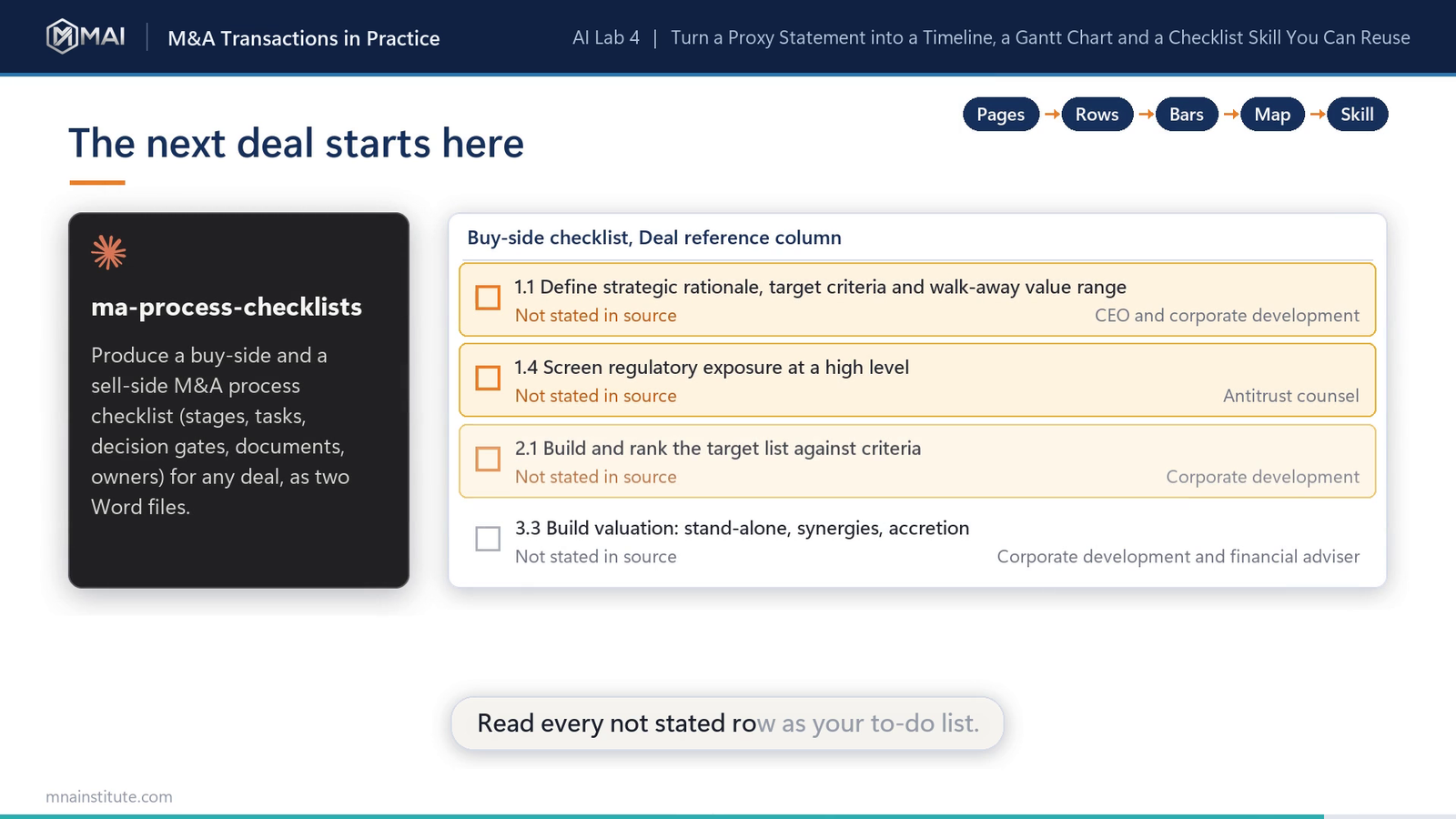
Sample a row from each side of the M&A checklist. Confirm that the task is checkable, the accountable role is explicit and the document reference supports the stated outcome. In the Ansys case, that can mean opening page 63 to verify exclusivity and Annex B to verify the fairness opinion. Keep unresolved facts open until the underlying evidence arrives.
6.1 Reconcile the register one row at a time
Copy the fields from the map and the M&A checklist into a small comparison sheet. Use document type, stage and page reference to line up the cards with the register. Review any mismatches for grouped entries, repeated references and differences in what the two outputs cover. If an entry cannot be reconciled, record the exception and the relevant source. The difference between the displayed totals is a reason to investigate, since a document may be split into several cards or combined with another reference in a register.
Read a task from each Word file without looking at the chat. A colleague should be able to see the requested action and know which source page to open. If a row cites an entire filing, narrow it to the relevant page or annex where possible. If the deal evidence is still missing, identify the document needed, name the role that will request it and leave the completion field open. This is where the M&A checklist starts to work as a handoff.
7. Run the two original prompts
Use the original document-map prompt first. Open two cards and compare them with the cited pages. Then use the checklist prompt, review the skill draft and open both Word files. Record one missing fact and one change to an owner or gate before reusing the instructions.
Get the original prompts and five-page practice guide. You can work from the proxy and an event register, then compare your output with the checks above.
7.1 Save a short review trail
Keep your original map, the two M&A checklists and a short list of changes you made after checking the filing. For each change, note the original field, the source reference, the updated wording and the reason. If you split a shared owner, note which role remained accountable and what the supporting role will do. If you found an unsupported date, keep it open until you can show the corresponding evidence.
Use the same handoff when you pass the M&A checklist to another reviewer. Ask them to select one document and one gate, read the cited page, and tell you whether the next action follows. Try a case where the gate should remain open. A review trail that records an unresolved issue helps the next reviewer pick up the work without reconstructing your AI conversation.
Frequently asked questions
How does an M&A checklist relate to a due diligence checklist?
The M&A checklist also covers decisions before and after diligence, including proposals, exclusivity, signing and closing. A due diligence checklist specifies the evidence a workstream needs to review.
Who owns a task if the filing names only the parties?
Assign a role using the authority and responsibilities on your deal. Record the historical parties separately and leave historical authorship open when the filing does not identify the drafter.
Can I reuse the same M&A checklist on another deal?
Reuse the M&A checklist fields and review steps. Confirm the stage boundaries, applicable approvals and responsible roles for the next transaction before marking any decision complete.
Sources and scope
Ansys definitive proxy and Synopsys prospectus, 17 April 2024. Background of the Merger, printed pages 51–68, and Annex B for the opinion. Synopsys completion Form 8-K, Item 2.01. The document map and Word checklists are recorded teaching outputs. The proposed task assignments are examples for a new deal.
When the handoff is complete, keep the current version of the M&A checklist with the source list. If someone later replaces a draft or clears a gate, record the new source and date so the team can see why the status changed.
At the end of the exercise, write a brief note for the deal lead. Name the source covered, one decision the evidence supports and one decision that still depends on a missing document. Include the owner and the date for the next follow-up. For example, a description of the signed exclusivity agreement can support the historical sequence while the review of exceptions for a new deal still depends on that deal’s draft. The note should make that distinction clear.
Ask the person receiving the note to check the cited page against the wording. If they cannot verify the next action from the entry, add the missing context or correct the reference. That check is useful even if the reader has no access to the tool that produced the original files.
Take the M&A checklist into your next deal review
Choose one gate and bring the source page, the accountable role and the next evidence request to a colleague. The MADEX Certification Bundle brings together the M&A Full Course, Financial Modeling & Valuation Full Course and a practical assessment. Certification is awarded after passing the assessment.