5 Techniques for M&A Price Negotiation: A Winning Guide
Navigating Price Negotiation in Mergers and Acquisitions (M&A)
Welcome to the MAI blog on strategies and techniques essential for mastering price negotiation in M&A. In this blog, we’ll take a structured approach to understanding the nuances of negotiation in this complex field.
Understanding Fundamental Price Negotiation Concepts in M&A
Price negotiation in M&A hinges on effective negotiation strategies. Let’s explore these concepts using an example of TechTitan Ltd. and CloudCraze Corp.
ZOPA: The Heart of Negotiation
The Zone of Possible Agreement (ZOPA) is where both parties find agreeable terms. For example, if TechTitan will pay up to $100 million and CloudCraze won’t go below $80 million, their ZOPA in the price negotiation is $80 to $100 million. This is the range where both parties are likely to agree.
BATNA: The Backbone of Negotiation
Best Alternative to a Negotiated Agreement (BATNA) is your fallback option if negotiations don’t go as planned. It’s a critical component of price negotiation, setting the baseline for acceptable terms. For TechTitan, if acquiring CloudCraze becomes unfeasible, their BATNA might be partnering with another firm for $75 million. This BATNA influences their approach to the negotiations with CloudCraze.
Anchoring: Setting the Stage in Negotiations
Anchoring plays a pivotal role in shaping negotiations. It’s the process of setting an initial number that frames the subsequent discussion. For instance, in our TechTitan scenario, by initially offering $85 million for CloudCraze, they’ve set the stage for negotiations, influencing CloudCraze’s perception of the deal’s value. This technique underscores the power of the first move in price negotiation.

Contingent Contracts: Flexibility in Price Negotiation
Contingent contracts are agreements that depend on future events. They introduce flexibility into negotiations, particularly useful in uncertain scenarios. For example, TechTitan might agree to pay an additional $10 million for CloudCraze if a certain product succeeds. This approach allows for progression amidst uncertainties and is often used in ‘Earn-Outs,’ a concept warranting separate discussion.
Salami Tactics: The Incremental Approach
Salami tactics involve breaking down the negotiation into smaller, manageable parts. Just like solving a puzzle piece by piece, this tactic allows TechTitan to methodically address different aspects of the negotiation, such as IP rights or staff concerns, one at a time. This incremental approach can pave the way for a comprehensive agreement in complex M&A price negotiations.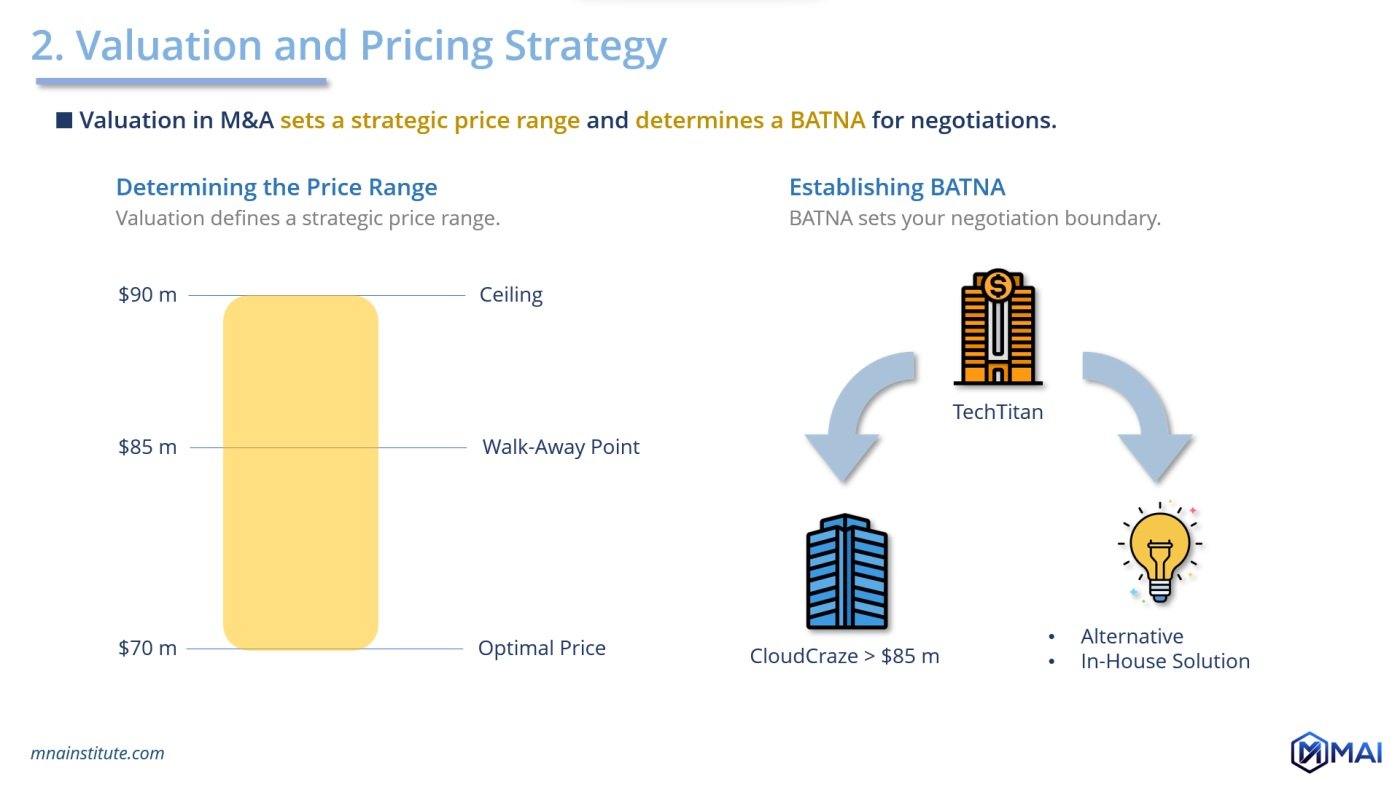

Valuation and Preliminary Pricing Strategy in M&A
Understanding valuation is crucial in developing a preliminary pricing strategy for M&A.
Determining the Price Range
Valuation is not about finding a single price but establishing a range, reflecting the associated uncertainties. In setting this range:
- Setting the Optimal Price: Identify the lowest price that makes the acquisition strategically and financially viable. For TechTitan, this might be $70 million, considering various factors like synergies and future revenues.
- Setting the Ceiling: Determine the maximum price beyond which the deal is no longer viable. This could be due to affordability issues or the risk of overpaying. TechTitan, for instance, might cap their offer for CloudCraze at $90 million to avoid over-leveraging.
- Walk-Away Point: This is the point beyond which the deal is not favorable. For TechTitan, any amount above $85 million might be their walk-away point, considering their resource allocation and ROI criteria.
Establishing BATNA
BATNA in price negotiation is your best alternative if the current negotiation fails. It sets the boundary for your negotiation terms. TechTitan’s BATNA could involve partnering with a different cloud service provider or developing an in-house solution. This alternative must offer a better strategic advantage or be more cost-effective than acquiring CloudCraze for over $85 million.
Anchoring Strategy
Anchoring is crucial in negotiations, as the initial price mentioned often sets the tone for the entire discussion. A well-placed anchor can significantly influence the negotiation towards your desired outcome.
- Example with TechTitan: Considering their valuation range for CloudCraze is between $70 million and $90 million, TechTitan might initially offer $68 million. This is strategically below their optimal price, giving them leverage to negotiate upwards. This move not only sets the stage for discussions but also ensures that subsequent negotiations likely revolve around their valuation range.

Predicting and Responding to Counterproposals
- Anticipating Counterparty Valuation: It’s essential to consider what the other party, in this case, CloudCraze, might value themselves at. If CloudCraze counters TechTitan’s $68 million offer with $95 million, TechTitan needs to be prepared.
- Strategizing Responses: TechTitan should be ready with a rationale for their original valuation and strategies to bridge the gap. This might include suggesting performance-based earn-outs or deferred payments. The key is to remain adaptive yet within the pre-determined range to avoid overstretching.

Navigating Price Negotiation and Drafting the LOI in M&A
Reacting to Unexpected Insights in Price Negotiation
Surprises are a common element in negotiations. For instance, during their valuation discussions, TechTitan’s estimation of CloudCraze shifted from $80 million to a range of $70 to $90 million due to new financial insights. Addressing these changes promptly and transparently is crucial, as it helps maintain a constructive negotiation atmosphere.
Understanding and Utilizing ZOPA
The ‘Zone of Possible Agreement’ (ZOPA) is critical. In our scenario, TechTitan’s valuation range overlaps with CloudCraze’s ($65 to $85 million), creating a ZOPA from $70 to $85 million. This overlap is where both firms will aim to find a mutually beneficial agreement. Recognizing and working within the ZOPA is essential for successful price negotiation.
Drafting the Letter of Intent (LOI)
- Initial Price Proposal: TechTitan drafts an LOI proposing an initial price of $78 million, which lies within the ZOPA.
- Incorporating Contingencies: To address uncertainties, the LOI includes clauses like adding $5 million to the acquisition price if CloudCraze’s software suite outperforms market expectations.
- Using Salami Tactics in the LOI: Segmenting the LOI allows both parties to focus on and resolve each aspect systematically – starting from intellectual property rights to staff integration and infrastructure integrations.
Incorporating Mutual Interests into the LOI
Drafting an LOI is a collaborative effort. TechTitan ensures that CloudCraze’s concerns, such as employee welfare post-acquisition, are adequately addressed. The LOI also outlines how CloudCraze’s products align with TechTitan’s growth plans, showcasing a unified vision for their future.

Finalizing the Acquisition: From LOI to Concrete Terms
Price Negotiations Post-LOI
After drafting an LOI with a proposed price of $78 million, TechTitan and CloudCraze entered formal negotiations. Here, the principles of price negotiation, particularly anchoring and understanding the Zone of Possible Agreement (ZOPA), were crucial.
- Anchoring Revisited: TechTitan’s initial offer of $68 million served as an anchor, with subsequent discussions orbiting around their valuation range of $70 million to $90 million, even when faced with CloudCraze’s counteroffer of $95 million. This demonstrates the lasting impact of a well-placed anchor in negotiations.
- Leveraging ZOPA: With a ZOPA identified between $70 million and $85 million, both parties used this as a framework for negotiation. If CloudCraze insisted on a price above $85 million, TechTitan, mindful of their walk-away point, considered contingent contracts to find a middle ground.
Incorporating Contingent Clauses
Building upon contingent contracts, both parties sought to bridge disparities. For example, if CloudCraze was confident about a forthcoming product, a clause could be added to adjust the price based on the product’s performance. This approach not only introduced flexibility but also ensured a shared risk-reward dynamic between TechTitan and CloudCraze.
Drafting the Final Agreement
Detailing Payment Terms and Responsibilities: The final agreement went beyond the LOI, specifying the terms of payment, timelines, and responsibilities. If the LOI suggested a $78 million price, the final agreement detailed how this would be paid – whether upfront, deferred, or linked to performance metrics.
- Using Salami Tactics: TechTitan methodically addressed each aspect of the agreement, including IP rights and employee transitions, ensuring comprehensive coverage of all elements.
- Alignment with BATNA: The final price reflected TechTitan’s strategic and financial goals, staying true to their BATNA. By integrating their valuation range, anchoring strategy, and ZOPA into the negotiation, they managed to translate their theoretical frameworks into a tangible, mutually beneficial agreement.


Advanced Negotiation Tactics in M&A
Post-Due Diligence Strategy Adjustments
After due diligence, it’s common for new information to emerge, which can significantly impact the negotiation. For example, if TechTitan discovers that CloudCraze’s patent portfolio is more extensive than anticipated, they should tactically respond.
- Using the Salami Tactic: TechTitan might focus discussions on this newfound patent strength before addressing other aspects. This segmented approach ensures thorough consideration of each element, making the negotiation more manageable.
Adapting to Unexpected Variables
M&A negotiations are often full of surprises, such as regulatory issues or competing bids. The ability to swiftly recalibrate strategies in response to these variables is crucial.
- Example of Regulatory Challenges: If CloudCraze faces unexpected regulatory constraints, TechTitan can incorporate contingent contracts. For instance, a clause stating that additional payment will be made if regulatory approval is obtained within a certain period provides a safeguard for both parties.
Holistic Negotiation Strategies
Advanced strategy often requires synchronised use of various tactics. If, for instance, CloudCraze counters TechTitan’s offer post-due diligence, TechTitan can blend different strategies.
- Responding to a Counter-Offer: Suppose CloudCraze demands a higher price due to their stronger patent portfolio. TechTitan could slightly increase their counter-offer while emphasizing their BATNA to remind CloudCraze of their other options. Adding a contingent contract based on the performance of the new patents can further strengthen their position.
In conclusion, M&A price negotiations, particularly in their advanced stages, demand a blend of strategic insight and adaptability. Companies like TechTitan and CloudCraze must master these techniques to ensure negotiations are constructive, targeting mutual understanding and benefit. This narrative highlights the importance of continuous learning and adaptability in the realm of M&A.