M&A TRANSACTIONS IN PRACTICE · AI LAB 1 PART 3
Board Memo Template: 7 Checks for Reliable AI Drafts
A board memo template should make the decision and its conditions easy to examine. In this exercise, an AI draft calls acquisition the “only route” while its own scorecard puts Partner ahead at equal weights. The useful next step is to challenge the recommendation, revise the Word file and check what survives in the slides.

A six-section memo outline, the original skeptical-director prompt, and seven checks for contradictions, omitted figures, proposed conditions and slide compression. The downloadable practice guide retains the course exercises.
This is a historical teaching case using Synopsys–Ansys announcement materials and FY2023 filings. The AI-generated memo and slides are practice outputs, not documents issued by either company, a current forecast or an acquisition recommendation.
1. A board memo template built around the decision
For an acquisition decision, the reader needs to understand what is being requested, why it is supported, and what could change the answer. A board memo template helps only if the evidence remains connected to the recommendation. Use the following outline in Word or as the structure of an AI drafting request. Adapt it to your organisation’s requirements; it is a practice framework, not a substitute for its approval process.
| Section | What to put in it | What to test |
|---|---|---|
| Decision requested | The action, scope and proposed conditions. | Can a director tell what requires approval? |
| Strategic gap | The capability or market access missing today, with a sourced comparison. | Does the evidence establish the gap? |
| Options and trade-offs | Build, Buy and Partner, including the criteria and weights. | Does another option win under plausible priorities? |
| Economics and funding | Price, valuation basis, cash requirement and financing exposure. | Are units, dates and denominators consistent? |
| Objections and responses | The strongest reasons to reject or defer, with specific responses. | Does each response address the objection? |
| Conditions and next steps | Proposed decisions, unresolved evidence and the next review. | Are proposals visibly distinguished from commitments? |
In the board memo template header, identify the author, audience, date, subject and source cut-off. Below them, retain a short source list and calculation notes. If a number comes from a calculation, identify its inputs. If a condition is proposed by the writer or AI, label that status where the condition appears.
This board memo template follows the task in the video: make a decision paper that can withstand questions. The Good Governance Institute’s guidance on board papers similarly recommends stating what directors are being asked to do, including relevant risks and keeping unnecessary detail out of the main paper. Its examples concern public-sector governance; the writing principle is useful here without treating it as transaction-specific legal advice.
Keep the board memo template’s main narrative concise. Supporting workings can sit in an appendix or linked model, but the implications belong beside the recommendation. Moving an uncomfortable assumption out of sight does not make the decision easier to judge.
Watch the 1:49 explanation
The video uses the existing AI Lab work rather than starting with an empty document. First Claude challenges the board memo. It then revises the Word file and turns that revision into five slides. The final check compares what the chat claims with what the downloaded files actually contain.
For the preceding steps, see checking the financial source data and the worked weighted decision matrix. Those inputs matter because a well-written memo can still carry forward an untested score or inconsistent data basis.
2. Set the board memo template’s evidence boundaries
Before asking AI to review a board memo template, supply the actual memo and the evidence behind it. For this exercise, that means the original Word file, the Build–Buy–Partner scorecard, the checked growth chart, the company filings and the January 2024 announcement materials. A reviewer who sees only the recommendation cannot test it against the underlying analysis.
Retain the case date and the financial basis. The exercise combines companies with different fiscal year ends and uses historical growth rates to illustrate a revenue gap. It does not produce a calendarised combined forecast. The distinction belongs in the source note and chart caption, not just in a previous chat message.
Keep missing information explicit. Internal build cost and timing, partnership economics and regulatory approval probability are not established by the materials used in this exercise. Do not ask the model to make the memo “complete” by supplying plausible figures. An unresolved input can be a valid reason to qualify a recommendation or request further work.
Anthropic’s current file-creation guidance confirms that Claude can create Word and PowerPoint files. Check that file creation is available in your workspace. Product controls can change; the substantive review process below does not depend on the exact appearance of a button.
Save the starting document as version 1. Ask for a separate revised file so that you can compare the wording, figures and conditions. Preserve the inputs used for that revision. Otherwise, a later correction to a spreadsheet may leave the memo and deck referring to different versions of the same analysis.
3. Test the board memo template’s recommendation
The first memo in the demonstration describes Buy as the “only route.” Its options table contains a more conditional result. Under the exercise’s deal-rationale weights, Buy scores 3.85 and Partner 3.40. With equal weights, Partner scores 3.60 and Buy 3.40. The ratings stay the same; the priorities change.
That does not establish that Partner is the right decision. It establishes that the recommendation depends on how the decision maker values customer access and control relative to cost and speed. The board memo template should expose that dependence rather than convert one selected weighting into an unconditional conclusion.
Read the board memo as the board’s most skeptical director. Give the three objections most likely to stop the vote, each tied to a figure or claim in the memo, then revise the memo to answer them and save it as a Word file.
This is the original course prompt. Its useful constraint is the link between each objection and a specific figure or claim. “The deal is risky” is too broad to guide a revision. “The conclusion is absolute, but Partner wins in the equal-weight case” identifies the exact sentence that needs qualification.
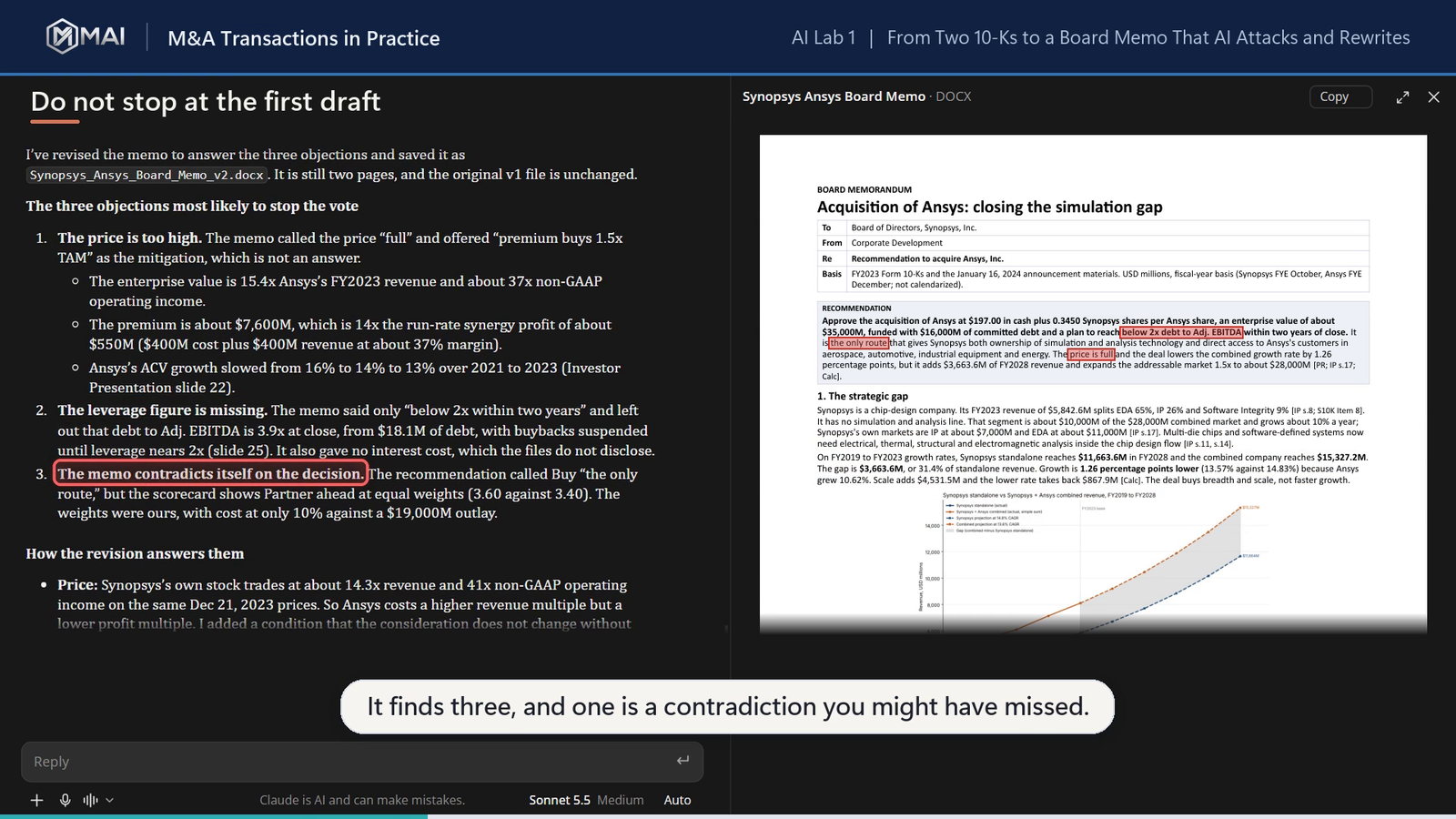
The revised memo replaces the absolute claim with a conditional recommendation: Buy is preferable if the board ranks customer access and technology control above cost and speed. Keep that qualification in the opening paragraph. A director should not have to reconcile the recommendation with a contradictory footnote several pages later.
4. Put the missing risk number beside the decision
The original memo mentions a plan to reduce debt to adjusted EBITDA below 2x within two years. It omits the 3.9x closing leverage figure highlighted during the critique. A future reduction target and the starting exposure answer different questions. Both are needed to understand the proposed financing path in this historical case.
In the revised Word file, 3.9x appears in the recommendation, the key-deal-numbers table and a dedicated risk row. This is a substantive improvement because the reader sees the starting exposure before reaching the mitigation. It does not mean the proposed financing has been independently validated.
In the board memo template’s risk section, read each mitigation and ask which exposure it answers. A statement about future synergies does not by itself explain whether the price is justified. A deleveraging target does not establish the interest cost or show how a weaker operating case would affect debt capacity.
Apply the same discipline to the board memo template’s economics section. Place the major exposure and its basis beside the proposed response. Where a relevant input is missing, say so. In the demonstration, interest cost on the committed debt is not disclosed in the materials used; a confident paragraph should not conceal that gap.

5. Separate proposed conditions from company commitments
The AI revision adds three conditions: board approval before changing consideration, restrictions tied to deleveraging, and confirmation of the scorecard weights before the vote. These are proposals generated during the exercise. They must not be presented as conditions that the companies actually adopted.
There is a second issue. The chat says the memo labels the three conditions as proposals. The downloaded Word file instead presents them as “Condition 1,” “Condition 2” and “Condition 3,” within an approval recommendation. The numbered conditions do not themselves carry the clear proposal label promised by the chat.
In your board memo template, use an explicit heading such as “Proposed conditions for board consideration.” Repeat the distinction where a condition appears in a table or slide that might circulate separately. A source citation near a new condition can otherwise make the whole row look sourced, even when only the background figure is.
This is why a board memo template needs a status field as well as a source field. A statement can be a disclosed fact, a management target, an analyst calculation, an AI judgment, a proposed action or an unresolved question. These categories have different meanings. Do not collapse them into one undifferentiated list of “findings.”
6. Inspect the calculation basis before polishing the prose
The exercise’s revised memo includes valuation multiples. Their apparent precision should prompt a check of the denominator, period and assumptions. For example, the operating-profit comparisons use approximately 35% for Synopsys and 41.5% for Ansys, with the latter taken from the midpoint of FY2023 guidance. They are not two identical audited profit measures.
The premium calculation also uses a basic share count. Keep that limitation attached to the result instead of turning it into a definitive fully diluted premium. If the article or slide does not need a derived number to explain the decision, avoid adding it merely because the AI produced it.
For each figure retained in the board memo template, record four things: the source, the period, the calculation and the interpretation. “15.4x revenue” is more informative when the reader can see that it uses an approximate transaction enterprise value and the exercise’s FY2023 Ansys revenue denominator.
Use the same check for the growth chart. The case’s $3,663.6 million FY2028 difference comes from historical-rate projections, while the combined growth rate is 1.26 percentage points lower than the standalone rate. A larger projected revenue total is not evidence of a faster growth rate. The memo should preserve both observations.
7. Inspect the completed board memo template in Word
Download the file and inspect it independently of the completion message. Check that the revised recommendation is present, the risk numbers match the table, the proposal labels are visible and the chart remains readable. In this exercise, the original task calls for two pages. Fitting that limit is useful only if the smaller chart and source notes can still be read.
Keep a short comparison log alongside the board memo template. Record the original sentence, the objection, the revision and any unresolved question. This gives a reviewer a clear account of what changed without forcing them to reconstruct the entire chat. It also makes it easier to spot a new unsupported statement introduced during an otherwise helpful rewrite.
Do not confuse a file that opens with a document that has been substantively checked. Opening confirms basic usability. Comparing the file with the evidence confirms whether the requested changes reached the deliverable. For the board memo template, both checks matter because the document, rather than the chat, is what the board will receive.

8. Carry the conditions into the five-slide deck
The final course prompt asks for five slides: the decision, the growth gap, why acquisition rather than building or partnering, the three objections and responses, and the next steps. This sequence carries the board memo template into a concise presentation. It also creates another opportunity for a qualification to disappear as paragraphs become labels.
| Slide | Keep visible |
|---|---|
| 1. Decision | The requested action, the conditional recommendation and the principal exposure. |
| 2. Growth gap | Units, historical projection basis and the distinction between scale and growth rate. |
| 3. Options | The priorities behind Buy and the equal-weight result favouring Partner. |
| 4. Objections | Each objection, its response, and a clear label on proposed conditions. |
| 5. Next steps | Which actions are proposed, which dates belong to historical sources, and what remains unknown. |
Compare the slides with the completed board memo template for changes in meaning. In the source deck, the growth-gap shading extends across historical years as well as the projection. The earlier memo chart shades the projected period. The numerical story may still be interpretable, but the chart treatment has changed and should be explained.
Another slide compresses an industry-mix comparison. The memo refers to about 85% of Synopsys revenue as semiconductor and high-tech. Treating the remaining approximately 15% as simply “outside semiconductors” changes the category definition. Preserve the original category labels rather than presenting the complement as a separately disclosed measure.
A board memo template and its slides should therefore be reviewed as linked outputs. Check the final recommendation, source periods, assumptions and proposed conditions across both. Fix the document that will circulate, even if the chat already contains the correct qualification.
Use the board memo template in your next AI review
Complete the board memo template with sourced evidence, apply the skeptical-director prompt, and require each objection to identify the sentence or figure it challenges. Revise the Word file, inspect the download and only then create the presentation. The goal is a recommendation whose conditions remain visible throughout that process.
Download the original prompts and 5-page practice guide →
The guide retains AI Lab 1 exercises 5 and 6. It explains the preparation, provides the original prompts and identifies the checks to repeat. Page 2 introduces the MADEX Certification Bundle and the two Full Courses for learners who want to develop the underlying transaction and valuation skills.
Questions about the board memo review
Can this board memo template also be used as a board paper?
Yes, the decision, evidence, alternatives and conditions can form a decision paper. Use the terminology, required sections and approval conventions of your organisation. A routine update or assurance paper may need a different structure from an acquisition vote.
Should AI decide which objection matters most?
AI can identify candidate objections and connect them to passages in the draft. The responsible reviewer still judges materiality, verifies the evidence and decides what further analysis is needed. Asking the model to critique its own work is a useful review step, not independent assurance.
Is the five-slide deck ready to send once generated?
No. Compare it with the checked memo, inspect every slide and confirm that numbers, categories and proposal labels retain their meaning. Keep the historical case date visible. A concise deck can make a qualified recommendation appear absolute if its conditions disappear.