M&A Advisory Fees: 5 Checks for the Success Fee
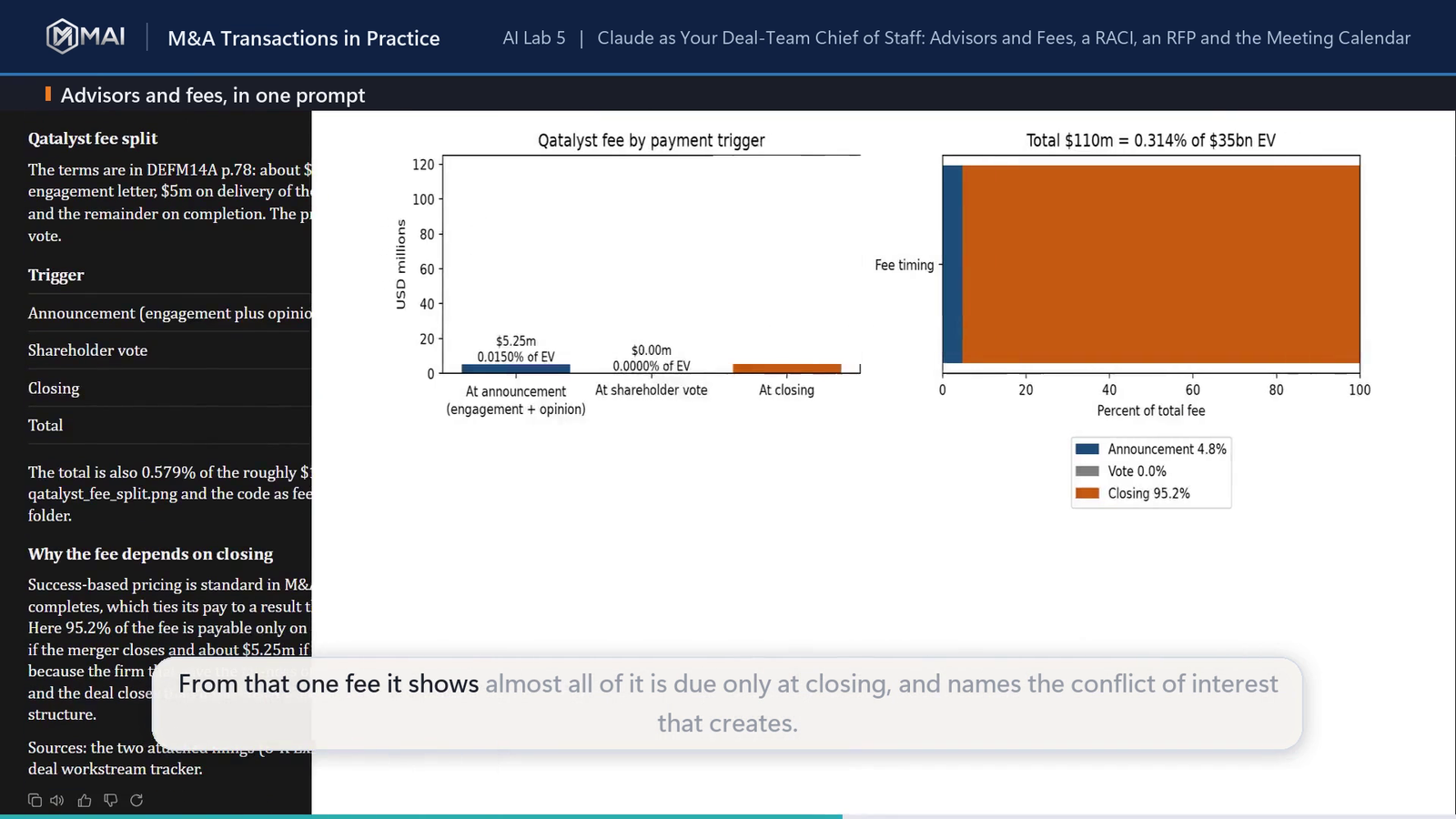
M&A advisory fees can include several payments with different triggers. In the Synopsys–Ansys case, the Ansys definitive proxy estimates Qatalyst Partners’ total fee at about $110 million. The disclosed terms imply that approximately $104.75 million depended on completion, about 95.2% of the estimated total.
Use this case to rebuild the fee from the filing, test what the AI output labels as a payment event, and decide who should review a similar engagement in your own deal. The companion M&A checklist exercise explains how to give each action a source and an owner.
1. Read the payment terms in the proxy
When reading M&A advisory fees, start with the adviser, its client and the service covered by each fee. Ansys engaged Qatalyst to provide financial advisory services in connection with the merger. Qatalyst delivered a fairness opinion to the Ansys board. The proxy sets out the engagement payment, the payment for delivery of the opinion and the balance contingent on completion.
Record the M&A advisory fees as three separate entries. The $250,000 payment was due when the engagement letter was executed. The $5 million payment was due on delivery of the opinion, regardless of its conclusion. The remaining portion was payable upon and subject to completion of the merger.
1.1 Record the wording, page and scope
For M&A advisory fees, use a source note such as “Ansys definitive proxy, Opinion of Qatalyst Partners, printed p. 78.” Capture the client, adviser, payment trigger, amount or formula, and whether the amount is an estimate. Keep a link to the filing with the fee schedule so a reviewer can inspect the source from the same row.
Claude’s recorded output found one disclosed fee in the inputs it read. Other advisers’ amounts belong in a field marked “not disclosed in reviewed materials.” Reserve a numeric zero for a narrowly defined event where the cited schedule provides no separate payment, such as a vote-specific fee in this case. A reviewer should be able to tell which entries require more research.
Where the file uses a grouped label, keep the source wording alongside the label. A spreadsheet can show the total committed amount for budget purposes and still preserve three lines for the events that make each portion payable. If the filing gives only a formula or an estimated aggregate, mark the input accordingly. In this case the completion payment is inferred from the aggregate estimate and the earlier specified amounts. An executed engagement letter or a later disclosure can provide more detail about how the estimate was derived.
Record the limit of your search for each adviser. The training exercise uses the press release and an excerpt from the proxy. A bank may be named in the financing section while its economics appear in a separate commitment or fee letter. Keep “adviser,” “lender” and “administrative agent” as separate roles if the documents distinguish them. A name in a funding table gives a reviewer a place to start, while the engagement terms determine whether that name belongs in your advisory fee schedule.
1.2 Define the coverage of the M&A advisory fees register
Start with four columns for the entity, the client it serves, the role stated in the source, and the location in that source. Add three fields for the fee, the currency and the payment event. This structure lets you group roles by client without merging distinct engagements. If the same firm appears in more than one capacity, add a separate row for each capacity you can substantiate. Keep a link back to the table or paragraph supporting each row.
When the AI supplies an amount you cannot find in the sources for M&A advisory fees, treat it as an open review item. Search the page first, then check the engagement or opinion section, using the printed page numbers. Record what you checked and the specific question that remains. If you have only the public extracts, ask for the source that describes the fee terms. Do not infer a fee from an adviser’s name or the fact that it appeared in the press release.
Watch the fee split and deal-team exercise
2. Rebuild M&A advisory fees by trigger
Express all M&A advisory fees in the same units before calculating the residual. In millions of US dollars, subtract 0.25 and 5.00 from the estimated total of 110.00. That leaves about 104.75 contingent on completion. Divide 104.75 by 110.00 to get approximately 95.2% of the estimated fee.
| Disclosed trigger | USD millions | Evidence |
|---|---|---|
| Execution of the engagement letter | 0.25 | Amount specified in the proxy |
| Delivery of the fairness opinion | 5.00 | Payable regardless of the opinion’s conclusion |
| Shareholder vote | 0.00 separately identified | The cited terms specify no vote-only payment |
| Completion of the merger | Approx. 104.75 | Calculated residual from the estimated fee |
| Estimated total | Approx. 110.00 | Aggregate estimate in the proxy |
2.1 Keep the fee share and deal-value ratio separate
The 95.2% figure answers how much of Qatalyst’s estimated fee was contingent on completion. A different calculation, $110 million divided by the case’s approximate $35 billion enterprise value, gives about 0.314%. Label the denominator beside each result when comparing M&A advisory fees. A reader should be able to recalculate both figures without guessing what the percentage measures.
The recorded chart calls the $5.25 million group “announcement.” The filing gives the underlying events as engagement execution and opinion delivery. Keep the chart’s grouping when discussing what the AI produced and use the filing’s event wording in any decision memo or fee schedule.
A useful review of M&A advisory fees also traces each spreadsheet input to one specific paragraph. Put the total, the two earlier payments and the residual on separate lines. Then run a simple tie-out that adds them back to the estimate. If a second analyst changes one of the earlier amounts after reading the filing, the residual and percentage should update from the same formula. Save the dated source alongside the spreadsheet so the person reviewing a later estimate can see exactly what changed.
Use the M&A advisory fees schedule to frame two scenarios for a transaction team. In the first, the engagement letter has been executed and the opinion delivered, but the transaction does not complete. In the second, the merger completes. Under the disclosed triggers, the second case adds the estimated completion-linked balance. The example illustrates the importance of an event-based budget, since two deals with the same aggregate fee can have very different amounts due before a closing decision.
2.2 Review payment dates and conditions for M&A advisory fees
A milestone in the deal timeline and a trigger in a fee schedule can occur on the same date. Give them separate fields so you can keep the source wording when the timing differs. A public announcement, the delivery of an opinion and the approval of a deal may happen close together. An adviser’s compensation terms can distinguish all three, as the two earlier payment triggers in this case show.
In a working model for M&A advisory fees, keep dates blank until the evidence supports them. You can still estimate cash due by event using the amount and trigger. If the model includes a payable or forecast cash date, show how you derived it and identify the remaining confirmation. Ask counsel to read the condition and ask finance to reconcile the amounts and any timing assumption. This lets each person verify the part that falls within their remit.
3. Identify the incentive the fee creates
Compare the amount due for providing the opinion with the amount that depended on closing. The completion-linked balance gives the adviser a financial interest in the outcome. When reviewing M&A advisory fees, a board or deal team can use that fact to decide which assumptions, comparisons and disclosures deserve closer review.
Check the opinion’s date, audience and scope before citing it. Ask whether the reviewer has the engagement terms and the full opinion. Keep the financial interest, the analysis supporting the opinion and the board’s own decision in separate lines of the review. Each line has a different source and person responsible for checking it.
3.1 Review the incentive in closing-contingent M&A advisory fees
When M&A advisory fees depend on completion, ask what assumptions the opinion used and when the adviser last checked them. Identify the information that changed after the opinion date, who evaluated it and how the team documented the conclusion. For a board briefing, put the timing of the opinion, the financial incentive and the decision requiring approval together so directors can ask which evidence supports each point.
Carry the distinction into the workstream tracker. The adviser can supply the work and explain its assumptions. The review owner decides whether the team has enough evidence to take the item forward and records any open question. If the workstream needs approval beyond that owner’s mandate, route it to the designated authority. The disclosure of M&A advisory fees helps identify what to review. The decision-rights sheet records who has authority to act.
4. Assign a role to check each fee and decision
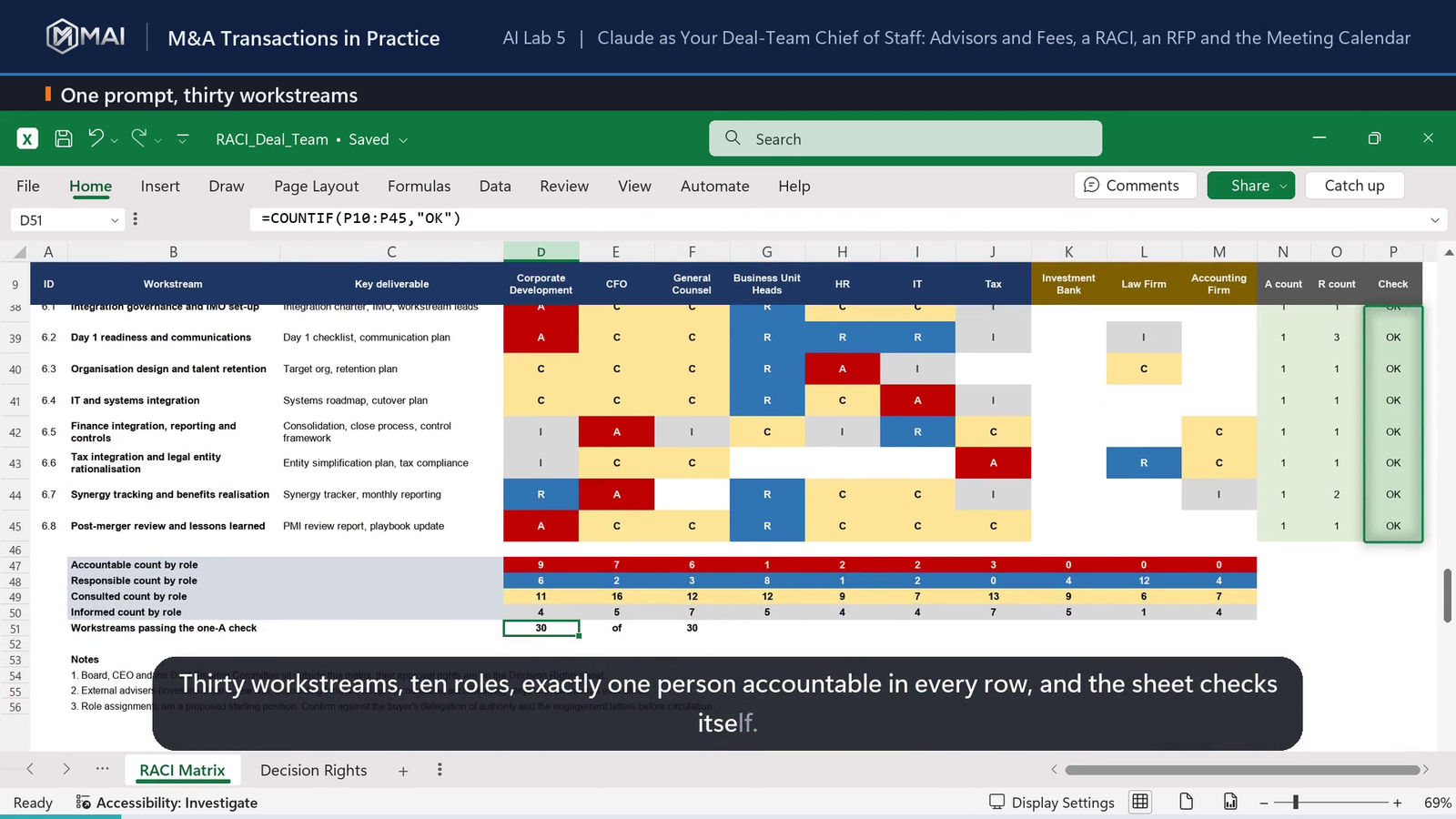
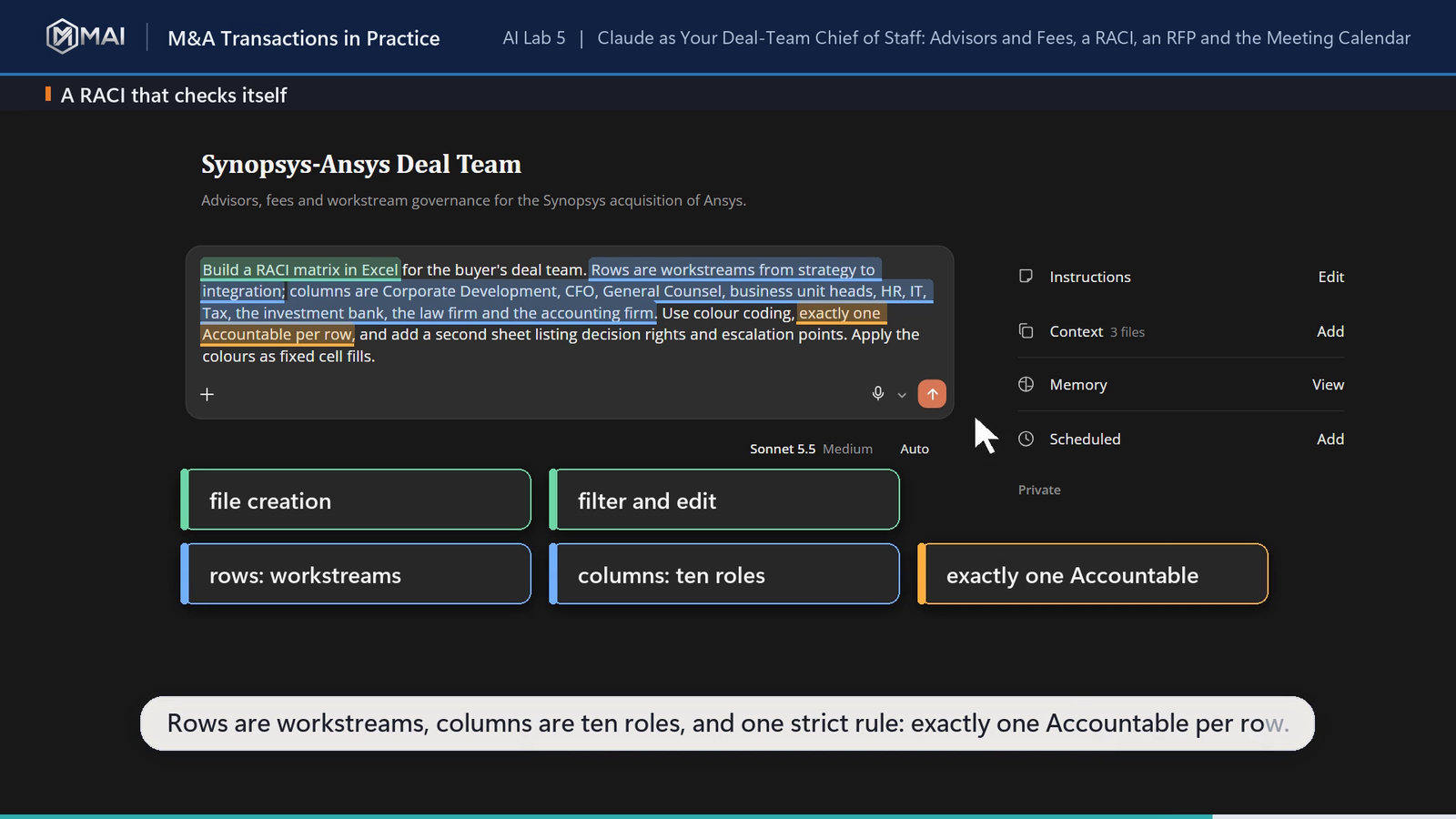
A RACI matrix identifies who is Responsible, Accountable, Consulted and Informed for a workstream. In the recorded exercise, Claude created 30 workstreams across ten role columns. Every row has one A and at least one R. The investment bank, law firm and accounting firm have no A assignments in this sample workbook.
Give the review of M&A advisory fees a named internal owner. For example, the deal lead can assemble the adviser list and confirm the underlying pages, counsel can check the engagement and disclosure terms, and the CFO can verify the arithmetic and the budget implication. Use the buyer’s delegation rules to identify who can approve a fee change.
4.1 Inspect the checks and the decision-rights sheet
The workbook counts A and R separately, then returns OK when the A count equals one and the R count is at least one. Check that the formulas cover all ten role columns. If a workstream passes, look at the role that holds the A and the deliverable described in the same row. Recalculate the checks after changing any roles. The fixed fill colours in the file can remain unchanged after an edit.
The second sheet records 16 decisions, a four-level escalation ladder and nine escalation triggers. It leaves the buyer’s approval amounts and other thresholds for the team to complete. Compare the proposed committee, escalation route and response time with the decision rules actually used in your transaction.
Check one approval path from start to finish. The recorded workbook’s decision-rights sheet assigns the non-binding offer recommendation to Corporate Development, shows the steering committee as the decision maker subject to the Board threshold, and lists CFO, Tax and the investment bank for consultation. The Board threshold is an input for the buyer to supply. Before reusing that line, open the actual mandate and identify who may sign or communicate an offer at the proposed price.
Apply the same check to a change in M&A advisory fees. Identify the role that tracks the engagement budget, the person who verifies the new trigger against the letter, and the role that can approve an overrun. Write down the escalation event in terms that a deal team can observe. The example workbook has a placeholder for the adviser fee overrun that triggers CFO review. Enter the approved threshold and confirm where the team records the decision.
5. Test the source and the assignment together
Rebuild the M&A advisory fees schedule from the public filing using the four payment-event lines. Give a colleague the source page and ask them to reconstruct the residual and percentage without looking at your worksheet. Then give one person the job of verifying the payment triggers and another the job of checking the arithmetic. Mark who is accountable for getting the finished review to the approval body.
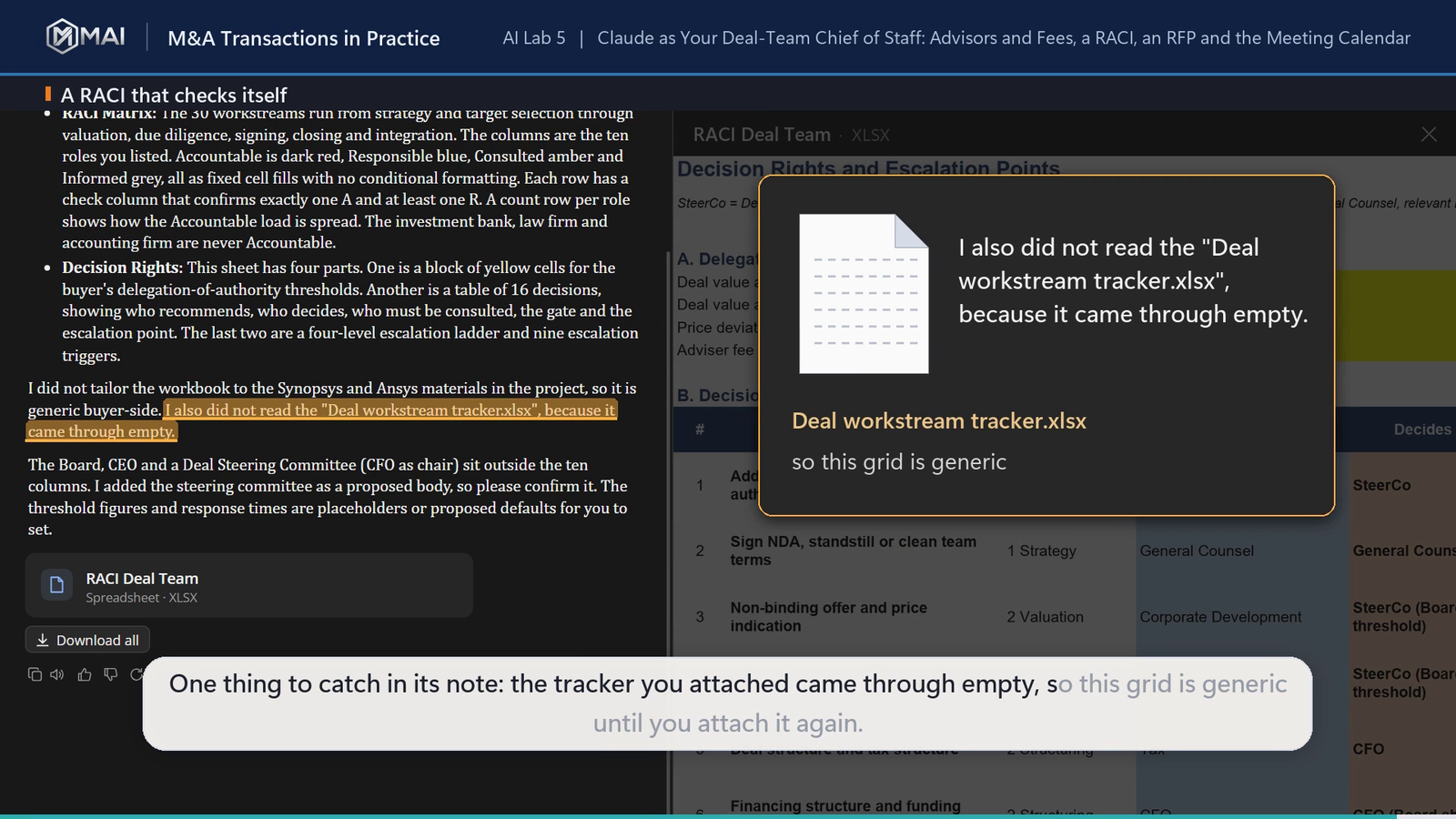
Claude said the attached tracker came through empty. That leaves the recorded workbook generic even though its formula checks pass. Confirm the contents of your own tracker in a fresh run. Ask the tool to identify the changed workstreams and explain any reassignment before you use the workbook with a deal team.
Have a second reviewer inspect a workstream that changed and one that stayed the same. Ask them to trace the role and the approval authority to the tracker or mandate. Then temporarily create a duplicate A in a working copy and confirm the check switches to CHECK. Restore the row and confirm it passes again. This checks that the formula can detect the error the team actually wants to catch. The role assignments themselves still need a review against the workstream evidence.
5.1 Leave a review trail for M&A advisory fees
For M&A advisory fees, give the reviewer a small set of artifacts: the cited filing page, the four-event fee worksheet, the relevant workbook row and the decision-rights entry for escalating a fee change. Include the date of the source and the scope of any excerpt. Ask the reviewer to recalculate the residual independently and to identify whether your authority entry refers to budget review, agreement approval or approval to close. Correct any ambiguity before circulating the pack.
Record the final owner in the workstream tracker with the evidence they need and the deadline. If an amount is still unconfirmed, assign the follow-up and leave the amount field unconfirmed. If a formula flags multiple accountable roles, fix the assignment and record which role will own the outcome. The schedule of M&A advisory fees, the workbook and the approval record should lead a colleague to the same next action.
FAQ
How much of the estimated fee depended on closing?
About $104.75 million, or 95.2% of the approximate $110 million estimate. The figure is the residual after $250,000 for engagement execution and $5 million for delivery of the opinion.
How do I record undisclosed M&A advisory fees?
Use the amount and trigger where the reviewed materials disclose them. For missing amounts, record the document scope and leave the amount unconfirmed. Seek the relevant engagement terms if the fee matters to the decision.
What does a passing RACI formula establish?
It establishes that the letters in the checked range satisfy the formula. Compare the proposed owner, decision right and escalation threshold with the actual mandate before relying on the assignment.
Sources and scope
Ansys definitive proxy, Opinion of Qatalyst Partners, printed page 78. Fees are estimates based on the disclosed payment triggers. Workbook counts refer to the recorded AI Lab 5 Excel output.
Check M&A advisory fees in your next deal
Open the filing, name the event for each payment, and write down who checks the fee before the approval meeting. Use the M&A advisory fees practice guide to run the two original exercises.