Financial Modeling and Valuation Course Structure
A Practical Learning Flow Built from Fundamentals to Valuation Report

How the Course Is Structured

Differentiated Learning Materials

AI Simulation, Excel, and Report
Our Learning Interface
Investment Valuation Made Structured, Visual, and Analyst-Ready
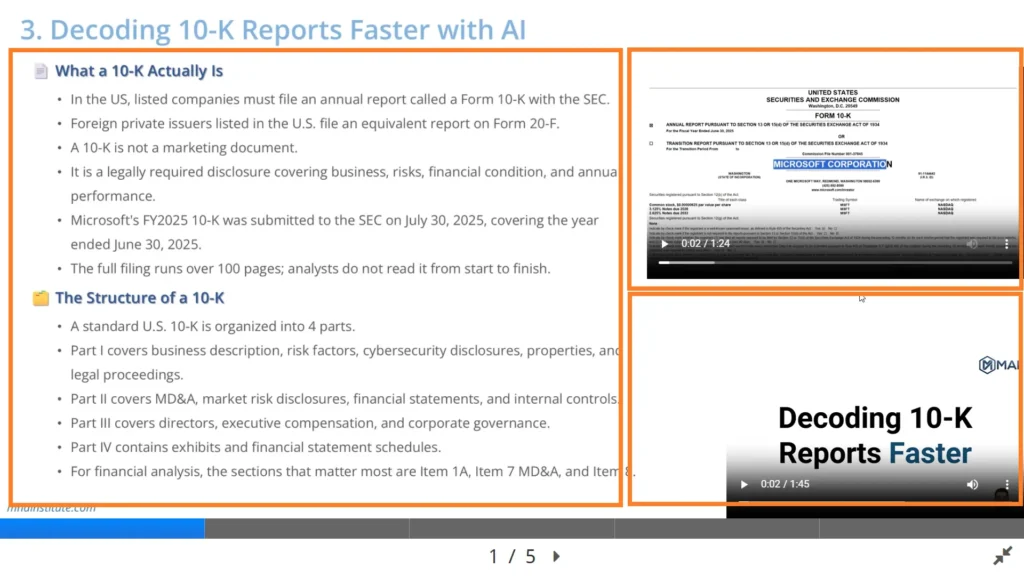
Our learning interface is engineered to convert complex valuation theory and financial data into analyst-grade judgment — across every stage of this financial modeling and valuation course.
- Scientifically Designed Three-Layer Interface
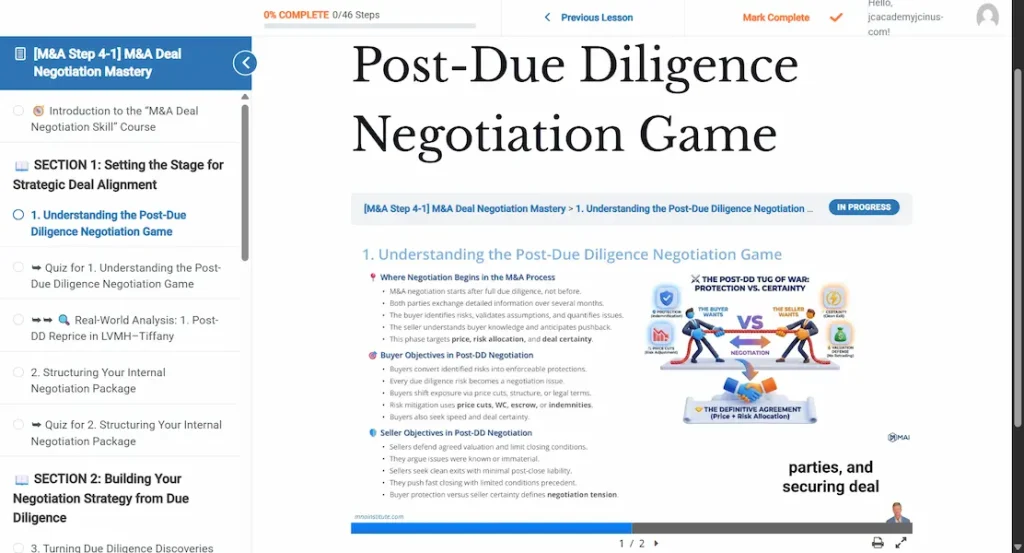
Every lesson in this corporate valuation course follows a three-layer learning structure designed to help learners understand complex concepts quickly and intuitively.
-
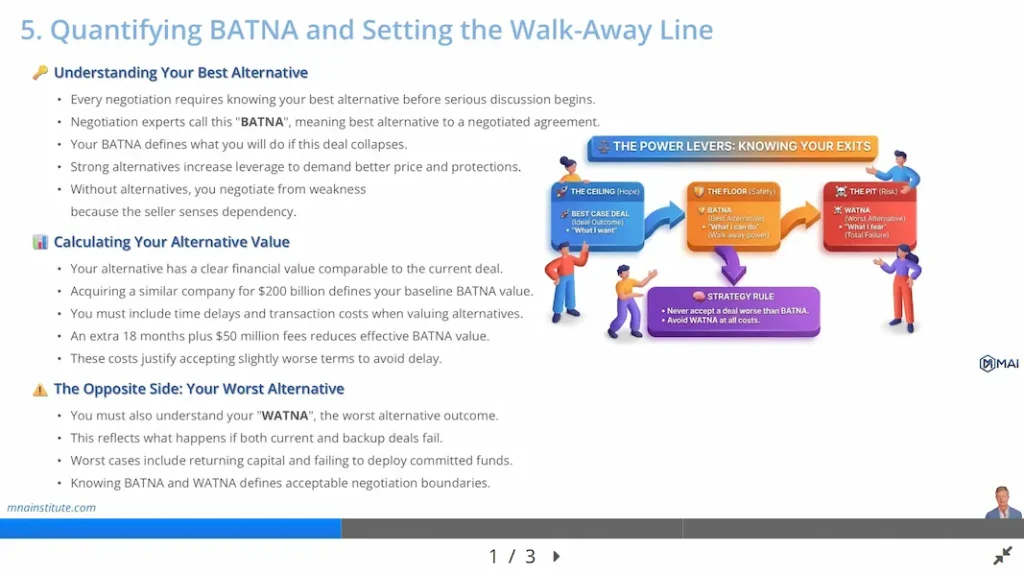
# Left Panel: Structured Written Content
Carefully edited bullet points guide you through each concept with clarity. Even reading the text alone ensures full comprehension. As the audio plays, your eyes naturally follow along, reinforcing understanding through synchronized reading and listening.
-
# Right Panel: Visual Infographics or Workflow Demonstrations
Visual Infographics and Valuation Walkthroughs Colorful diagrams translate abstract valuation logic. Where AI is applied, screen walkthroughs show the exact prompt, the output, and the analyst's verification step.
-
# Bottom: Audio Narration with Real-Time Subtitles
Live subtitles appear word-by-word as you listen. Adjust playback speed (0.5x to 2x) to match your learning pace. Fullscreen mode available for immersive focus.
- -
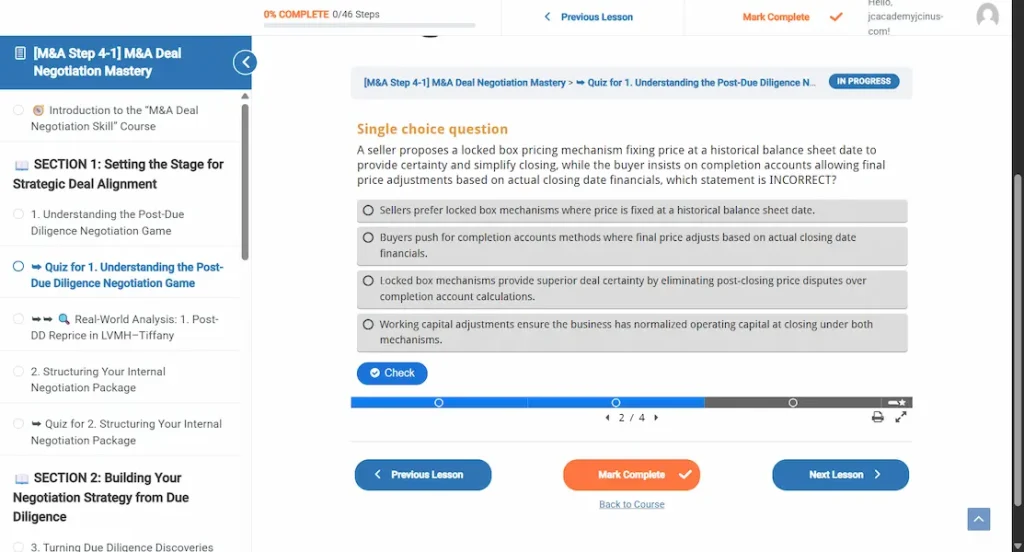
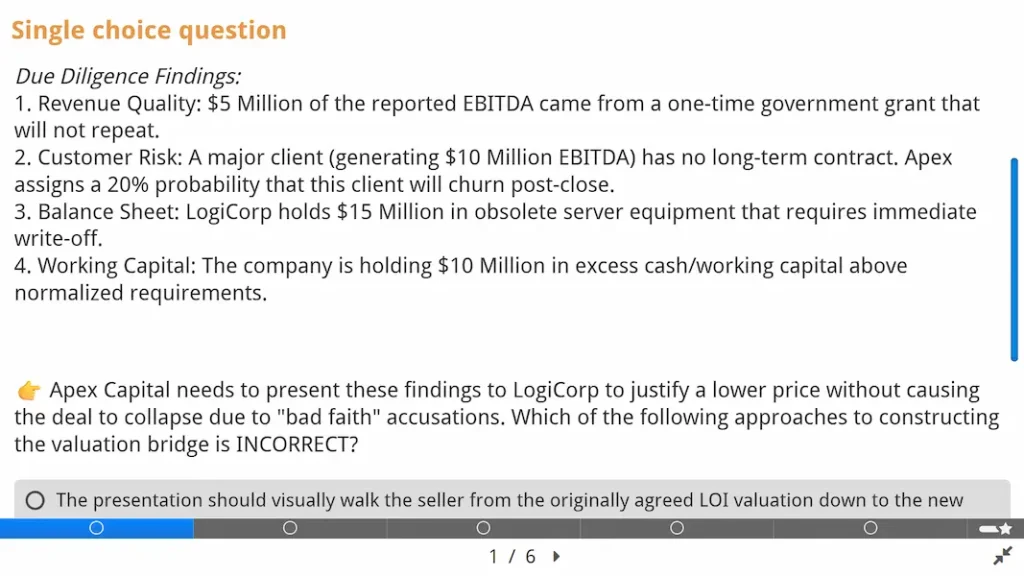
Practical Application Quizzes
What you learn in the lesson becomes yours through targeted quizzes. Each question is designed with valuation and modeling scenarios, testing not just knowledge, but your ability to apply forecast logic, statement linkage, and analyst judgment in practice.
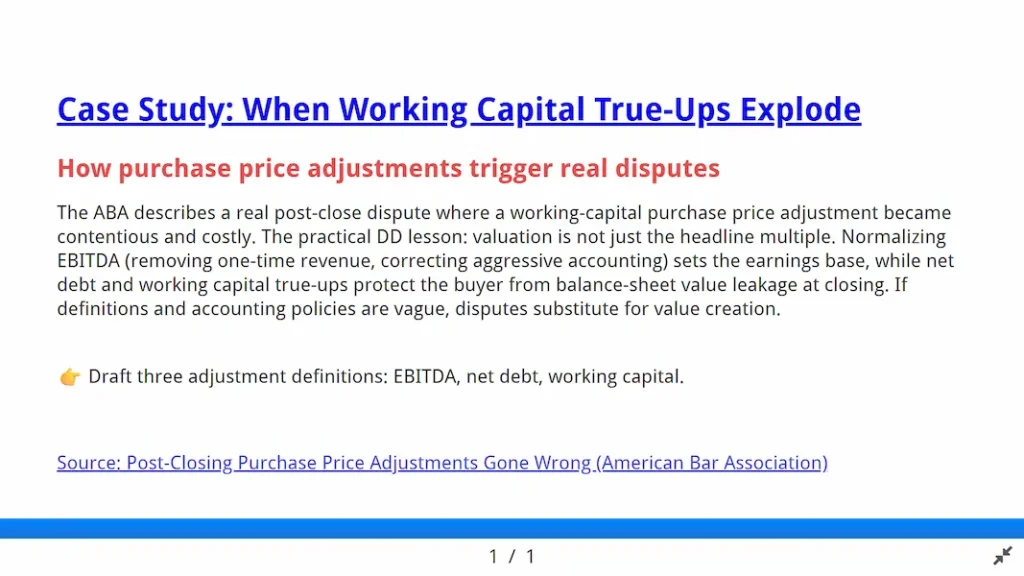
- - Applied Financial Analysis Tasks
Turn each lesson into analyst work. Complete focused tasks using 10-K filings, AI prompts, Excel models, peer data, and report outputs to calculate WACC, project FCFF, read a Comps table, and write valuation report conclusions. This financial modeling and valuation course is built so that every task produces a usable analyst output.
The result? You don't just understand valuation. You execute it — from DCF to Comps to a professional report —
completing this financial modeling and valuation training with the discipline of a working analyst.
From Valuation Skills to MADEX Readiness
Learn the Model. Support the Deal.
This course strengthens the financial analysis and modeling foundation that supports MADEX preparation.
It helps you interpret financial performance, cash flow, valuation logic, and transaction economics with greater confidence.
MADEX exam questions are drawn directly from the M&A Full Course; this course supports the financial understanding behind acquisition financing and LBO work.
Course Content
🏗️ Course I. Valuation Fundamentals + AI & Excel Functions
Build the foundation for valuation judgment before moving into financial statements, forecasting, WACC, DCF, CCA, and report writing.
- Separate value from price, define real valuation purposes, and understand when analysts use valuation in equity research, M&A, IPOs, fundraising, and internal decision-making
- Learn EV (Enterprise Value), Equity Value, valuation method selection, time value of money, and the Excel logic behind the first DCF model
- Apply AI as a valuation accelerator using structured prompts, trust verification, and a ready-to-use prompt library
-
📊 Course II. Financial Statement Analysis Course
Understand how analysts read income statements, balance sheets, cash flow statements, and 10-K filings before valuation begins.
- Connect financial statement analysis to earnings quality, FCF, valuation multiples, DCF inputs, credit risk, and deal judgment
- Analyze revenue quality, cost structure, liquidity, working capital, net debt, ROIC, DuPont, and valuation signals
- Use AI to extract filing data, clean Yahoo Finance tables, calculate ratios, detect red flags, and write analyst commentary
-
📑 Course III. 3-Statement Financial Modelling Course
Turn business research and historical financials into a forecast model that produces EPS, EBITDA, FCF, and valuation-ready outputs.
- Translate products, customers, pricing, volume, industry forces, and cost structure into forecast assumptions
- Build revenue, CapEx, D&A, working capital, debt, interest, SBC, buyback, share count, and statement schedules
- Verify the full model through balance sheet checks, cash checks, net income linkage, calibration, and scenarios
-
⚖️ Course IV. Calculate WACC
Learn how practitioners build the discount rate that drives every serious DCF valuation.
- Use market value capital structure weights instead of book values when calculating WACC
- Calculate cost of debt, cost of equity, CAPM inputs, beta, equity risk premium, tax shield, and final WACC
- Apply WACC to test whether an investment creates value or destroys value under real capital allocation logic
-
📈 Course V. Discounted Cash Flow Analysis
Build the intrinsic valuation method that converts forecast free cash flow into enterprise value and implied share price.
- Calculate FCFF and FCFE, then understand which method produces enterprise value or equity value
- Forecast revenue, EBIT, tax, D&A, CapEx, working capital, and FCF with real modelling logic
- Estimate terminal value, discount projected cash flows, read the implied share price, and stress-test the valuation range
-
🔍 Course VI. Comparable Company Analysis
Use market-based valuation to understand how public investors price similar companies.
- Choose comparable companies with analyst judgment across industry, business model, size, growth, margin, and risk
- Apply P/E, PEG, EV/EBITDA, EV/Revenue, P/BV, and FCF multiples in the right valuation context
- Read a comps table like a banker and convert peer multiples into an implied share price range
-
📝 Course VII. Turn Valuation Work Into a Professional Report
Convert valuation analysis into a clear, defensible conclusion for readers who need to make decisions.
- Define purpose, scope, standard of value, valuation date, audience, and report structure before writing
- Select the DCF, CCA, sensitivity, and scenario evidence that actually belongs in the report
- Reach a concluded value, defend the method weighting, and write an executive summary that earns trust
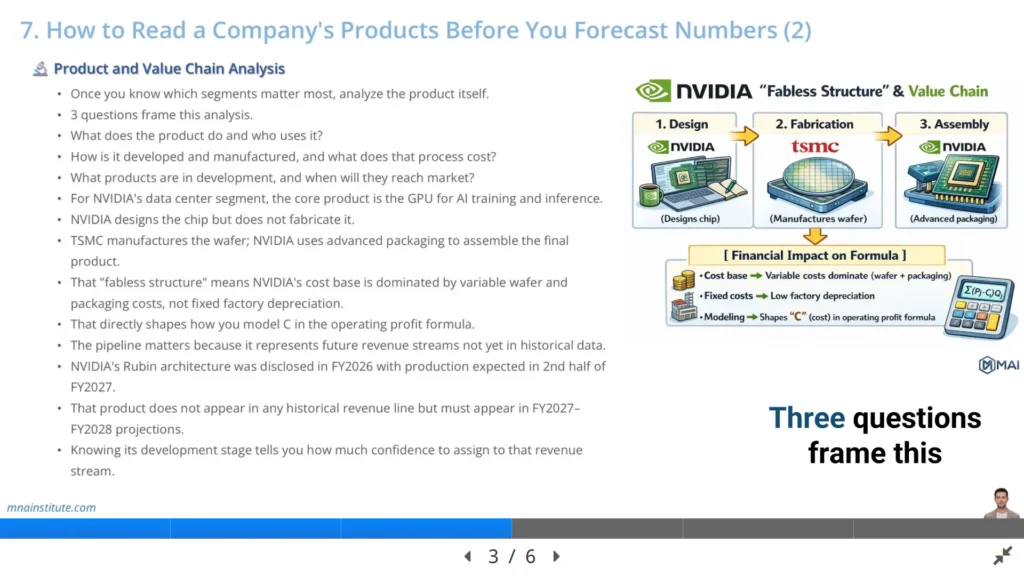
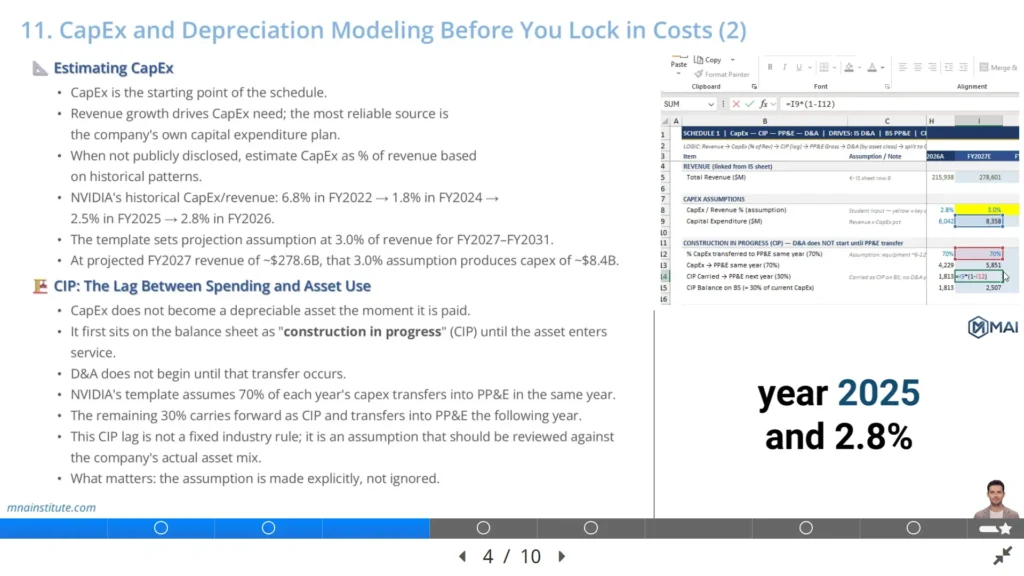
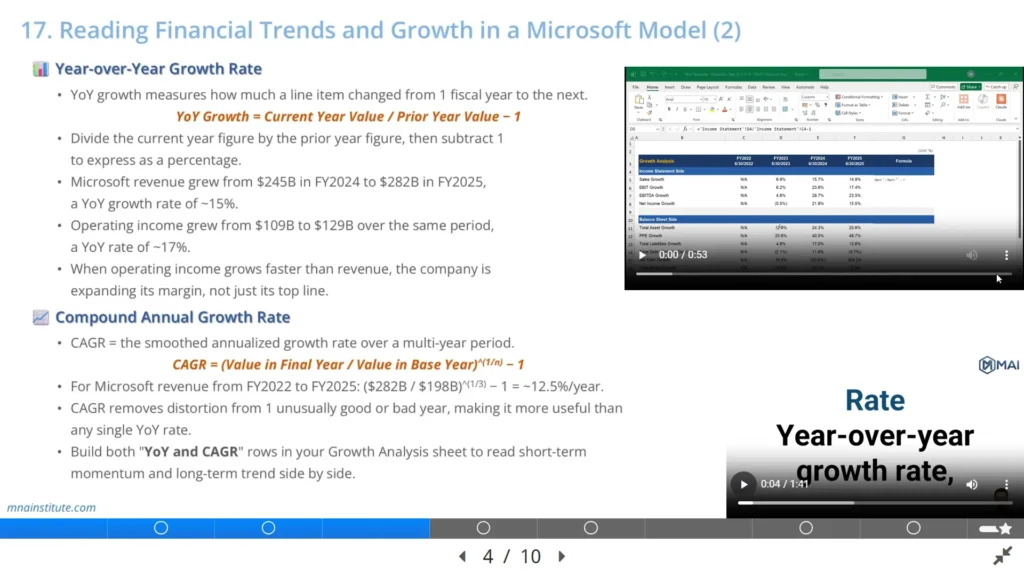
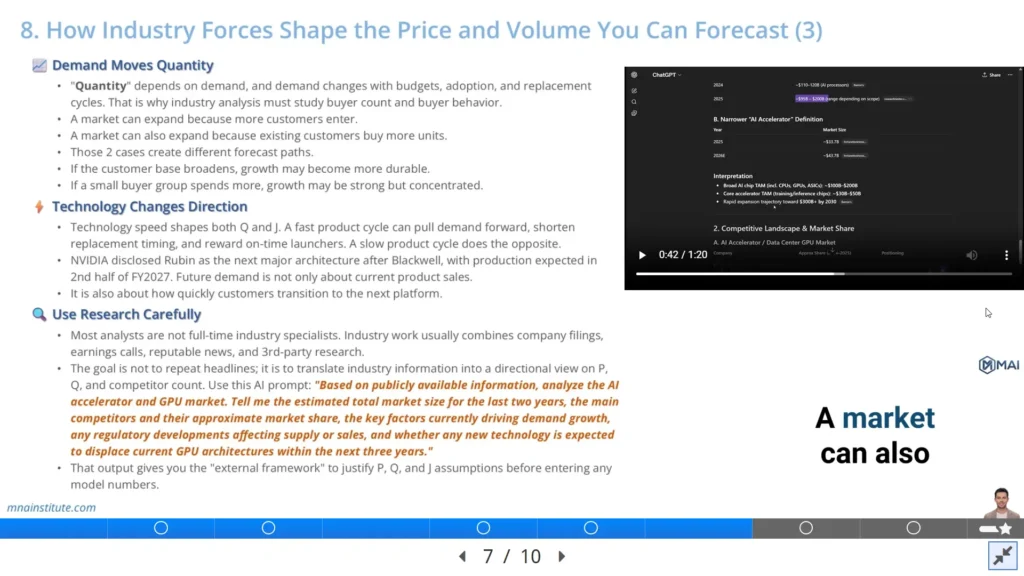
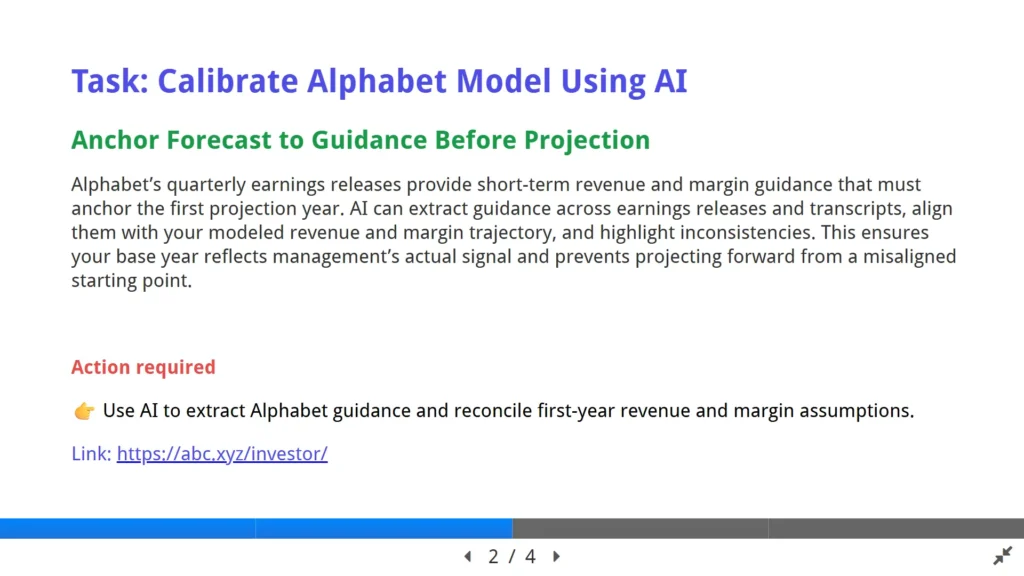
Applied AI Prompting and Tasks
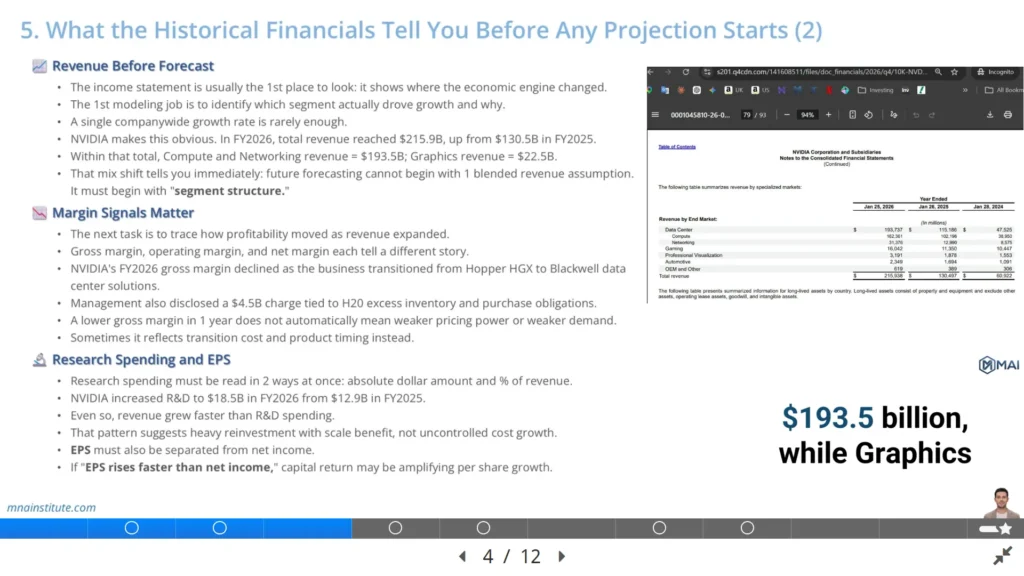
This financial modeling and valuation course applies AI across filing review, model building, valuation checks, and report writing.
- Reading 10-K Filings with AI
Use AI to extract revenue, operating income, cash flow, risk factors, segment data, and valuation inputs, then verify every figure against the original source.
- - Building Model-Ready Excel Inputs
Convert raw Yahoo Finance, 10-K, and peer data into structured Excel tables for financial statement analysis, forecasting, WACC, DCF, and CCA.
- - Forecasting with AI Support
Use AI to organize revenue drivers, margin assumptions, CapEx logic, working capital signals, and management guidance before building the forecast model.
- - Reviewing Valuation Formulas
Apply AI to explain, audit, and challenge WACC, FCFF, terminal value, EV bridge, sensitivity, and CCA formulas before final use.
- - Writing an Investment Report
Convert model outputs into concise investment commentary, valuation rationale, sensitivity interpretation, and report-ready conclusions.
- - And more
Applied AI tasks across financial statement analysis, 3-statement forecasting, WACC, DCF, CCA, sensitivity analysis, and valuation report writing.
Your Course 13 Templates
What You Will Analyze in This Financial Modeling and Valuation Course
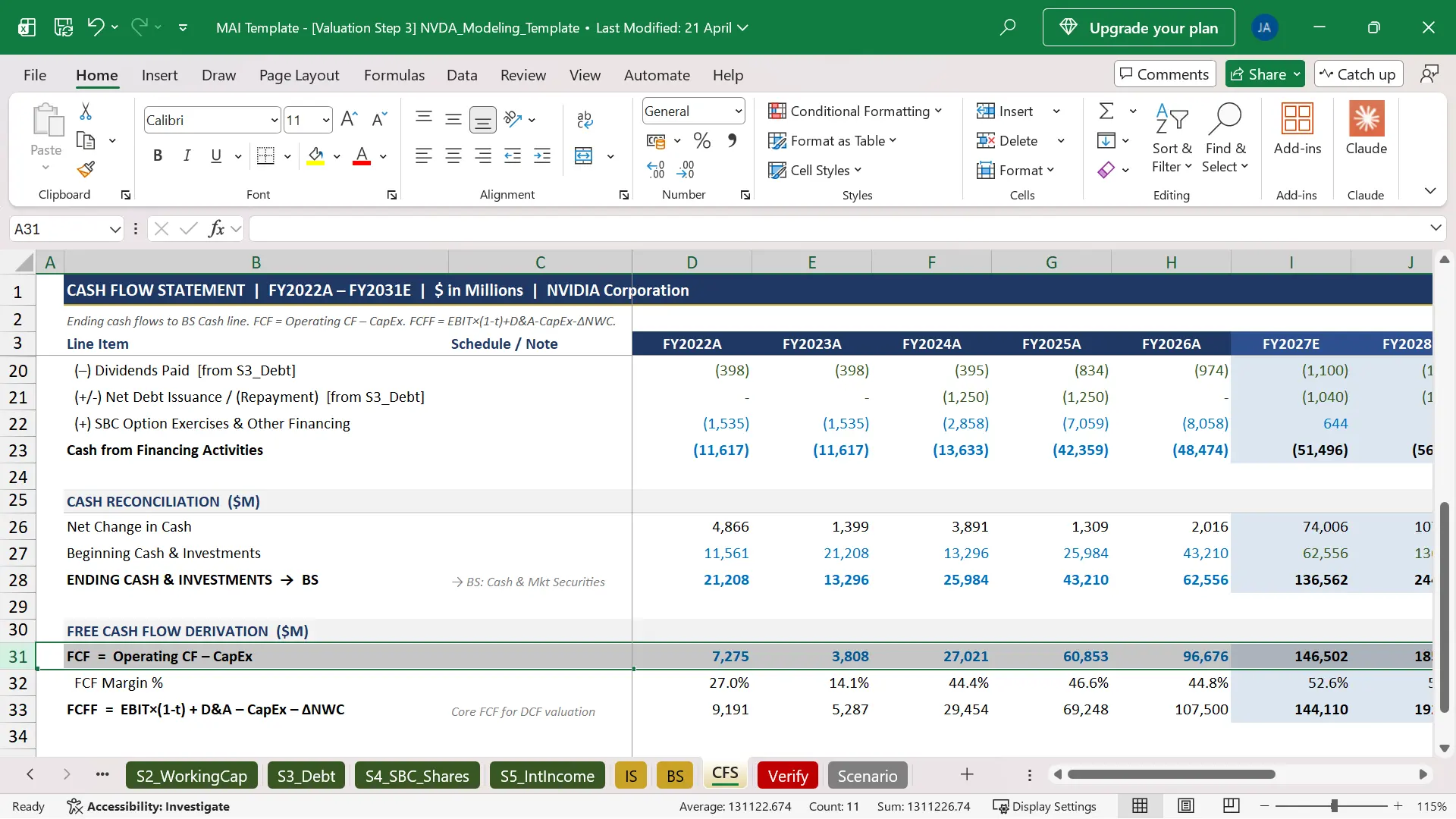
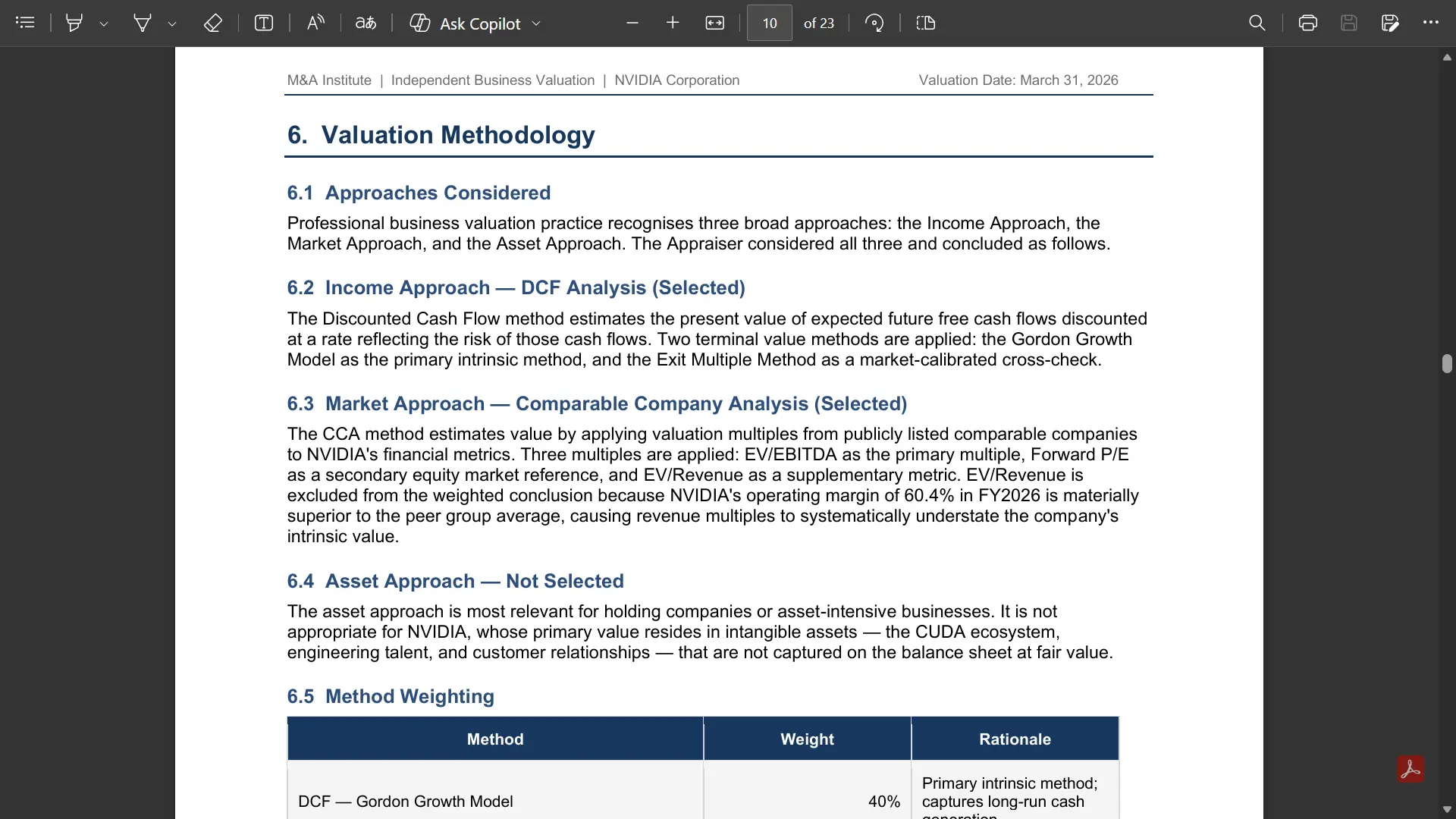
13 Professional Template that You Will Have/Analyze in This Financial Modeling and Valuation Course
- Financial Statement Analysis Templates
Use "the MSFT Financial Analysis Excel Model", "Industry-Specific FS Analysis Template", and "AI Prompt Playbook" to convert raw 10-K data into earnings quality, FCF, ratio, risk, and valuation judgment.
-
- 3-Statement Financial Modelling Template
Use "the NVDA 3-Statement Modeling Template" to understand how business research becomes revenue assumptions, schedules, income statement, balance sheet, cash flow statement, EPS, EBITDA, and FCF.
-
- Valuation Excel Templates
Work through TVM, Excel foundations, WACC, beta, DCF, CCA, and full valuation templates that show how professional valuation models move from assumptions to implied share price.
-
- Valuation Report Template
Review "the NVIDIA Valuation Report" structure to understand how purpose, methodology, DCF, CCA, sensitivity, concluded value, and executive summary become a professional valuation report.
-
- AI Prompt Playbooks (Prompt Engineering)
Use prompt libraries for financial analysis and valuation work, including extraction, assumption development, formula review, comps organization, risk identification, and analyst commentary.
AI-Powered Valuation Practice
in this Financial Modeling and Valuation Course
3 AI Simulations, 3 Excel Tasks, and 1 Report Writing Task
1. AI Simulation 1. Financial Statement Deal Analysis Lab
- Evaluate SignalWorks Analytics as a hybrid SaaS, hardware, and services acquisition target.
- Test revenue quality, EBITDA normalization, cash conversion, FCF, net debt, ROIC, valuation multiples, and deal judgment under CFO review.
2. AI Simulation 2. ArcLight Semiconductor IC Pressure Test
- Act as a junior equity research analyst defending a 3-statement forecast model for ArcLight Semiconductor.
- Translate business drivers into assumptions, schedules, EPS, FCF, calibration, scenarios, and IC-ready forecast judgment.
3. AI Simulation 3. HelioGrid Acquisition Valuation Committee
- Act as a Corporate Development and Valuation Associate evaluating Orion’s acquisition of HelioGrid Analytics.
- Defend price vs value, EV to Equity bridge, WACC, FCFF, DCF, CCA, sensitivity, bid range, and final IC recommendation.
4. Excel Task 1. NVIDIA FS Ratio Modeling Task
- Build a simplified one-sheet financial statement analysis model for NVIDIA.
- Calculate growth, margins, liquidity, leverage, efficiency, cash conversion, FCF, valuation signals, and short analyst commentary.
5. Excel Task 2. Alphabet Mini Financial Modeling Task
- Build a simplified one-sheet financial model for Alphabet.
- Connect revenue, operating income, net income, EPS, operating cash flow, CapEx, FCF, and analyst commentary.
6. Excel Task 3. Alphabet One-Sheet Valuation Model
- Build a compact valuation model for Alphabet with only five sections:
- Estimated FCF Table, WACC, DCF, Sensitivity, and CCA.
7. Report Task 1. Alphabet Abbreviated Valuation Report
- Write a concise 2 to 3 page Word report that converts DCF, CCA, sensitivity,
and concluded value into a clear investment recommendation.
Sample Internal View of The Course
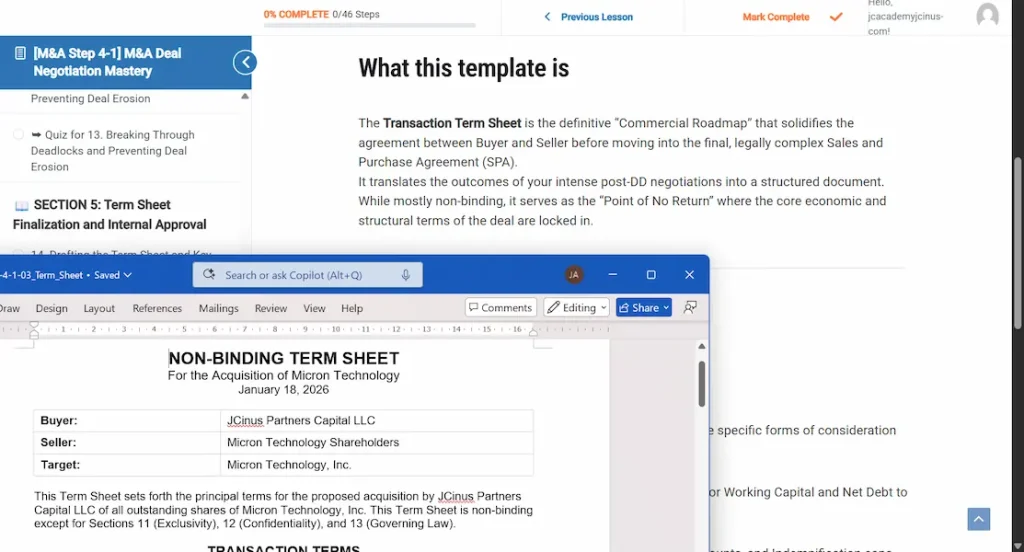
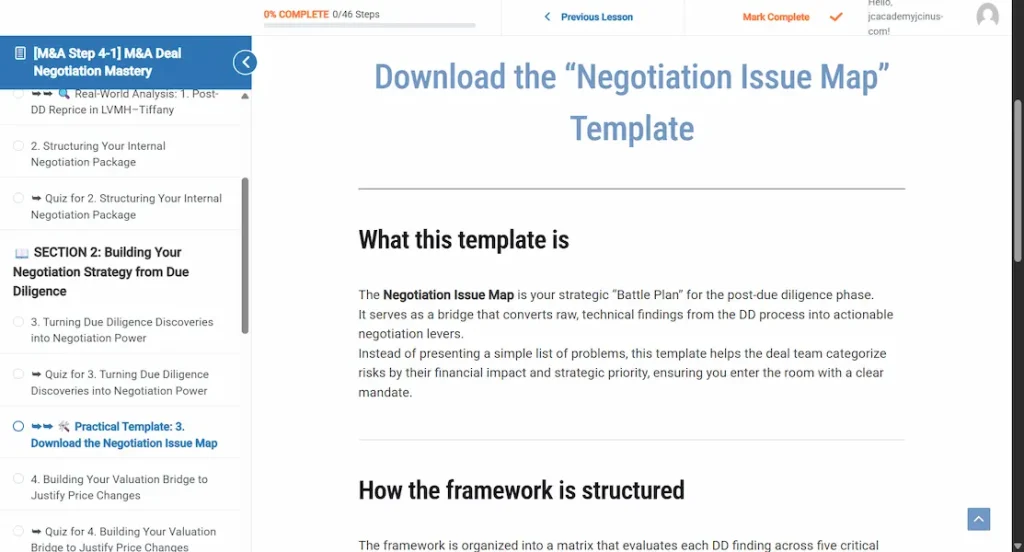
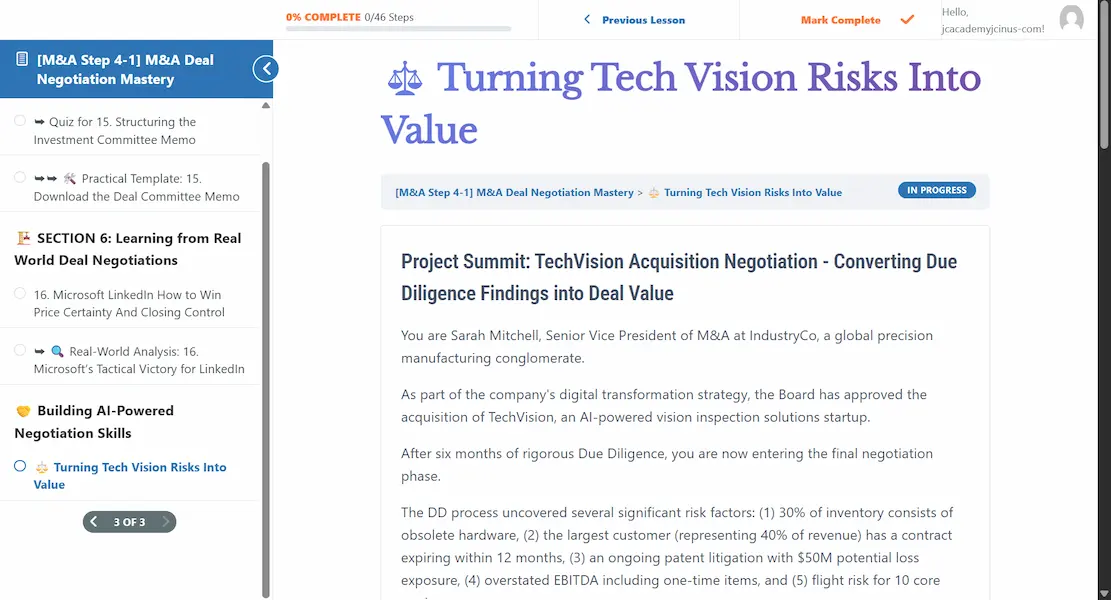
Visual Examples of Our Learning Tools
The images shown below are from another course and are included for reference only.
What You Will Gain from This Course
This online financial modeling and valuation course trains you
to read, model, value, and explain companies with analyst-grade judgment.

Read Filings and Extract Valuation-Ready Signals
Read 10-K filings the way valuation analysts do. You will know which items drive FCFF forecasts, which signal credit risk, and which require adjustment before entering a DCF or CCA model.

Translate Business Research into Forecast Assumptions
Build the discipline to convert products, customers, pricing dynamics, and industry forces into segment-level revenue and margin assumptions. You will never accept a generic growth rate without a business-driven rationale.

Calculate WACC and Apply It as a Decision Tool
Master the discount rate that drives every serious DCF valuation. Calculate cost of debt, cost of equity, and beta, then apply WACC to test whether an investment creates or destroys shareholder value.

Build DCF and CCA Models and Reconcile Their Outputs
Build intrinsic valuation using FCFF projections and terminal value, then cross-check against peer multiples. You will explain the DCF-to-CCA gap the way an investment committee expects an analyst to defend it.

Use AI Without Losing Valuation Judgment
Apply AI throughout this valuation workflow to extract data, organize assumptions, and draft report sections. You will know exactly which steps AI accelerates and which require independent analyst verification and final judgment.

Produce a Valuation Report and Defend It Under IC Pressure
Practice the financial modeling and valuation course content in AI simulation and Excel execution under IC pressure. You will receive instant feedback to convert model outputs into a concluded value and professional report.

Who Made This Course?
Built by the M&A Institute team, where real finance experience meets training design.
This financial modeling course was architected by experts with over 10~20 years of combined experience in M&A, Private Equity, Corporate Finance, Valuation, and Corporate Strategy.
Bridging the gap between financial modeling, corporate valuation training, and investment valuation training, we have translated the actual analytical frameworks of finance professionals into a practical, rigorous curriculum.
Content Built on Battle-Tested Experience
● Our curriculum is derived from actual experience in Cross-border M&A, Venture Capital, Corporate Buyouts, IPOs, Mezzanine Financing, and financial analysis.
● We utilize the exact analysis frameworks, modeling templates, and decision matrices used by CFA/MBA professionals in top-tier firms.
● The content is verified by practitioners in New Business Strategy, Corporate Finance, Research Centers, IB Divisions, and PE Teams.
● Our instructors have delivered over 200 corporate training sessions to global firms and financial institutions, educating over 8,000 professionals.
What Our Corporate Clients Say: