M&A Full Course/Step 7 of 9

Practical M&A Negotiation Course

From Valuation Bridge and BATNA to Term Sheet and IC Approval

This M&A negotiation course turns due diligence findings into price, protections and a credible walk-away position. Rehearse concessions and use a valuation bridge, term sheet and committee memo to obtain approval for a deal you can defend.

Course Highlights

  • 45 learning modules across 16 lessons in 6 sections.
  • Convert diligence findings into negotiable issues. Identify what belongs in price, a purchase price adjustment, an indemnity or a condition to closing.
  • Build a valuation bridge and a credible BATNA. Tie your opening position, concession limits and walk-away price to evidence the team can explain.
  • 5 AI Labs with original source materials and a downloadable practice guide.

What You Will Achieve

  • Quantify BATNA and set walk-away limits for committee approval.
  • Turn diligence findings into price, protection and closing-condition requests.
  • Use earnouts, escrow and MAE clauses to protect deal value.
  • Draft the M&A term sheet and committee memo for board approval.
16
lessons
45
learning modules
5
AI Labs
3 months
course access
Course Level
Beginner to intermediate
Prerequisites
M&A Process in Practice is recommended but optional.
Total Study Time
25–30 hours (estimated)
Final Deliverable
Negotiation issue map, valuation bridge, term sheet and committee memo
Who Should Take This Course?
  • Corporate development and PE deal teams
  • Investment banking and M&A advisers
  • Strategy and finance managers
  • Professionals preparing a term sheet

Our In-Person Training Delivered At

PwC, Samsung, LG, Hyundai, SK hynix and more

Course Structure & Learning Flow

Built by M&A Institute, drawing on 12 years of practical finance training and in-person instruction for more than 9,000 professionals.

  • Convert diligence findings into negotiable issues. Identify what belongs in price, a purchase price adjustment, an indemnity or a condition to closing.
  • Build a valuation bridge and a credible BATNA. Tie your opening position, concession limits and walk-away price to evidence the team can explain.
  • Rehearse the exchange with the seller. Record the move, the counteroffer and what your team received for each concession.
  • Translate the agreed package into a term sheet and deal committee memo. Test both against the original issue map before asking for approval.

How this M&A negotiation course is structured

  • 6 sections · 16 lessons · 45 learning modules
  • 5 AI Labs with guided practice
  • Quizzes and applied case studies
  • 25–30 hours of study (estimated)

Differentiated Learning Materials

  • Easy-to-follow infographics
  • Downloadable PDF lesson slides
  • Worked transactions and company cases
  • Negotiation issue map, valuation bridge, term sheet and committee memo

AI Labs

  • Convert DD into a negotiation brief
  • Test your price bridge
  • Rehearse a counteroffer
  • Audit the approval package

How you will use AI in M&A negotiation

Watch the M&A negotiation course demonstrations, then follow the source files and prompts to reproduce each result.

AI Practice Highlights

IC brief

Turn diligence into deal terms

Sort each finding into a price adjustment, a contractual protection or a question the seller must answer.

Output A negotiation issue log with proposed buyer responses

Valuation bridge

Set the walk-away price

Trace each issue to the valuation bridge and quantify the point at which the buyer prefers its alternative.

Output An issue map and defensible walk-away calculation

Risk allocation

Price the downside package

Test earnouts, escrow and adverse-change provisions against the same facts before offering a trade.

Output A priced package of risk-sharing terms

Negotiation map

Rehearse the counteroffer

Test the opening anchor and concession sequence against the seller’s priorities and internal approval limits.

Output An opening offer and conditional concession plan

Document audit

Check the approval package

Compare the term sheet with the issue log and flag commitments the committee has yet to approve.

Output A reconciled term sheet and investment committee memo

AI Skills You’ll Build

Convert DD into a negotiation brief

  • Give Claude the diligence log and source documents for each issue.
  • Review whether its suggested remedy addresses the underlying exposure.

Test your price bridge

  • Ask AI to trace each adjustment to the same valuation base.
  • Test the evidence supporting the buyer’s proposed walk-away price.

Rehearse a counteroffer

  • Give the simulated seller specific objectives and approval limits.
  • Compare what the buyer concedes with what it receives in return.

Audit the approval package

  • Cross-check the draft term sheet against the negotiated issue log.
  • Flag conflicting commitments before the memo reaches the investment committee.

What Each Section Covers

Section 1 · Setting the Stage for Strategic Deal Alignment

  • Map the decision makers on each side of the table.
  • Identify where price, protection and closing certainty create room to trade.
  • Distinguish a stated demand from the interest behind it.
  • Set the buyer’s mandate and its internal approval limits.

Section 2 · Building Your Negotiation Strategy from Due Diligence

  • Translate each diligence finding into a specific negotiating issue.
  • Quantify the effect of those issues in a valuation bridge.
  • Value the buyer’s best alternative if talks break down.
  • Use that alternative to establish a credible walk-away price.

Section 3 · Structuring Deal Economics and Risk Sharing

  • Distinguish a fixed price change from a contingent payment.
  • Design an earnout around the performance gap the parties dispute.
  • Use escrow and indemnities to allocate identified downside risk.
  • Test what protection a material adverse effect clause provides.

Section 4 · Tactical Negotiation Execution

  • Choose an opening anchor consistent with the buyer’s mandate.
  • Sequence concessions so each move receives something in return.
  • Respond to stakeholder pressure without abandoning the walk-away line.
  • Record the terms on which each concession was offered.

Section 5 · Term Sheet Finalization and Internal Approval

  • Translate agreed economics and protections into a term sheet.
  • Distinguish binding provisions from terms still subject to approval.
  • Summarise alternatives and concessions for the investment committee.
  • Identify unresolved terms and the decision required on each.

Section 6 · Learning from Real World Deal Negotiations

  • Follow the competing bids in the Microsoft–LinkedIn negotiation.
  • Compare price with the certainty of completing each offer.
  • Identify which negotiated terms protected the path to closing.
  • Apply the trade-offs to your own approval recommendation.

Detailed Course Curriculum

6 sections · 16 core lessons · 5 AI Labs

🧭 Introduction to the “M&A Deal Negotiation Skill” CourseSample
01Setting the Stage for Strategic Deal Alignment3 learning items
02Building Your Negotiation Strategy from Due Diligence6 learning items
03Structuring Deal Economics and Risk Sharing5 learning items
04Tactical Negotiation Execution5 learning items
05Term Sheet Finalization and Internal Approval5 learning items
06Learning from Real World Deal Negotiations1 learning items
07🤝 Building AI-Powered Negotiation Skills1 learning items

Real-World Case Studies

LVMH and Tiffany

Examine the renegotiated price. Identify what changed after signing and how each side used its alternatives.

Dell management buyout

Work through a shareholder negotiation. Separate the stated price demand from the alternatives available to each side.

Fresenius and Akorn

Test how a material adverse effect changes negotiating leverage and which findings support a walk-away position.

Microsoft and LinkedIn

Compare the bids on speed, payment and execution certainty. Explain why a seller can prefer one package over another.

Your Course Deliverables

Negotiation issue map, valuation bridge, term sheet and committee memo

Take a finding from diligence through the price bridge and into a negotiated term. Leave a clear record of concessions, unresolved issues and the decision the investment committee must make.

Issue map and price bridge

  • Classify findings by their effect on price, protection or timing.
  • Show how the proposed adjustments reconcile to the valuation base.
  • Record the fallback if the seller rejects each material request.

Negotiation term sheet

  • Document the price, contingent payments and protections agreed.
  • Identify which provisions bind the parties at this stage.
  • List open conditions alongside the decisions needed to resolve them.

Deal committee memo

  • Present the negotiated package against the buyer’s original mandate.
  • Explain which concessions bought value and which risks remain.
  • State precisely what the committee is being asked to approve.

Classroom Preview

Watch how a diligence finding changes the buyer’s proposed terms in the M&A negotiation course.

Infographic Lesson Preview

Downloadable Practice Guides

The M&A negotiation course guides set out the evidence, prompts and checks for each negotiation exercise.

Practice guide · exercises and materials
Practice steps, prompts and checks

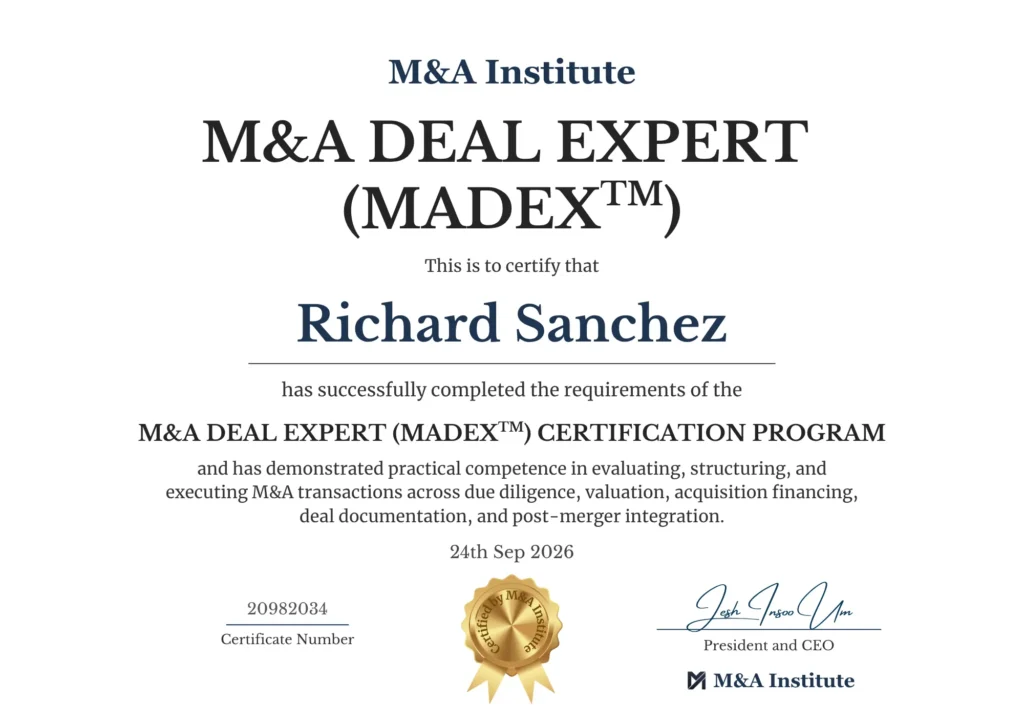
From M&A Course to MADEX Certification

Learn the Deal. Prove You Can Execute.

This course builds one part of the knowledge and judgment directly assessed in MADEX.

  • M&A Steps 1–5: Strategy, Sourcing & Due Diligence
  • M&A Step 6: Acquisition Financing & LBO
  • M&A Steps 7–9: Negotiation, SPA & PMI

Complete this module as part of the M&A Full Course, then earn MADEX through the 3-step examination.

Explore MADEX Certification
MADEX certification

What You Will Gain from This Course

Turn findings into terms

  • Separate findings that change price from those requiring protection.
  • Turn each material exposure into a specific request.
  • Assign someone to validate the evidence behind the request.

Build a defensible price

  • Reconcile each price adjustment to a common valuation base.
  • Set a range that reflects the buyer’s best alternative.
  • Explain what would make walking away the better decision.

Allocate uncertainty

  • Match an earnout to the performance assumption in dispute.
  • Compare escrow with other protections for an identified loss.
  • Test who bears the downside if the assumption fails.

Negotiate a package

  • Identify who can approve concessions on each side.
  • Sequence trades around the other party’s priorities.
  • Record the conditions attached to each counteroffer.

Draft a term sheet

  • Translate agreed economics into clear term-sheet language.
  • Distinguish binding commitments from points still under discussion.
  • Flag conditions that need further diligence or approval.

Win internal approval

  • Reconcile the final term sheet with the negotiation log.
  • Explain how the package compares with the buyer’s alternative.
  • Give the investment committee a decision it can act on.
M&A Institute team

Who Made This Course?

Built by M&A Institute practitioners with 10–20 years of experience across M&A, private equity and corporate strategy. We bring together corporate development’s planning discipline and investment banking’s standards for execution.

200+ corporate training sessions9,000 professionals trained

Built on Deal Experience

Cross-border M&A, venture capital, corporate buyouts, IPOs and mezzanine financing inform the cases, valuation models and decision frameworks. Practitioners in corporate strategy, finance, research, investment banking and private equity reviewed the content.

The M&A Institute Difference

Convert diligence findings into negotiable issues. Identify what belongs in price, a purchase price adjustment, an indemnity or a condition to closing. Narrated infographics, worked cases and practice files let you follow the decisions and try them yourself.

Our Training Philosophy

“Great training translates complex theory into immediate field capability.”

Every framework should have a use at work. Take a finding from diligence through the price bridge and into a negotiated term. Leave a clear record of concessions, unresolved issues and the decision the investment committee must make.

What Our Corporate Clients Say

Enrolment

Can you defend the terms as well as the price?

In the M&A negotiation course, you will turn a diligence finding into a proposal you can defend across the negotiating table.

Continue with a full program

Frequently Asked Questions

Who is this M&A negotiation course designed for?

This course is designed for corporate development professionals, PE and IB deal teams, strategy and finance managers, and anyone who needs to run a post-DD M&A negotiation process and protect value through term sheet execution in practice, not just conceptually.

Does this module prepare me for MADEX?

Yes. This module is one part of the M&A Full Course, the 9-step curriculum that all directly assessed MADEX content is drawn from. See the M&A Full Course or M&A Certification for how each step maps to the exam.

Is this course suitable for beginners with no prior deal experience?

Yes. This M&A negotiation course covers deal negotiation strategy from the ground up. We start with internal package design before moving into valuation bridges, deal economics, and tactical execution. It is designed to take a novice to a professional level within 3 months.

What experience will help me get the most from the M&A negotiation course?

No formal prerequisites are required. The course is structured so learners progress logically from foundational frameworks to execution-level judgment. Even without prior experience, you can follow the full M&A negotiation process step by step.

How does this differ from academic finance courses?

Unlike university theory, this is a practical M&A negotiation course. We focus on the actual issue maps, valuation bridges, M&A term sheet structures, and deal committee memos used by practitioners, not abstract negotiation principles.

How practical is the content?

Every section mirrors the real deal negotiation strategy discipline used in live transactions, supported by four professional templates, real case analysis on named deals, and a 10-scenario guided AI practice that forces genuine decision output.

  • Build a mandate before the first offer. Start with the negotiation issue map. Record what diligence uncovered, which party should carry the risk and what you can trade. Then use the valuation bridge to quantify an opening position and a walk-away point.
  • Test a package at the table. Use the M&A negotiation strategy exercises to compare cash at closing, deferred consideration and contingent payments. A change in headline price may still be a poor trade if the downside protection is weaker.
  • Write down the decision. Bring the agreed terms into a draft M&A term sheet. Your committee memo should identify open points, show what moved from the mandate and tell the approver which exception needs a decision.
How do I practise with AI in this course?

Convert the diligence log into alternatives for price, protection and follow-up. Cross-check term sheet language against the issue map before briefing the committee. The course includes a PDF practice guide.

How much study time and access does the Practical M&A Negotiation Course include?

Allow 25–30 hours in total. Your individual course includes 3 months of online access.

For Teams

Bring the M&A negotiation course to your deal team

Use the M&A negotiation course to rehearse the negotiation mandate, package trades and investment committee approval. Companies, financial institutions and universities can enrol together.

  • Practise with the same cases and decision tools.
  • Study online across roles and locations.
  • Enquire about group pricing for your team.

Group enrolment enquiry

Name

Shopping Cart

Find a course or service

Scroll to Top