How this post merger integration course is structured
- 2 sections · 15 lessons · 98 learning modules
- 5 AI Labs with guided practice
- Quizzes and applied case studies
- 35–40 hours of study (estimated)
M&A Full Course/Step 9 of 9
From Integration Thesis to a Day 1–100 Value-Up Plan
This post merger integration course shows how to turn the deal thesis into an operating plan. Choose what to integrate, set up the integration management office and track synergy owners, Day 1 readiness and the first 100 days.
This course builds the post-merger integration skills used in the MADEX practical examination.
 Course Highlights
 What You Will Achieve
 Integration management office leaders
 Corporate development and PE teams
 Functional workstream owners
 Strategy and transformation managers
Our In-Person Training Delivered At

Built by M&A Institute, drawing on 12 years of practical finance training and in-person instruction for more than 9,000 professionals.
 How this post merger integration course is structured
 Differentiated Learning Materials
 AI Labs
Watch the post merger integration course demonstrations, then follow the source files and prompts to reproduce each result.
Integration model
Score five business units against the autonomy criteria and document why an exception is justified.
Output An integration thesis and unit-by-unit decision matrix
IMO scorecard
Build the IMO charter, map 30 decisions across 11 workstreams and identify who can escalate a stalled decision.
Output An IMO charter, RACI matrix and reporting templates
Value-up roadmap
Trace value levers to a starting figure, a delivery date and an owner who can verify the benefit.
Output A synergy register and value-up roadmap
Function plans
Translate the roadmap into seven functional plans and check how their 82 KPIs track the promised benefits.
Output Workstream plans and a KPI baseline
Day 100 review
Check the 72 Day 1 actions against evidence, then use the Day 30, 60 and 100 reviews to replan.
Output A readiness workbook and decision review pack
 Evaluate integration choices
 Build an IMO scorecard
 Connect synergies to actions
 Audit first-100-day progressSection 1 · PMI Pre-Planning and IMO establishment
 Section 2 · PMI Planning and Simulation
2 sections · 15 core lessons · 5 AI Labs

Use the merger to identify where strategic expectations and integration execution can diverge. The lesson asks where the original value thesis depended on cooperation between the two businesses and where their operating cultures pulled in different directions.

Examine how operating priorities enter the investment process and translate into post-close actions. Look at how the portfolio company’s management and operating specialists turn an investment thesis into a value-up strategy with clear responsibilities.

Examine which business capabilities stayed independent and what that choice meant for integration governance. Apply the same question to the integration office. Which decisions call for coordination and which should stay with the acquired management team?

Connect transaction synergies to the actions, ownership and milestones needed to capture them. Follow the use of Fox franchise rights in Disney+ and cross-platform marketing. Identify the commercial measure that would show whether the integration created value.

Consider how a financial institution coordinates integration work across teams while continuing to serve customers. The Merrill Lynch case focuses on legal and governance uncertainty. Determine who has authority to resolve an issue when two management structures overlap.

Use the acquisition filings in AI Lab 1 to choose an integration approach for each business and document the supporting evidence. The working file links diligence findings to integration actions. Use the evidence to explain why two units of the same acquisition can require different levels of autonomy.
Turn the acquisition thesis into workstream plans. Give each synergy an owner and a baseline, distinguish evidence from reported progress, and use the first 100 days to revisit decisions when conditions change.
Integration thesis and charter Value-up control workbook
 Day 1–100 review pack
Follow a synergy from the deal thesis to its owner and Day 100 milestone in the post merger integration course.
The post merger integration course guides include source files, prompts and checks for each of the 5 AI Labs.
This course builds one part of the knowledge and judgment directly assessed in MADEX.
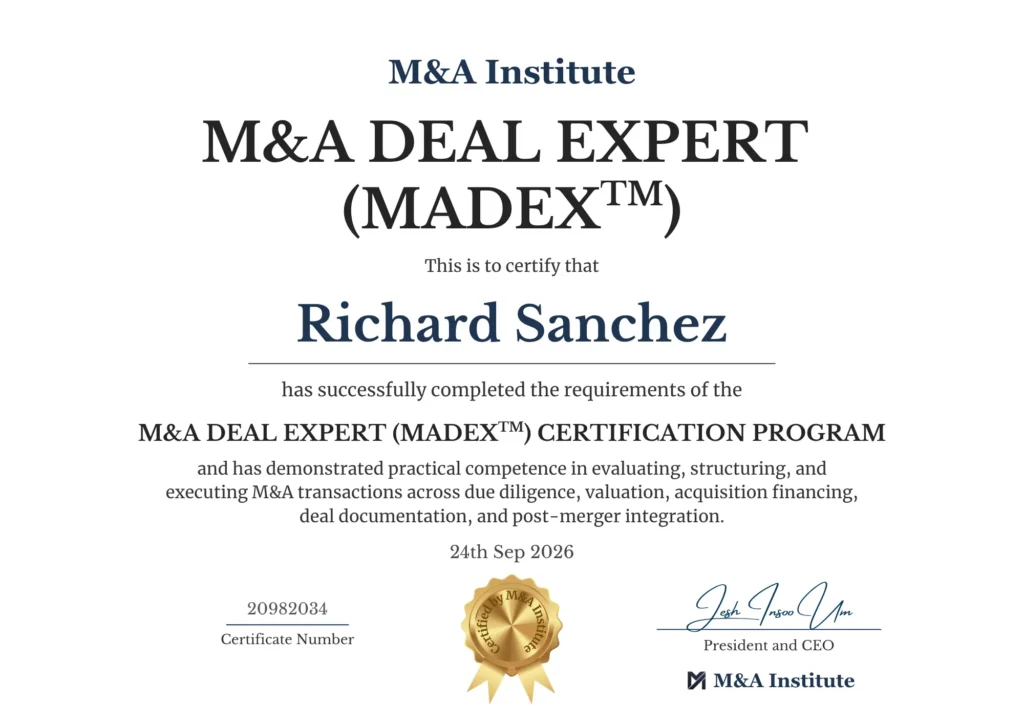
Complete this module as part of the M&A Full Course, then earn MADEX through the 3-step examination.
Explore MADEX CertificationChoose what to integrate Set up an effective IMOTranslate synergies into plansCoordinate the functions
 Test Day 1 readiness
 Manage the first 100 days

Built by M&A Institute practitioners with 10–20 years of experience across M&A, private equity and corporate strategy. We bring together corporate development’s planning discipline and investment banking’s standards for execution.
Cross-border M&A, venture capital, corporate buyouts, IPOs and mezzanine financing inform the cases, valuation models and decision frameworks. Practitioners in corporate strategy, finance, research, investment banking and private equity reviewed the content.
Decide where integration creates value and where autonomy matters. Set out the trade-offs by business unit before imposing a common operating model. Narrated infographics, worked cases and practice files let you follow the decisions and try them yourself.
“Great training translates complex theory into immediate field capability.”
Every framework should have a use at work. Turn the acquisition thesis into workstream plans. Give each synergy an owner and a baseline, distinguish evidence from reported progress, and use the first 100 days to revisit decisions when conditions change.
“Practical, insightful, and engaging M&A training that exceeded our expectations. The PMI module was particularly valuable for our team's execution capabilities.”H Group · Corporate training feedback
“The training helped me transition from early-stage startup investment to M&A. The practical knowledge and insights from the post merger integration process were invaluable.”S Group · Corporate training feedback
“Excellent course with high satisfaction and practical value. Highly recommended for any professional involved in the post merger acquisition lifecycle.”L Chemical · Corporate training feedback
Enrolment
In the post merger integration course, you will translate the deal thesis into a Day 1 plan, named workstream owners and a schedule for measuring value.
This course is designed for any professional responsible for making M&A deals successful after the contract is signed. It is ideal for:
Yes. This module is one part of the M&A Full Course, the 9-step curriculum that all directly assessed MADEX content is drawn from. See the M&A Full Course or M&A Certification for how each step maps to the exam.
Not necessarily. While a background in finance is helpful, this course is built to be practical for professionals from various functions. It focuses on the strategic and operational challenges of the post merger integration process, making the content accessible and valuable whether your background is in finance, HR, IT, or strategy.
This module is self-contained for learners focused on PMI. However, a basic understanding of the M&A transaction process is beneficial. For a complete foundation from start to finish, we recommend taking Module 1 of our series first.
Allow 35–40 hours in total. Your individual course includes 3 months of online access.
The course is built entirely around practical application. Every component is designed to ensure you can use what you learn:
Test the autonomy threshold for each unit and document any justified exceptions. Check claimed completion against evidence and identify actions that need replanning. The course includes a PDF practice guide.
Individual courses do not award a completion certificate. You can earn MADEX certification by passing the separate MADEX assessment.
Use the post merger integration course to rehearse the handoff from due diligence to the integration office, operating teams and executive sponsors. Companies, financial institutions and universities can enrol together.