Free Merger and Acquisition Course Online – 27 M&A Lessons
A strategy analyst at a consumer goods company is assigned to support an acquisition process for the first time.
She has a strong finance background and can build a DCF model without hesitation.
On the first day, the lead advisor asks her to prepare a go-no-go memo based on the preliminary due diligence findings.
She knows what the findings are, but she does not know what a go-no-go memo looks like, what decision gates it should address, or what risk thresholds should trigger a no-go recommendation.
That gap, between financial analysis skills and deal execution judgment, is what separates a finance analyst from an M&A practitioner.
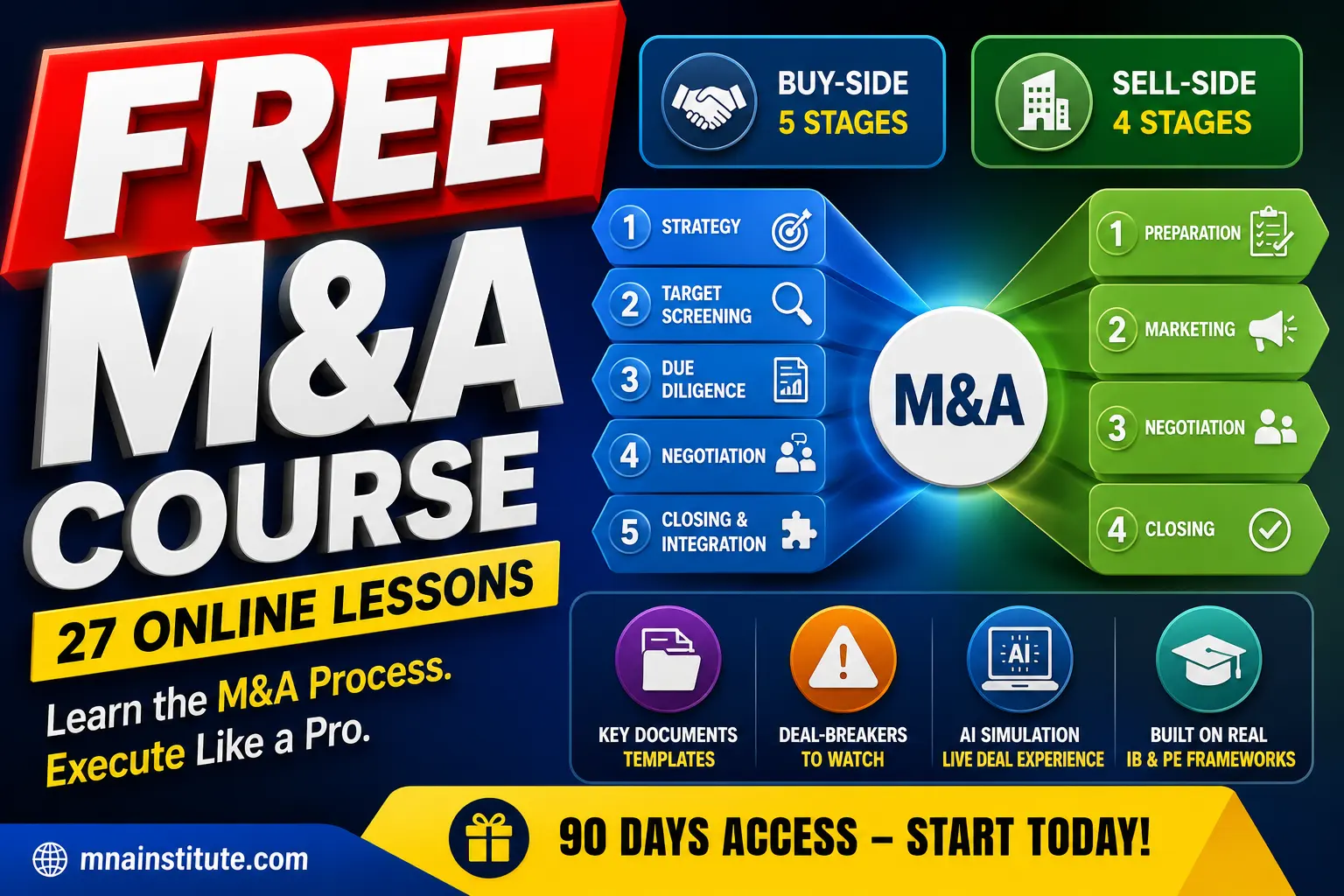
The free merger and acquisition course at M&A Institute is built to close that gap, covering the full M&A transaction lifecycle from strategic rationale through deal structuring, buy-side and sell-side execution, risk control, and an AI-powered simulation, across 27 lessons and 74 modules at no cost.

What the Free Merger and Acquisition Course Covers
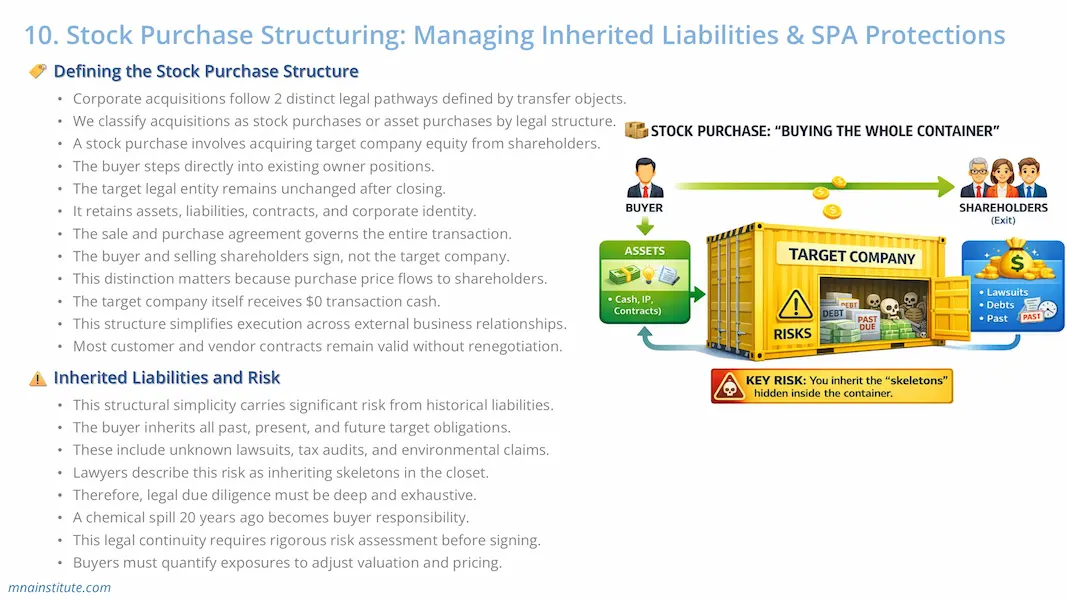
The free merger and acquisition course is organized into 6 sections and 27 lessons, each built around the actual documents, decision gates, and analytical frameworks that practitioners use in live transactions.
It is designed for learners with no prior M&A experience and can be completed within 3 months at 2 to 3 hours per week.
The total estimated study time across all 74 modules is 25 to 35 hours.
The six sections of our free merger and acquisition course cover the following areas of the M&A transaction lifecycle.
- Section I: Why companies pursue M&A and how to build and quantify the strategic rationale and growth gap analysis
- Section II: The legal and operational difference between a merger and an acquisition, and how that structural choice shapes integration outcomes
- Section III: Deal structuring mechanics, covering stock purchase versus asset purchase and the tax, liability, and SPA implications of each
- Section IV: The full buy-side M&A process across 5 stages and the sell-side M&A process across 4 stages, with specific documents and decision gates at each stage
- Section V: How to build an internal M&A team, assign decision rights, and manage external advisors without losing process control
- Section VI: How to identify deal-breakers early across valuation, regulatory, and financing risk, and how to use go, no-go, and escalate decisions to protect value
This free M&A course online includes six real-world case studies, two board-ready deliverables, and an AI simulation that places the learner in a live acquisition decision under investment committee pressure.
No prerequisites for this free merger and acquisition course are required, and all lessons are available for download in PDF format with unlimited access for 3 months.

Beyond Excel Modeling: What CFI and WSP Teach vs What This Free Merger and Acquisition Course Builds
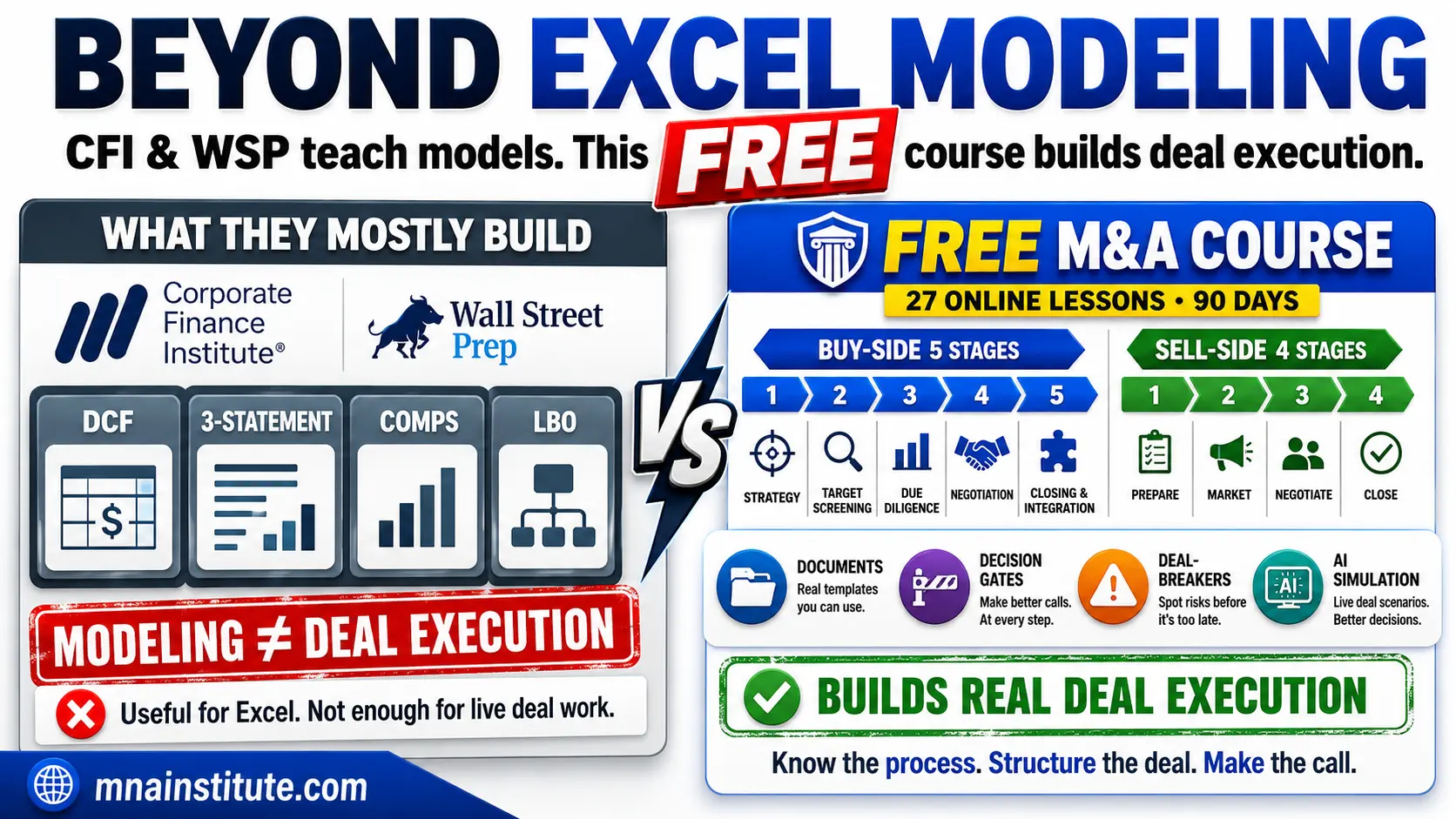
The Corporate Finance Institute and Wall Street Prep are two of the most widely used finance training platforms.
Both deliver structured programs covering DCF modeling, three-statement financial modeling, comparable company analysis, and LBO modeling in Excel.
These are genuinely useful skills for analysts building financial outputs in investment banking and private equity contexts.
However, both programs are built on the premise that financial modeling proficiency is equivalent to deal execution capability.
In practice, that equation does not hold.
A candidate who can build a fully linked three-statement model in Excel but cannot explain the five stages of a buy-side M&A process, the structural difference between a stock purchase and an asset purchase, or what a go-no-go decision gate looks like at each stage of diligence is not equipped for deal work.
Financial modeling tells you what a company is worth.
Deal execution knowledge tells you how to structure, negotiate, and close a transaction that captures that value.
CFI’s flagship FMVA program and WSP’s core curriculum focus on the modeling layer.
Neither program covers how to design a target screening process, how to manage a data room, how to structure a go-no-go memo after due diligence, or how to negotiate an LOI when findings change the risk profile after management presentations.
Those are the competencies that corporate development teams, strategy professionals, and M&A candidates are actually tested on in real transactions and in interviews at advisory firms.
The free merger and acquisition course at M&A Institute is not a replacement for financial modeling training.
It is the deal execution layer that sits above modeling and determines whether a transaction creates or destroys value.
Analysts who want both layers, modeling and deal execution, can combine this free course with the Financial Modeling and Valuation Course with AI and Excel to build a complete investment professional toolkit.
How This Free Merger and Acquisition Course Is Structured
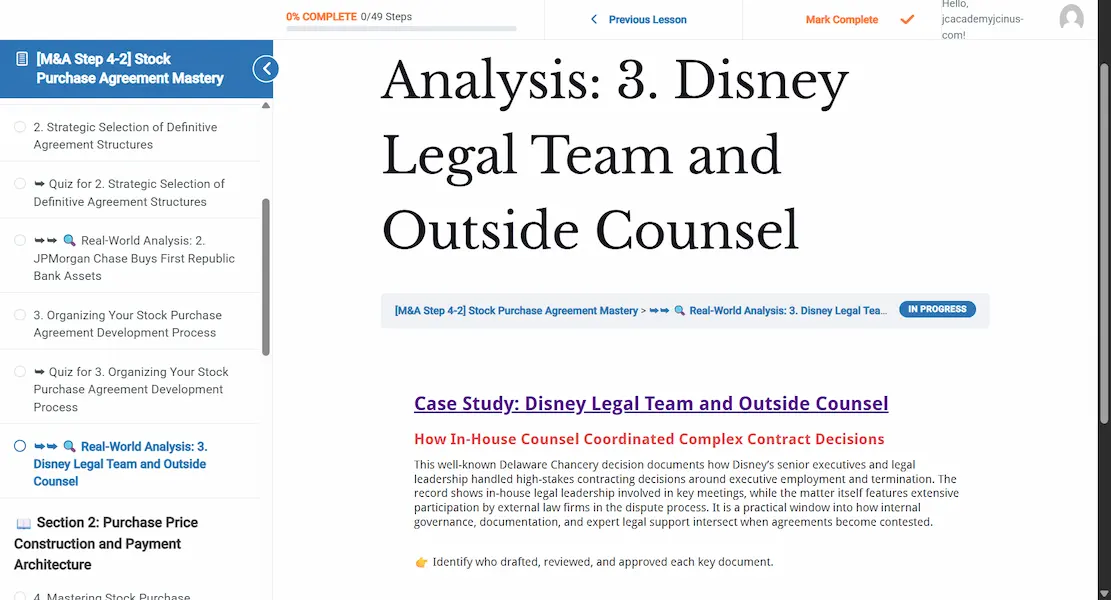
Our free merger and acquisition course follows a five-stage learning cycle that converts passive reading into active deal judgment.
- Practical theory explanation: every lesson begins with visually structured written content and audio narration, so learners absorb the material through reading and listening simultaneously
- Retention quizzes: quizzes after every lesson use real-world scenarios that test application rather than memorization
- Case studies: each section is anchored in historical transactions that show exactly how the concept played out in a live deal
- Template analysis: learners work through the buy-side and sell-side decision frameworks as structured exercises
- AI-powered simulation: the final section places the learner as Corporate Development Lead on a live acquisition decision with immediate feedback on every choice
Each module is designed for 20 to 30 minutes of focused study.
The learning interface uses a three-layer design: structured written content on the left panel, visual infographics on the right panel, and audio narration with real-time subtitles at the bottom.
This format allows learners to process each concept through three simultaneous channels, which reduces the number of repetitions needed to retain complex deal logic.
This mergers and acquisitions course online free is accessible across desktop, tablet, and mobile, and all 27 lessons are available as downloadable PDFs for review without internet access.

The Full Curriculum: 6 Sections, 27 Lessons, 74 Modules
The free merger and acquisition course curriculum is organized so that each section builds directly on the previous one, following the same sequence that a real M&A transaction follows from strategic decision to closing.
Section I: Why Companies Pursue M&A Transactions
Section I establishes the strategic foundation for any acquisition decision.
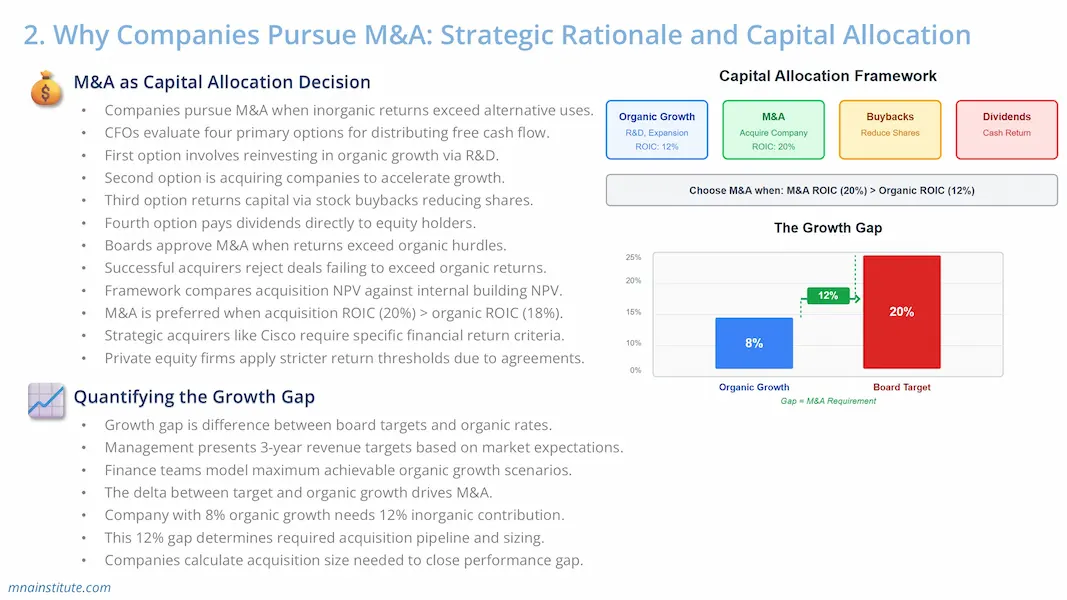
It covers what M&A is, why companies pursue it as an alternative to organic growth, and how to quantify the growth gap that a specific transaction is designed to close.
Learners examine the history of major global M&A transactions and extract the common patterns behind both successful value creation and failed deal logic.
Disney’s acquisition of Marvel in 2009 for approximately $4 billion anchors this section: Disney identified a demographic gap in young male audiences, valued the Marvel IP portfolio, and acquired it at a price that proved to represent a fraction of the subsequent value generated through film franchises, licensing, and theme park integration.
Section II: Merger vs Acquisition and Legal Structure
Section II explains the legal and operational difference between a merger and an acquisition, and why that choice at the outset determines what integration looks like at the end.
In a merger, two companies combine fully and one entity ceases to exist as a separate legal structure.
In an acquisition, the buyer purchases the target and can choose to maintain it as a subsidiary with its own operational identity.
Google’s acquisition of Android in 2005 illustrates the subsidiary approach: Google preserved Android’s separate operating identity and open-source engineering culture, which proved critical to Android’s subsequent distribution across device manufacturers globally.
The Kraft-Heinz merger is used as the contrasting case: a merger driven by cost synergy logic that progressively eroded brand equity by cutting investment in marketing and product development, ultimately resulting in a multi-billion dollar write-down in 2019.
Section III: Deal Structuring Mechanics
Section III covers stock purchase versus asset purchase, which is one of the most consequential structuring decisions in any acquisition and one of the most frequently tested concepts in M&A interviews.
In a stock purchase, the buyer acquires the equity of the target company and inherits all assets and liabilities, including contingent and undisclosed liabilities.
In an asset purchase, the buyer selects which specific assets and liabilities to acquire, leaving the remainder with the seller.
In the United States, asset purchases typically allow the buyer to step up the tax basis of acquired assets to their fair market value at closing, generating future depreciation deductions.
KKR’s acquisition of Unilever’s spreads business is used as the case study for this section, illustrating the operational complexity of carving out a specific business unit from a global conglomerate through an asset purchase structure.
Section IV: Buy-Side and Sell-Side M&A Processes
Section IV is the operational core of the free merger and acquisition course and covers the process literacy that candidates consistently lack when entering deal roles.
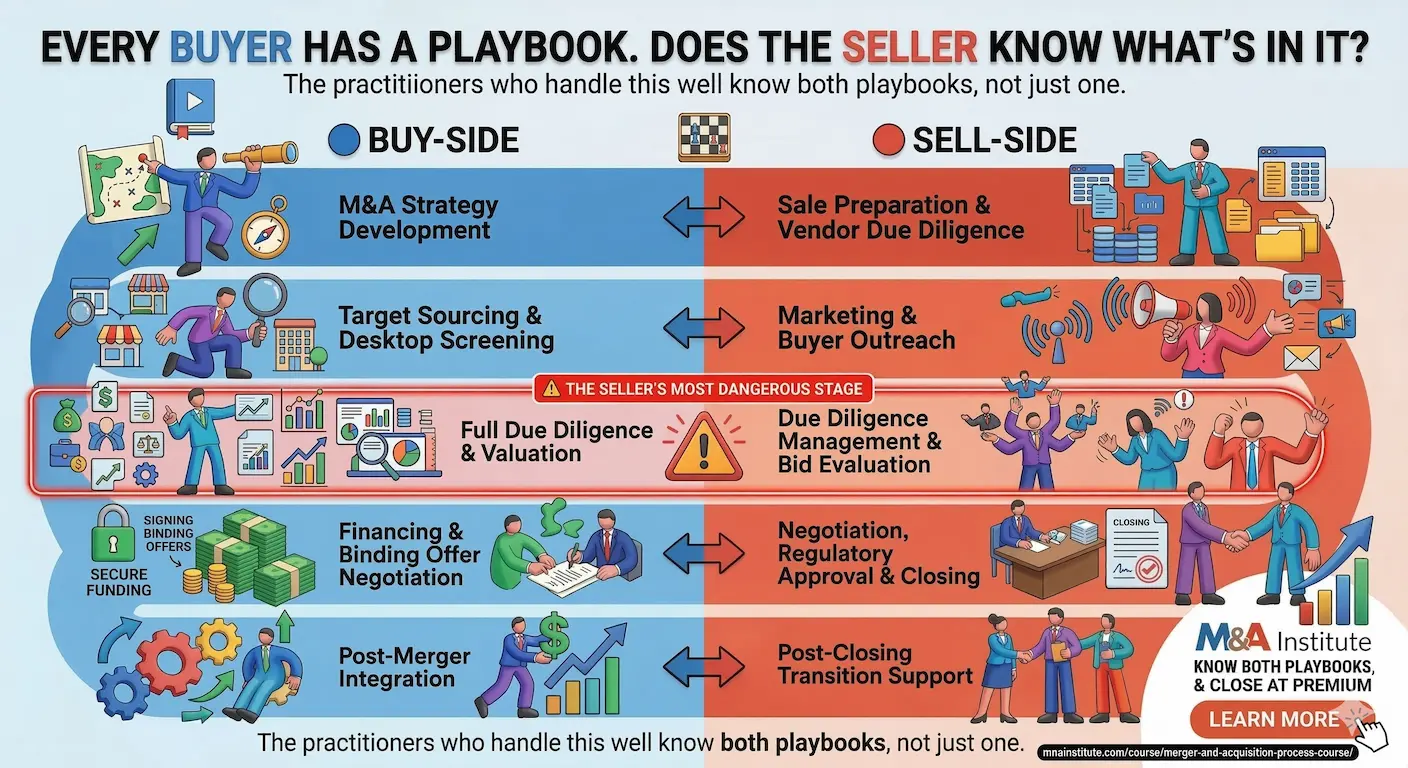
The buy-side M&A process covers five stages: strategic planning and target identification, initial approach and NDA, due diligence, LOI negotiation, and signing and closing.
The sell-side M&A process covers four stages: preparation and marketing materials, buyer outreach and management presentations, data room and due diligence management, and exclusivity through closing.
Each stage includes the specific documents, decision gates, and communication protocols that practitioners use to manage the process and prevent value leakage.
Sections V and VI: Team Structure and Risk Management
Section V explains how to build an internal M&A team with clear decision rights and how to manage external advisors, legal counsel, and financial advisors simultaneously.
Cisco’s M&A organization is used as the benchmark case: Cisco successfully integrated over 200 acquisitions through a dedicated deal team with institutionalized playbooks and repeatable post-close processes.
Section VI covers deal-breaker identification and the go, no-go, and escalate decision framework.
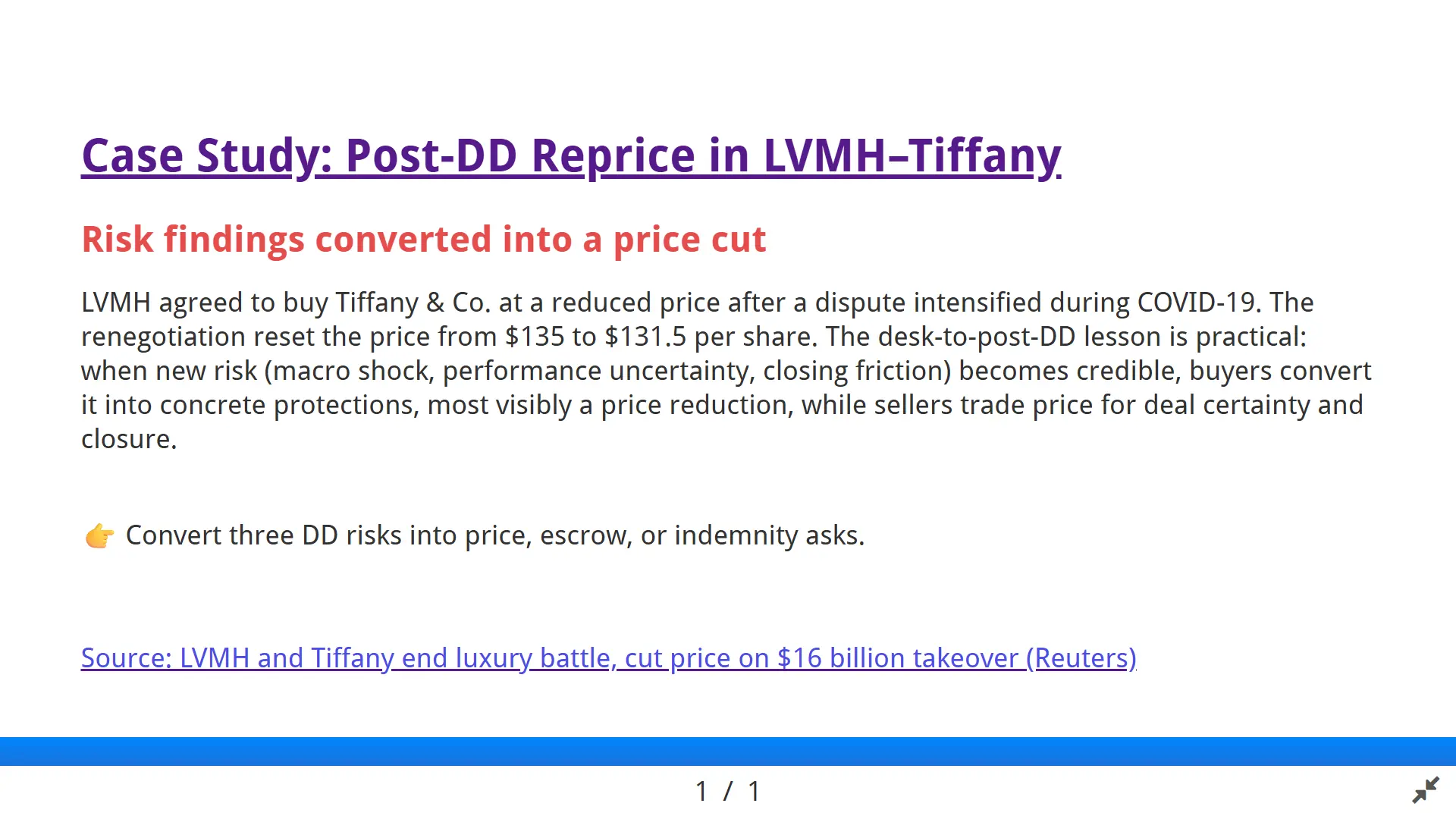
The Broadcom-Qualcomm and Xerox-HP attempted transactions are examined as cases where deal-breakers materialized through regulatory intervention and valuation gaps respectively, showing how late-stage deal terminations occur in practice.

Real-World Case Studies That Drive Execution Judgment
The free merger and acquisition course uses six historical transactions as teaching cases, each selected to isolate a specific deal decision that the section concept requires the learner to make.
- Disney’s acquisition of Marvel for approximately $4 billion in 2009: strategic rationale, growth gap analysis, and long-term value creation through IP licensing and franchise development
- Kraft-Heinz Merger: how cost synergy logic overrode revenue investment, eroded brand equity, and produced a multi-billion dollar write-down
- Google’s acquisition of Android in 2005: how the subsidiary structure preserved engineering culture and secured mobile distribution control at a price that proved to be one of the most value-accretive acquisitions in technology history
- Cisco’s M&A machine: how institutionalized deal playbooks and a dedicated integration team enabled more than 200 successful acquisitions over time
- KKR’s acquisition of Unilever’s spreads business: the legal, operational, and financial complexity of a carve-out through an asset purchase structure
- Broadcom-Qualcomm and Xerox-HP: how regulatory intervention and valuation disagreement terminate deals at late stages despite apparent buyer commitment
Each case is embedded in the section where the decision it illustrates is taught, so the historical outcome reinforces the analytical framework rather than existing as a separate narrative.

Deliverables of Our Free Merger and Acquisition Course
Learners who complete the free merger and acquisition course receive two structured decision frameworks that can be applied directly in professional M&A contexts.
Buy-Side Decision Framework
The buy-side framework provides strategic screening gates with clear go-no-go criteria at each stage of the process.
It includes quality of earnings checkpoints designed to prevent value destruction before due diligence conclusions are converted into negotiation positions.
It also incorporates risk mitigation triggers across the full deal lifecycle, from initial target identification through integration planning.
Sell-Side Decision Framework
The sell-side framework covers pre-marketing readiness assessment, which determines whether a business is positioned to maximize value before a process is launched.
It includes buyer qualification gates that protect the seller from sharing sensitive commercial, financial, and operational data with parties who have no genuine acquisition intent.
Exclusivity control mechanisms are embedded in the framework to maintain competitive tension through the final negotiation stages rather than allowing a single buyer to use exclusivity as leverage to extract price concessions.
These frameworks are not theoretical templates.
They reflect the actual governance structure that deal teams use to prevent decision-making from being driven by deal momentum rather than disciplined analysis.
Understanding when to invoke a no-go decision, and having a documented framework that justifies that decision to senior stakeholders, is one of the competencies that distinguishes experienced deal professionals from analysts who are new to M&A work.

AI Interactive Simulation: Acquiring AI Tech for a Legacy Manufacturer
The AI-powered simulation is the final component of this free merger and acquisition course and the component that most directly tests whether the learner can apply deal logic under conditions that approximate real acquisition pressure.
In the simulation, the learner acts as Corporate Development Lead for a traditional manufacturing firm evaluating the acquisition of an agile AI venture company.
The scenario requires four connected decisions that reflect the sequence of a real transaction.
- Assess strategic fit and justify whether building the AI capability internally is more rational than acquiring it, quantifying the time-to-market difference and the cost of delay
- Select the deal structure that retains key engineering talent at the target, which changes the acquisition logic and the SPA protections required compared to a standard financial acquisition
- Negotiate the LOI terms with full awareness of the valuation assumptions, risk allocations, and exclusivity provisions embedded in the early-stage documentation
- Make the final go-no-go decision after due diligence findings and provide a structured recommendation that a board or investment committee could act on without additional context
After each decision, the AI simulation delivers immediate analysis of the reasoning, identifying gaps in logic, overlooked risk factors, or structural choices that conflict with the stated strategic objective.
The feedback is not a simple correct-or-incorrect judgment.
It explains why a particular structural choice creates exposure, what alternative approaches exist, and how experienced deal professionals would evaluate the same situation.
This iterative feedback mechanism is what makes the simulation more effective than reading a case study solution, because it forces the learner to articulate their reasoning and receive an analytical response to it.

Who Should Take This Free Merger and Acquisition Course
The free merger and acquisition course is designed for five distinct audiences, each of which has a different gap between their current knowledge and the deal execution capability that M&A roles require.
- Finance students and recent graduates who want to understand how M&A transactions work before entering investment banking, private equity, or corporate development roles
- Early-career analysts in corporate finance, strategy, or business development who are assigned to M&A workstreams without prior transaction training
- IB, PE, and VC candidates preparing for technical interviews who need process literacy alongside the financial modeling skills they have already developed
- Finance professionals transitioning into deal-oriented roles from adjacent functions such as accounting, audit, or financial planning and analysis
- University students and job seekers who need a structured, verifiable M&A process credential without the cost of paid certification programs
The free merger and acquisition course has no prerequisites and no cost.
It is completable within 3 months at 2 to 3 hours per week and delivers 25 to 35 hours of structured learning across 74 modules.
Learners who complete this free merger and acquisition course will understand how to trace a transaction from mandate to closing on both the buy side and the sell side, how to make structuring decisions that protect value, and how to identify deal-breakers before they force late-stage renegotiations or terminations.

From Deal Logic to Deal Execution
The free merger and acquisition course at M&A Institute covers the process literacy that financial modeling training does not: how a transaction is structured, how it is executed, how risks are identified and managed, and how value is protected through discipline at every stage.
The 27 lessons, 74 modules, and six case studies move in the same sequence that a real deal follows, from strategic rationale to closing.
The two deliverables give learners a structured framework they can apply from Day 1 in a corporate development, strategy, or advisory role.
And the AI simulation tests judgment under conditions that replicate the pressure of a real investment committee presentation.
- Professionals who want to extend their M&A knowledge into the full 9-step transaction curriculum, including valuation, acquisition financing, LBO modeling, negotiation, and post-merger integration, can access the complete program through the Mergers and Acquisitions Online Course at M&A Institute.
- For analysts who need deep due diligence skills alongside deal process knowledge, the M&A Due Diligence Course covers commercial, financial, legal, and HR due diligence with AI-powered simulation and practitioner-grade frameworks.
- For professionals working in post-acquisition integration, the Post Merger Integration Course covers PMI planning, 100-day integration frameworks, synergy execution, and IMO leadership.
Sources
- Corporate Finance Institute: Introduction to Mergers & Acquisitions.
- Corporate Finance Institute: Mergers & Acquisitions Modeling in Excel Part 1.
- Wall Street Prep: Financial & Valuation Modeling Certification Program.
- McKinsey & Company: Four Keys to Merger Integration Success.